All or any part
An all-or-any-part order is a trading instruction granting a broker or syndicate manager the authority to execute an entire order or any smaller portion available at the specified price.
What Does “All or Any Part” Mean in Trading?
In securities trading, fixed-income syndication, and discretionary portfolio management, all or any part (often abbreviated as AOAP) is an order qualification instructing an executing broker, market maker, or syndicate desk that the investor will accept execution of the complete order volume or any smaller partial lot available at the specified limit price or better.
The primary operational purpose of an all-or-any-part stipulation is maximizing execution probability. In illiquid markets, large institutional orders frequently exceed the depth of the immediate order book. By explicitly permitting partial fills, the trader ensures that available liquidity is captured immediately, while the remaining balance continues to rest on the exchange book until additional counterparties emerge.
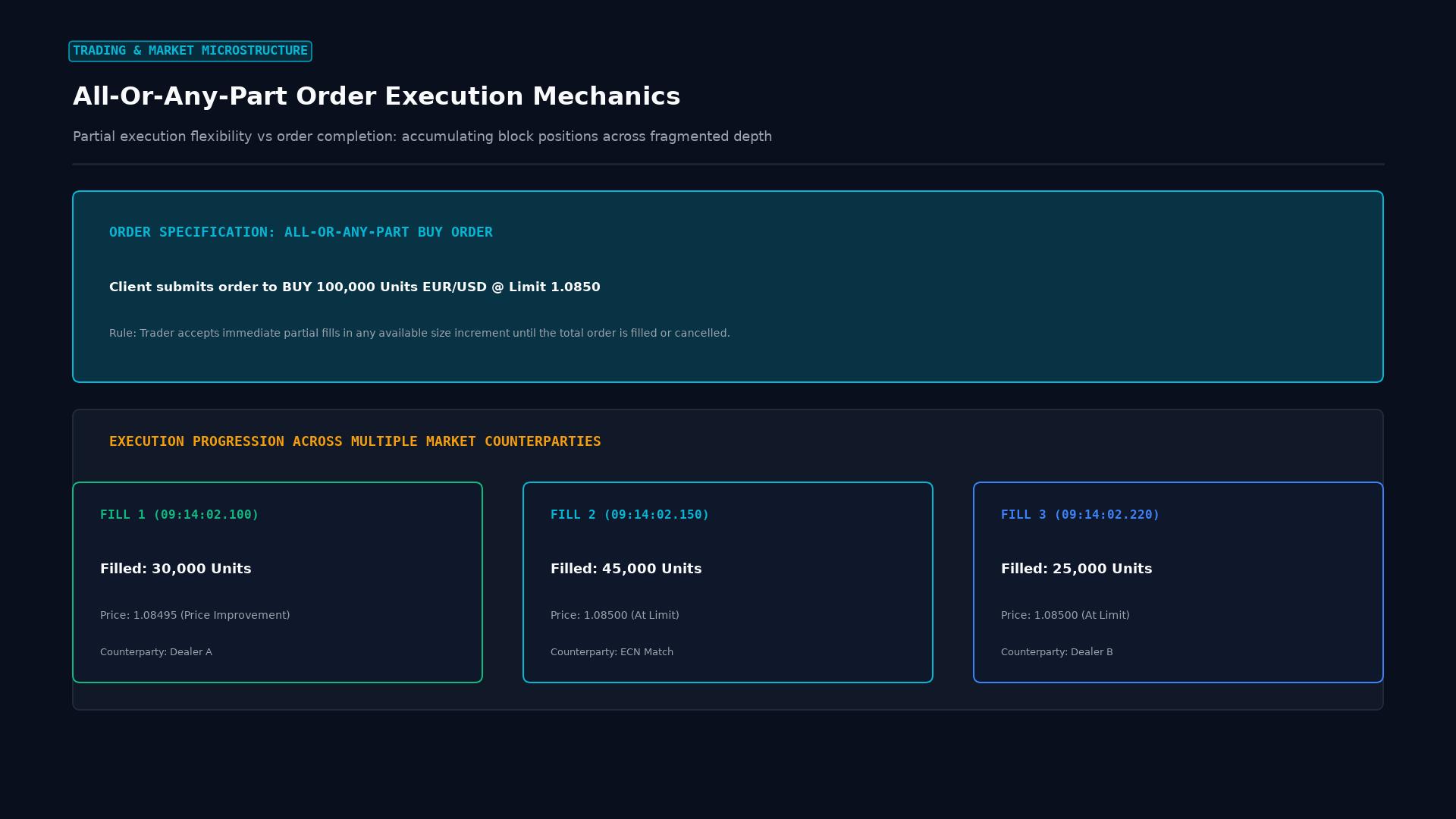 Figure: Institutional order accumulation: allowing sequential partial fills across fragmented market makers and ECN venues until full block volume is satisfied.
Order Qualification Comparison Matrix
To understand how an all-or-any-part instruction functions within modern electronic matching engines, traders compare it against standard exchange order qualifiers:
| Order Qualifier | Execution Requirement | Handling of Unfilled Balance | Timing Condition |
|---|---|---|---|
| All or Any Part (AOAP) | Partial fills permitted | Leaves remainder resting on order book | Valid for day or GTC |
| All-Or-None (AON) | Full size mandatory | Rejects partial prints; waits for full lot | Valid for day or GTC |
| Immediate-Or-Cancel (IOC) | Partial fills permitted | Immediately cancels any unfilled remainder | Instantaneous execution |
| Fill-Or-Kill (FOK) | Full size mandatory | Instantly cancels entire order if not filled | Instantaneous execution |
Unlike an Immediate-Or-Cancel (IOC) order, which cancels any portion not filled within milliseconds, an all-or-any-part order keeps the working balance alive on the exchange until the trading session concludes or the trader enters an explicit cancellation.
Practical Applications in Financial Markets
The all-or-any-part stipulation is deployed across several institutional trading environments:
1. Municipal Bond Syndication and New Debt Offerings
When investment banking syndicates underwrite large municipal bond issues, institutional buyers (such as insurance companies and bond funds) submit competitive subscription bids. By marking an order “all or any part,” an asset manager indicates willingness to accept a partial allotment if the bond issue is heavily oversubscribed. Syndicate managers prioritize AOAP orders because they provide the flexibility needed to balance allotments across multiple institutional clients.
2. Discretionary Account Block Trading
Wealth managers executing trades on behalf of hundreds of client accounts combine orders into a single aggregate block. If the manager submits a block purchase of 100,000 shares under an AOAP instruction, the broker fills whatever shares are available at the limit price. The wealth management custodian then allocates the executed shares proportionally across client accounts using average price matching.
Block Execution Flow Under an All-Or-Any-Part Instruction:
┌────────────────────────────────────────────────────────┐
│ Institutional Buy Order: 50,000 Shares @ $25.00 (AOAP) │
└──────────────────────────┬─────────────────────────────┘
                           │
             ┌─────────────┼─────────────┐
             ▼             ▼             ▼
 ┌──────────────────┐ ┌──────────────────┐ ┌───────────────────┐
 │ Fill 1:          │ │ Fill 2:          │ │ Remaining Balance │
 │ 15,000 Shares    │ │ 20,000 Shares    │ │ 15,000 Shares     │
 │ Executed @ $24.98│ │ Executed @ $25.00│ │ Rests on Book     │
 └──────────────────┘ └──────────────────┘ └───────────────────┘
Strategic Tradeoffs: Partial Fills vs. Odd Lots
While AOAP instructions eliminate the risk of missing market moves entirely, they introduce distinct structural tradeoffs:
- Fractional Odd-Lot Positions: A trader attempting to purchase a standard round lot of 1,000 shares might receive a partial fill of only 120 shares before the market rallies sharply away from the limit price. The trader is left holding an awkward odd-lot position that incurs disproportionate transaction fees.
- Multiple Commission Tickets: While modern zero-commission retail equity brokers have reduced this burden, institutional derivatives and corporate bond desks still pay per-ticket or per-fill execution fees. Receiving multiple small partial fills over several hours can accumulate unexpected clearing costs.
Key Takeaways
- An all-or-any-part (AOAP) order authorizes a broker to execute all or any portion of an order that matches the specified price.
- It maximizes execution probability by capturing available market liquidity rather than demanding an all-or-nothing fill.
- The unfilled balance remains active on the order book, distinguishing AOAP from Immediate-Or-Cancel (IOC) orders.
- In municipal debt offerings, AOAP bids give syndicate underwriters the flexibility to allocate bond tranches during oversubscriptions.
Frequently Asked Questions
What is the default order handling rule if no qualifier is specified?
On most major electronic stock and futures exchanges, standard limit and market orders default to an all-or-any-part framework. Unless a trader explicitly attaches an All-Or-None (AON), Fill-Or-Kill (FOK), or Immediate-Or-Cancel (IOC) tag, matching engines will automatically execute whatever partial quantity is available at the limit price.
Why would a trader choose All-Or-None over All-Or-Any-Part?
A trader chooses All-Or-None when their investment thesis or mathematical hedging model requires a precise minimum capital allocation to be viable. For example, an institutional options trader executing a complex multi-leg volatility spread may require full contract execution on every leg to avoid directional delta risk.
Can an AOAP order execute across multiple price levels?
If entered as a market order, yes; the order will sweep the book across different price levels until filled. If entered as a limit order, the order can execute across different prices, provided that every partial fill occurs at the specified limit price or a price more favorable to the trader.
Ready to trade forex?
Open a free demo account with a regulated broker. Practice with virtual funds before risking real money.