All or none
All or none (AON) is an order restriction instructing an exchange to execute a trade in its entirety or not at all, or in underwriting, a contingency where an entire capital offering must be funded or cancelled.
What Does “All or None” (AON) Mean in Finance?
In financial markets, the phrase all or none (commonly abbreviated as AON) operates across two foundational disciplines:
- Secondary Market Order Execution: A specific order qualification attached to a buy or sell order submitted to an exchange. An AON restriction instructs the broker and matching engine that the order must be executed in its full, complete quantity or not executed at all. Partial fills are strictly prohibited.
- Primary Capital Market Underwriting: A type of best-efforts underwriting agreement where the issuing company mandates that the entire security offering must be completely sold to investors by a specified deadline; otherwise, the offering is cancelled and all escrowed funds are returned to subscribers.
Understanding both applications is essential for navigating market microstructure rules and evaluating initial public offering risks.
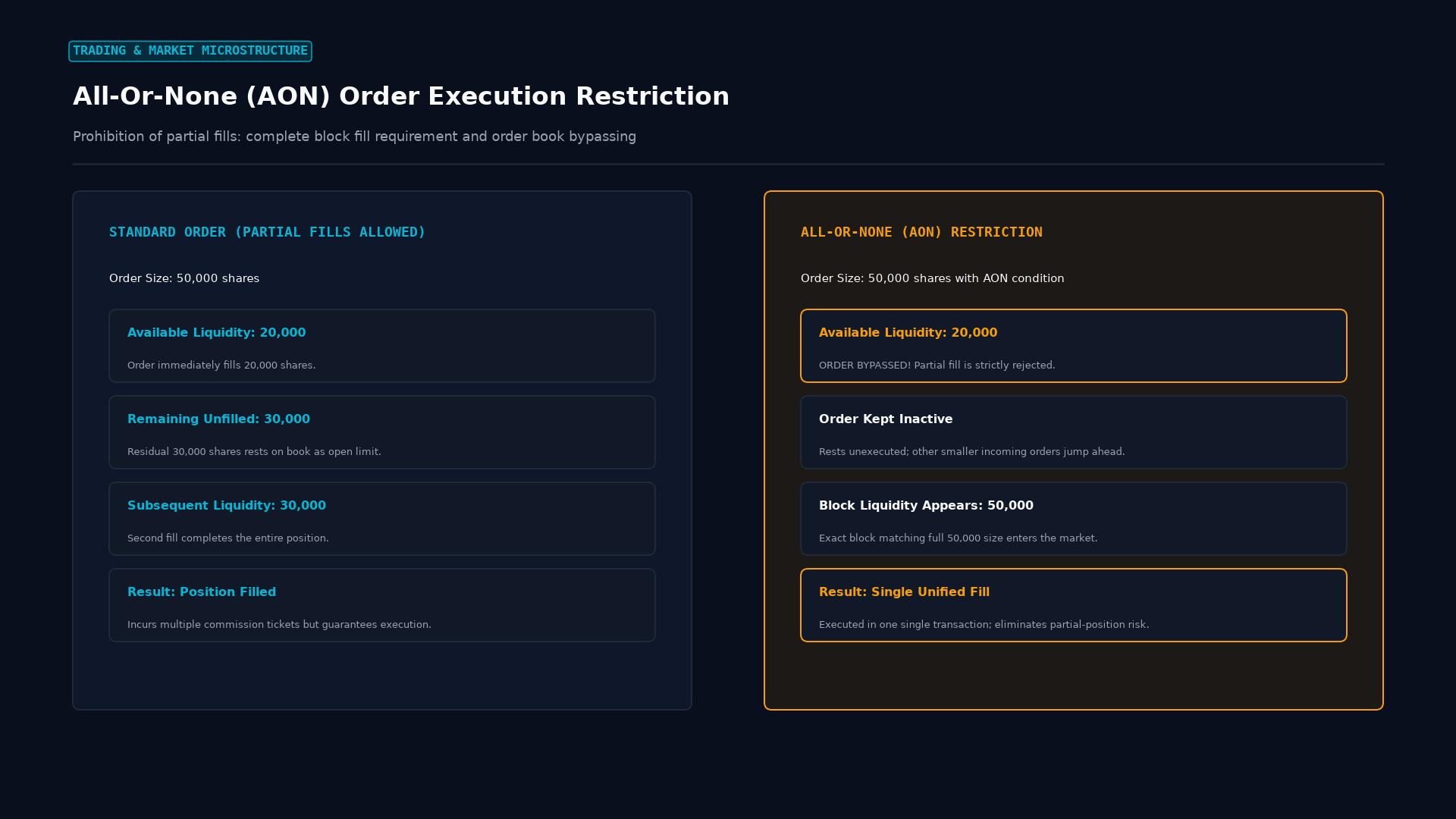 Figure: All-Or-None (AON) matching restriction: order book bypassing mechanism preventing partial fills until an exact matching block size becomes available.
Order Execution Mechanics: AON vs. FOK
In electronic matching engines, traders often confuse an All-Or-None (AON) order with a Fill-Or-Kill (FOK) order:
- Fill-Or-Kill (FOK): Requires that the entire order quantity be executed immediately upon receipt by the exchange matching engine. If the full volume is not available at that precise millisecond, the entire order is instantly cancelled.
- All-Or-None (AON): Demands complete volume execution, but does not require immediate execution. An AON order can remain resting on the exchange limit order book for the entire trading day (or as a Good-Til-Cancelled order) until a counterparty emerges willing to trade the entire block size.
Exchange Order Matching Hierarchy:
┌─────────────────────┬───────────────────────────┬─────────────────────┐
│ Order Type          │ Partial Fill Allowed?     │ Time in Force       │
├─────────────────────┼───────────────────────────┼─────────────────────┤
│ Standard Limit      │ YES                       │ Day / GTC           │
│ All-Or-None (AON)   │ NO                        │ Day / GTC           │
│ Fill-Or-Kill (FOK)  │ NO                        │ Immediate (Seconds) │
│ Immediate-Or-Cancel │ YES (Cancels remainder)   │ Immediate (Seconds) │
└─────────────────────┴───────────────────────────┴─────────────────────┘
Order Book Priority Penalties
Because an AON order imposes an execution restriction, major equity exchanges (including the NYSE and Nasdaq) strip AON orders of traditional price-time priority. If a trader posts an AON bid to buy 10,000 shares of stock at $50.00, and subsequent traders submit standard limit bids to buy 500 shares at $50.00, incoming sell orders will bypass the AON bid and execute against the smaller standard orders. The AON bid will sit unexecuted until a single sell order of at least 10,000 shares arrives at $50.00.
Capital Markets: All-Or-None Underwriting Agreements
In securities underwriting, corporations issuing shares or bonds partner with investment banks under distinct risk structures:
- Firm Commitment: The investment banking syndicate purchases the entire offering directly from the issuer, assuming complete balance sheet risk for any unsold shares.
- Best-Efforts All-Or-None (AON): The underwriter acts purely as an agent, agreeing to sell as many shares as possible. However, the transaction is legally conditioned on selling 100% of the offering:
- Investor subscription funds are deposited directly into an independent bank escrow trust account.
- If the entire offering is not fully subscribed by the contractual closing date, the offering is terminated.
- The escrow agent returns 100% of collected capital to investors without penalty or administrative deductions.
All-Or-None Underwriting Escrow Flow:
┌────────────────────────────────────────────────────────┐
│ Public Offering Announced: $10,000,000 Minimum Capital │
└──────────────────────────┬─────────────────────────────┘
                           │ Investor Subscription Monies
                           ▼
┌────────────────────────────────────────────────────────┐
│ Independent Bank Escrow Account (SEC Rule 15c2-4)      │
└──────────────────────────┬─────────────────────────────┘
                           │ Target Deadline Arrives
             ┌─────────────┴─────────────┐
             ▼                           ▼
 ┌───────────────────────┐   ┌───────────────────────────┐
 │ Offering Sells 100%   │   │ Offering Sells < 100%     │
 │ ($10M+ Raised)        │   │ (e.g., $7.5M Raised)      │
 ├───────────────────────┤   ├───────────────────────────┤
 │ Funds released to     │   │ Offering CANCELLED        │
 │ issuer; shares issued │   │ 100% of cash refunded     │
 │ to investors          │   │ to investors from escrow  │
 └───────────────────────┘   └───────────────────────────┘
Regulatory Safeguards: SEC Rules 10b-9 and 15c2-4
Because unscrupulous promoters historically manipulated all-or-none offerings by creating fake non-bona-fide purchases to hit minimum targets and unlock escrowed funds, the Securities and Exchange Commission enforces strict anti-fraud rules:
- SEC Rule 10b-9: Prohibits issuers and underwriters from declaring an all-or-none offering complete unless all securities are sold in bona fide transactions to actual arm’s-length investors who have paid in full.
- SEC Rule 15c2-4: Mandates that broker-dealers participating in all-or-none offerings must promptly deposit all investor payments into a separate escrow account maintained at an insured commercial bank. Promoters are barred from commingling investor deposits with general operating capital.
Key Takeaways
- In trading, an All-Or-None (AON) order forbids partial fills, requiring the entire order quantity to execute in a single print.
- AON orders lose traditional exchange book priority, allowing smaller standard limit orders to execute ahead of them.
- In underwriting, an AON offering conditions deal completion on selling 100% of the securities, returning all escrowed funds if targets are missed.
- SEC Rules 10b-9 and 15c2-4 mandate independent bank escrow accounts to protect investor capital during all-or-none public distributions.
Frequently Asked Questions
Why do institutional traders use AON orders?
Large institutional funds use AON orders when executing specialized options strategies, multi-leg arbitrage, or block equity accumulations where receiving a tiny partial fill would disrupt position sizing, create unhedged delta exposure, or incur minimum ticket transaction fees.
What is the difference between an All-Or-None and a Mini-Max offering?
An All-Or-None offering requires that 100% of the offered shares be sold to close the deal. A Mini-Max offering establishes both a floor and a ceiling: the offering closes and unlocks funds once a specified minimum threshold is reached, while allowing sales to continue up to a maximum cap.
Can an investor cancel an AON order while it is resting on the book?
Yes. As long as an AON order has not yet been filled, the investor can modify or cancel the order at any time through their trading platform, just like a standard resting limit order.
Ready to trade forex?
Open a free demo account with a regulated broker. Practice with virtual funds before risking real money.