All-risks coverage
All-risks coverage, or open perils insurance, is a policy structure that covers physical damage to assets from any unforeseen cause, except for perils explicitly excluded in the contract.
What Is All-Risks Coverage in Risk Management?
In commercial insurance, maritime trade, and enterprise risk management, all-risks coverage (frequently designated as open perils or special form coverage) is a comprehensive property insurance contract that covers loss or damage resulting from any fortuitous external cause.
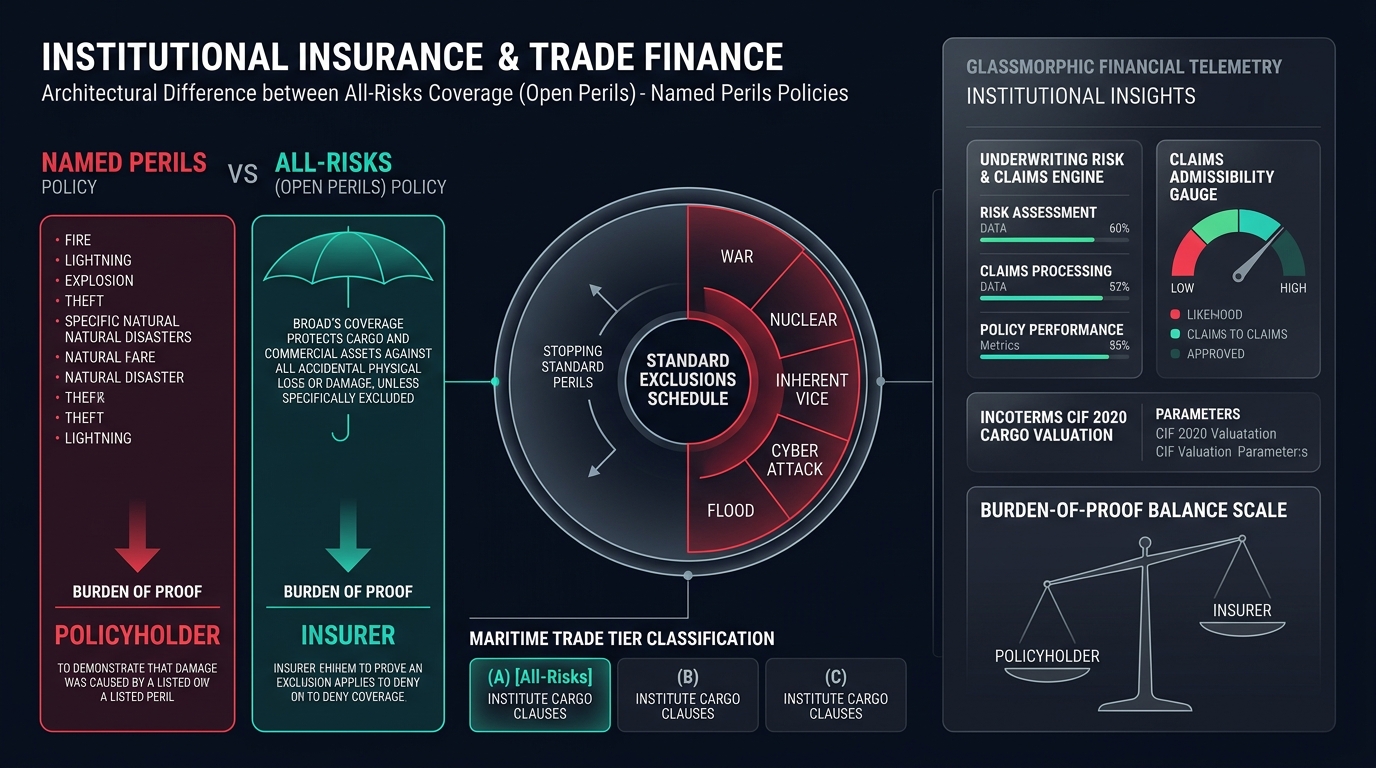
Unlike legacy insurance structures that require every covered risk to be individually cataloged, an all-risks policy operates on an inverse exclusionary principle: everything is automatically covered unless it is explicitly listed under the policy’s exclusion schedule.
This structural distinction alters the legal relationship between the policyholder and the insurance underwriter, particularly regarding the legal burden of proof during claims litigation:
Standard Exclusions in All-Risks Contracts
Despite its expansive title, an “all-risks” policy does not cover every imaginable eventuality. Insurance underwriters incorporate standardized exclusion schedules to eliminate moral hazard, uninsurable catastrophic risks, and predictable physical degradation:
- Inherent Vice and Wear and Tear: Gradual deterioration, rust, metal fatigue, dry rot, mold, and latent manufacturing defects that occur naturally over time without external shock.
- War, Insurrection, and Nuclear Hazards: Acts of war, military invasion, civil revolution, terrorism, and radioactive contamination, which create unmodelable correlated systemic losses.
- Earth Movement and Flood: Earthquakes, landslides, sinkholes, and rising surface water inundation are almost universally excluded from base commercial property forms, requiring specialized standalone endorsements or national flood programs.
- Intentional Misconduct: Fraudulent destruction, arson, or gross criminal negligence committed directly by the insured enterprise or its executive officers.
- Cyber Warfare and System Outages: Following recent reinsurance market reforms, insurers explicitly exclude damages resulting from state-sponsored cyberattacks and malware extortion.
Maritime Trade: Institute Cargo Clauses (A)
In international shipping, commodities trading, and cross-border supply chains, all-risks insurance is standardized under the Institute Cargo Clauses (A), formulated by the International Underwriting Association (IUA) of London:
| Cargo Clause Tier | Coverage Scope | Risk Management Application |
|---|---|---|
| Institute Cargo Clauses (A) | All-Risks (Full open perils) | High-value manufactured goods, electronics, pharmaceuticals |
| Institute Cargo Clauses (B) | Named Major Perils | Bulk agricultural grains, timber, raw non-fragile materials |
| Institute Cargo Clauses (C) | Basic Catastrophic Perils | Scrap metals, low-value ores, minimum trade contract compliance |
Under maritime commercial terms (such as CIF, Cost, Insurance, and Freight under Incoterms 2020), exporters shipping high-value cargo are contractually required by trade finance banks to procure Institute Cargo Clauses (A).
In addition to direct physical damage, Clause (A) covers General Average contributions (where cargo owners must share the cost of sacrifices made by the ship captain to save the vessel from sinking, such as jettisoning cargo during severe storms under the York-Antwerp Rules).
Institute Cargo Clauses Protection Architecture:
┌────────────────────────────────────────────────────────┐
│ Global Ocean Freight / Air Cargo Transit               │
└──────────────────────────┬─────────────────────────────┘
                           │ Insured Under Institute Cargo Clause (A)
                           ▼
┌────────────────────────────────────────────────────────┐
│ Full Open Perils Protection                            │
│ • Collision, stranding, and sinking                    │
│ • Heavy weather water damage and washing overboard     │
│ • Cargo theft, piracy, and handling impact damage      │
│ • General Average salvage contributions                │
└────────────────────────────────────────────────────────┘
Corporate Finance: Collateral Protection in Commercial Lending
Commercial banks and corporate bond trustees insist on all-risks property coverage when structuring secured debt:
- Commercial Real Estate Mortgages: Lenders financing corporate headquarters, logistics warehouses, or multifamily apartment complexes require the borrower to maintain an active Special Causes of Loss (All-Risks) commercial property policy. The bank is designated on the declarations page as the First Mortgagee or Loss Payee.
- Asset-Based Lending (ABL): In revolving credit facilities backed by warehouse inventory and manufacturing equipment, lenders audit the borrower’s all-risks inland marine property coverage annually. If a factory fire or warehouse roof collapse destroys collateral, the insurance proceeds are paid directly to the bank to retire the outstanding loan balance.
Key Takeaways
- All-risks coverage protects property against all fortuitous external physical damage except for perils explicitly excluded in the policy contract.
- In claims disputes, the legal burden of proof rests on the insurance company to demonstrate that a specific exclusion applies.
- Common exclusions include wear and tear, inherent vice, flood, earth movement, war, and state-sponsored cyber warfare.
- In maritime commerce, Institute Cargo Clauses (A) represent the international all-risks standard for ocean freight and trade finance.
Frequently Asked Questions
Does all-risks coverage protect against flood and earthquake damage?
No. Standard commercial and residential all-risks property policies exclude flood (rising surface water) and earth movement (earthquakes). To obtain protection against these perils, property owners must purchase separate specialty insurance endorsements or standalone catastrophe policies.
What does “inherent vice” mean in insurance law?
Inherent vice refers to a natural, internal characteristic of an asset that causes it to deteriorate or destroy itself over time without any external intervention (such as the natural spoiling of fresh fruit, the rusting of untreated iron, or spontaneous combustion in damp grain). Inherent vice is universally excluded from all-risks coverage.
Why do commercial lenders prefer all-risks coverage over named perils?
Lenders prefer all-risks coverage because it eliminates ambiguity regarding whether an unusual accident is covered. Because every cause of loss is covered unless explicitly excluded, the lender’s loan collateral is protected against unexpected hazards that might not appear on a named perils list.
Ready to trade forex?
Open a free demo account with a regulated broker. Practice with virtual funds before risking real money.