ALL
ALL is the standardized three-letter ISO 4217 currency code representing the Albanian Lek, used in international banking telecommunications, cross-border settlements, and foreign exchange trading.
What Does ALL Stand For in Foreign Exchange?
In foreign exchange trading, international banking infrastructure, and cross-border payments, ALL is the official three-letter alphabetic currency code designated by the International Organization for Standardization (ISO 4217) to represent the Albanian Lek, the national currency of Albania. Assigned alongside the three-digit numeric code 008, the identifier ensures precise automated processing across global financial networks.
Under the ISO 4217 standard nomenclature, currency codes follow a rigorous two-part derivation:
- The first two characters (AL) represent the sovereign country code for Albania under the ISO 3166-1 alpha-2 standard.
- The third character (L) represents the initial letter of the domestic currency unit, the Lek.
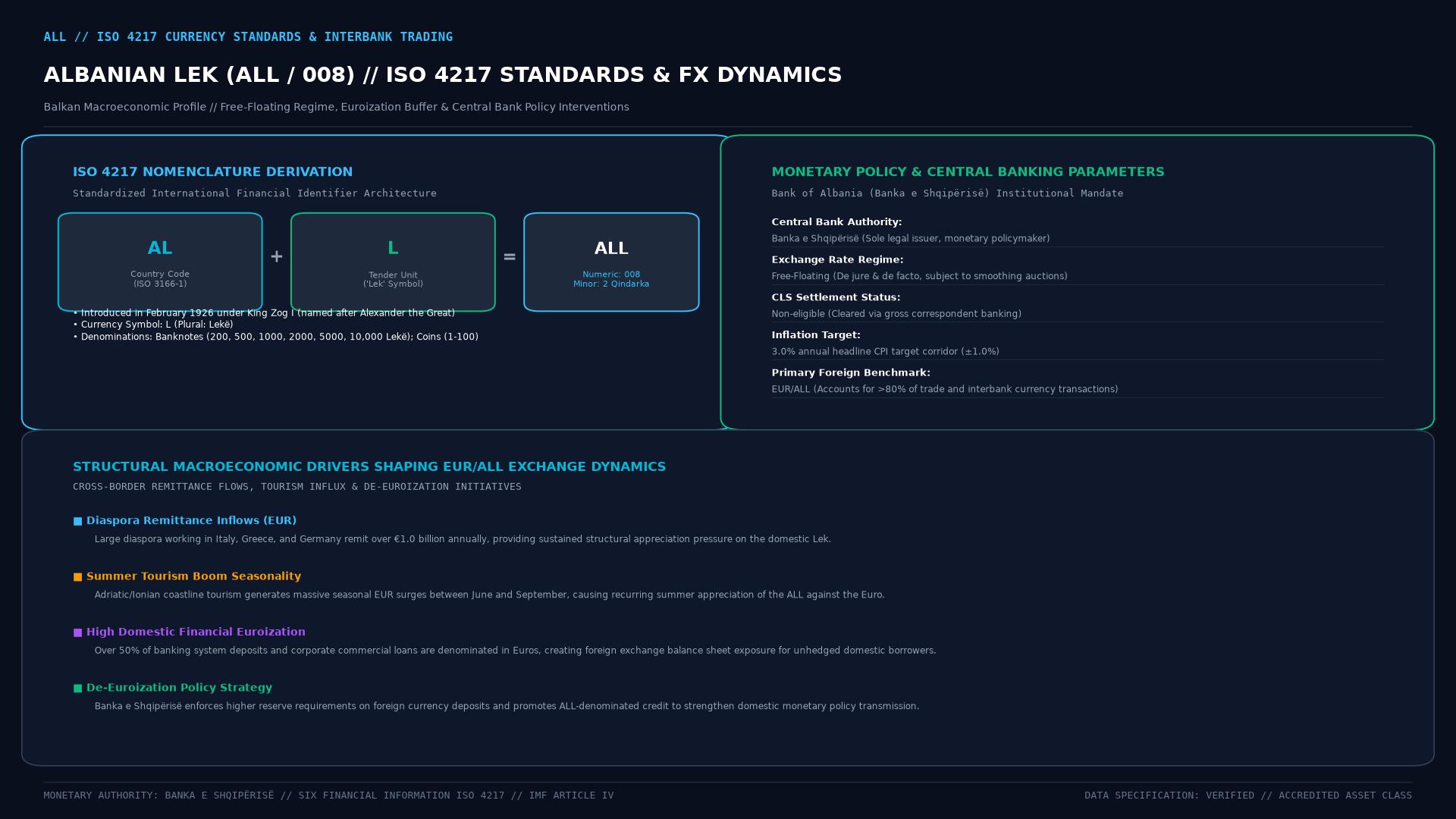 Figure: ISO 4217 currency standards derivation for the Albanian Lek (ALL / 008), Bank of Albania monetary parameters, and macroeconomic drivers shaping EUR/ALL exchange rates.
ISO 4217 Technical Specifications
The table below details the formal institutional parameters assigned to the ALL currency identifier by the ISO 4217 Maintenance Agency (SIX Financial Information):
| Specification Parameter | Institutional Detail |
|---|---|
| Alphabetic Code | ALL |
| Numeric Code | 008 |
| Minor Currency Unit | 2 (Nominally 1 Lek = 100 Qindarka) |
| Issuing Authority | Bank of Albania (Banka e Shqipërisë) |
| Settlement Status | Continuous Linked Settlement (CLS) non-eligible |
| ISO 20022 XML Tag | <Ccy>ALL</Ccy> in pacs.008 settlement messages |
| Primary Clearing Systems | AIPS (RTGS high-value) and AECH (retail clearing) |
The numeric code (008) is utilized in automated clearinghouses, mainframe ledger software, and international databases where character encodings or non-Latin alphabets could introduce typographical errors during automated funds transfer.
Role in Global Banking and Financial Messaging
Although the Albanian Lek is an exotic currency with limited liquidity outside Southeastern Europe, the ALL code is essential across cross-border banking operations:
1. SWIFT and ISO 20022 Telecommunications
International wire transfers sent to Albania via the Society for Worldwide Interbank Financial Telecommunication (SWIFT) utilize the ALL currency identifier. In traditional MT103 customer transfer messages, Field 32A requires the specific inclusion of the ISO code, settlement date, and transaction volume. In modern ISO 20022 messaging formats, the code is transmitted within standardized XML schema elements:
Sample SWIFT MT103 Field 32A Sequence:
:32A:260923ALL25000000,00
  │   │     │   └─ Transaction Amount: 25,000,000.00
  │   │     └───── ISO 4217 Currency Code: ALL
  │   └─────────── Value Date: September 23, 2026
  └─────────────── SWIFT Mandatory Tag for Value Date/Currency/Amount
2. Domestic RTGS Interbank Settlement: AIPS and AECH
Within Albania, the central bank operates two core electronic clearing engines:
- AIPS (Albanian Interbank Payment System): A Real-Time Gross Settlement (RTGS) network designed for systemic, high-value, and time-critical transactions denominated in ALL.
- AECH (Albanian Electronic Clearing House): An automated net clearing platform handling bulk retail payments, payroll disbursements, and recurring utility debits under 1.5 million Lekë.
Foreign Exchange Quotation and Trading Conventions
In global foreign exchange markets, ALL currency pairs adhere to established market conventions:
- EUR/ALL Quotation: The Euro serves as the base currency, while the Albanian Lek serves as the quote currency. A quotation of
EUR/ALL = 100.50indicates that one Euro purchases 100.50 Lekë. EUR/ALL is by far the most liquid trading pair involving the currency, reflecting Albania’s close economic, commercial, and migration ties with the Eurozone. - USD/ALL Quotation: The US Dollar serves as the base currency. A quotation of
USD/ALL = 92.20indicates that one US Dollar purchases 92.20 Lekë. - Bid-Ask Spread Dynamics: Because secondary market liquidity for ALL is concentrated among domestic commercial banks in Tirana and regional Austrian and Italian banking groups, trading spreads are wider than those of G10 currency pairs. Spreads widen during European bank holidays and outside domestic Balkan market trading hours.
Foreign Exchange Quotation Hierarchy:
┌────────────────────────┐         ┌────────────────────────┐
│ EUR / ALL              │         │ USD / ALL              │
│ Base: Euro (EUR)       │         │ Base: US Dollar (USD)  │
│ Quote: Lek (ALL)       │         │ Quote: Lek (ALL)       │
├────────────────────────┤         ├────────────────────────┤
│ Dominant pair for      │         │ Primary pair for       │
│ European trade, travel,│         │ energy commodity       │
│ and worker remittances │         │ settlement & reserves  │
└────────────────────────┘         └────────────────────────┘
Key Takeaways
- ALL is the standardized three-letter ISO 4217 code for the Albanian Lek, paired with numeric code 008.
- The first two letters designate the country code (AL), while the final letter designates the currency (Lek).
- It is mandatory across SWIFT MT103 wires and ISO 20022 XML messages for routing cross-border remittances.
- EUR/ALL is the primary market pair, quoted with the Euro as the base currency and the Lek as the terms currency.
Frequently Asked Questions
Can an investor hold ALL in multi-currency retail trading accounts?
Most retail brokerages do not support multi-currency accounts denominated in ALL because the Albanian Lek is an exotic currency with limited offshore liquidity. Investors seeking exposure typically access the currency through physical exchange bureaus in the Balkans or through domestic commercial bank accounts in Albania.
What is the numeric code 008 used for?
The numeric code 008 is the machine-readable ISO 4217 equivalent of ALL. Automated interbank settlement systems, accounting software, and trade databases use the numeric code to prevent system errors that might arise from varying regional language character sets.
How does the Bank of Albania regulate the ALL exchange rate?
The Bank of Albania maintains a free-floating exchange rate regime. The central bank does not target a rigid peg for ALL against the Euro or US Dollar, allowing market supply and demand from tourism, exports, and remittances to determine the exchange rate while intervening occasionally to smooth extreme market volatility.
Ready to trade forex?
Open a free demo account with a regulated broker. Practice with virtual funds before risking real money.