Alligator spread
An alligator spread is options trading slang for a multi-leg spread where transaction commissions, exchange fees, and bid-ask slippage consume all potential profits, creating a net loss regardless of market direction.
What Is an Alligator Spread in Options Trading?
In options trading, an alligator spread is not a deliberate, textbook options strategy like an iron condor or a calendar spread. Instead, it is colorful market slang coined on the trading floors of the Chicago Board Options Exchange (CBOE) and the American Stock Exchange (AMEX) to describe a trade where transaction frictions devour all potential returns.
The name derives from the trader aphorism that the broker’s commissions, exchange clearing fees, and bid-ask slippage “eat the trader alive, just like an alligator.” In an alligator spread, even if the trader correctly forecasts market direction, underlying volatility, and price timing, the gross profit generated by the options combination is smaller than the cumulative transaction costs required to open and close the position.
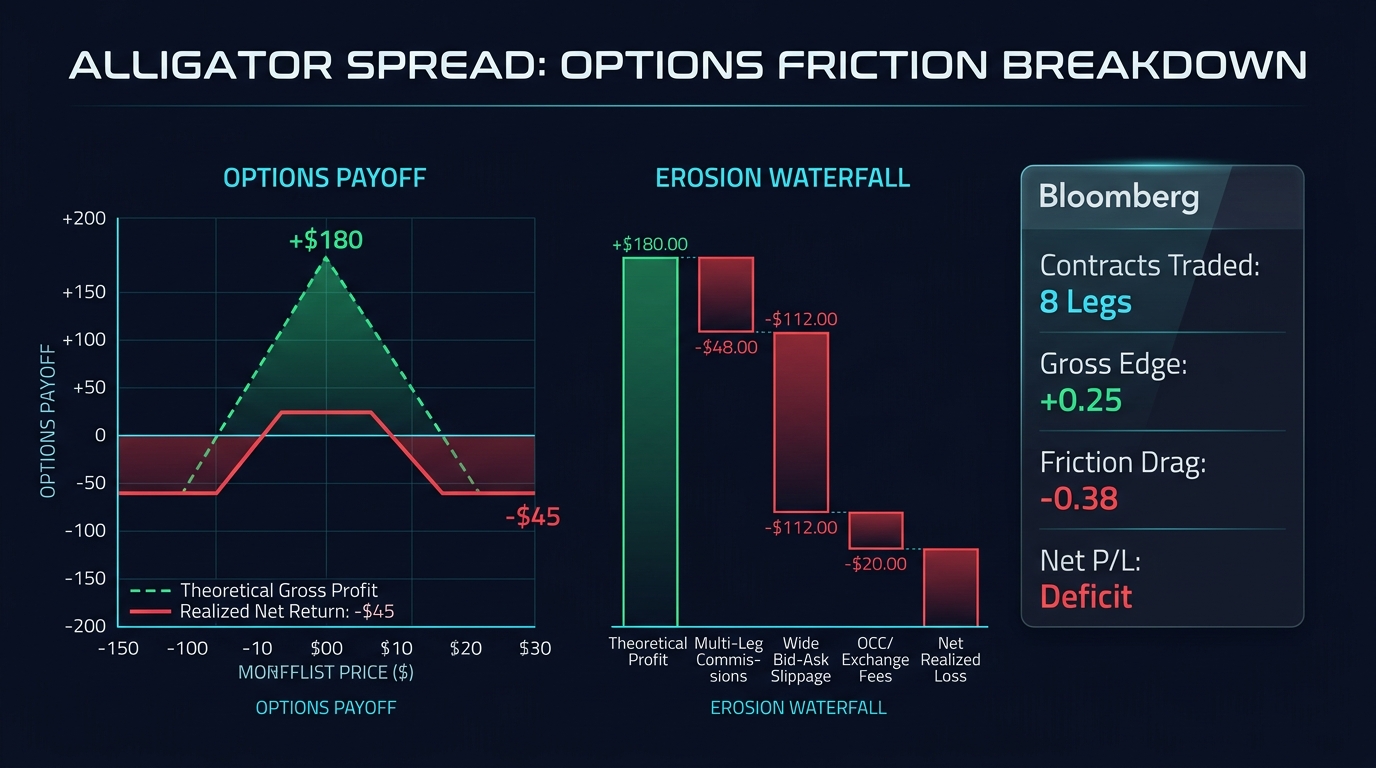
Anatomy of an Alligator Spread Payoff Destruction:
┌────────────────────────────────────────────────────────┐
│ Theoretical Gross Profit from Market Move: +$25.00     │
└──────────────────────────┬─────────────────────────────┘
                           │ Consumed by Transaction Frictions
             ┌─────────────┼─────────────┐
             ▼             ▼             ▼
 ┌──────────────────┐ ┌──────────────────┐ ┌───────────────────┐
 │ Brokerage Per-   │ │ Bid-Ask Spread   │ │ Exchange & OCC    │
 │ Contract Fees:   │ │ Execution Slip:  │ │ Clearing Fees:    │
 │ -$12.00          │ │ -$16.00          │ │ -$2.50            │
 └──────────────────┘ └──────────────────┘ └───────────────────┘
                           │
                           ▼
┌────────────────────────────────────────────────────────┐
│ Net Realized Loss Retained by Trader: -$15.50          │
│ (The alligator ate all trading capital)                │
└────────────────────────────────────────────────────────┘
How an Alligator Spread Occurs: A Mathematical Example
Alligator spreads typically emerge when novice traders design complex, multi-leg options combinations aimed at capturing tiny, high-probability price discrepancies:
Scenario: The Tight Butterfly Spread
Consider a trader who constructs a long call butterfly spread on a moderately traded mid-cap stock trading at $50.00:
- Leg 1: Buy 1 Call at $48 strike (Cost: $2.80)
- Leg 2: Sell 2 Calls at $50 strike (Credit: $1.50 each = $3.00)
- Leg 3: Buy 1 Call at $52 strike (Cost: $0.40)
- Net Debit Paid: $0.20 per share ($20.00 per spread)
The maximum theoretical profit occurs if the stock closes at precisely $50.00 at expiration: $$\text{Max Theoretical Gross Profit} = \text{Strike Difference} - \text{Net Debit} = $2.00 - $0.20 = $1.80 \text{ ($180 per spread)}$$
However, if the stock closes at $49.70, the theoretical value of the spread at expiration might be only $0.35 ($35.00).
The Friction Toll:
- Contract Volume: Executing this single spread requires trading 4 option contracts to enter, and another 4 option contracts to exit (8 contracts total).
- Broker Commission: At $0.65 per contract, round-trip commissions equal $5.20.
- Exchange and OCC Fees: Clearing and regulatory fees add another $1.20.
- Bid-Ask Slippage: Because mid-cap options have wide spreads (for example, a $0.05 spread on each leg), crossing the market on 4 legs to enter and exit consumes approximately $0.40 per share ($40.00) in round-trip bid-ask slippage.
$$\text{Net Economic Result} = $35.00 \text{ (Gross Gain)} - $6.40 \text{ (Fees)} - $40.00 \text{ (Slippage)} = -$11.40$$
Although the stock moved favorably and the position was mathematically “in the money,” the trader lost money. The only winner was the broker and the market maker.
Gross Edge vs. Friction Threshold in Options:
┌──────────────────────────────┬──────────────────────────────┐
│ Viable Options Strategy      │ The Alligator Trap           │
├──────────────────────────────┼──────────────────────────────┤
│ • Wide profit margins        │ • Razor-thin profit targets  │
│ • High liquidity (penny tick)│ • Wide bid-ask spreads       │
│ • Simple 1 or 2-leg designs  │ • Complex 4 to 8-leg setups  │
│ • Frictions < 5% of profit   │ • Frictions > 100% of profit │
└──────────────────────────────┴──────────────────────────────┘
Modern Electronic Trading and the Persistence of the Trap
Many retail investors assume that the introduction of “zero-commission” stock trading in 2019 eliminated the alligator spread. In reality, options market microstructure preserves the risk:
- Per-Contract Fee Structure: Most retail brokerages still charge between $0.50 and $0.65 per option contract, plus proprietary index licensing surcharges on index products (such as SPX and NDX).
- Payment for Order Flow (PFOF) and Price Slippage: While stated ticket commissions may appear modest, retail brokerages frequently route complex multi-leg options orders to wholesale market-making firms. In less liquid equity options, the widened bid-ask spread on complex multi-leg combo orders extracts significant hidden value from the retail trader.
Strategic Rules to Avoid Alligator Spreads
Professional options traders apply strict execution filters to prevent capital from being consumed by fees:
- Trade Only Penny-Wide Liquidity: Restrict complex multi-leg spreads (butterflies, condors, and ratio spreads) to hyper-liquid underlyings (such as SPY, QQQ, AAPL, and NVDA) where option bid-ask spreads trade at a single penny.
- Require Favorable Return-to-Friction Ratios: Never enter an options spread where total estimated round-trip transaction costs and bid-ask slippage exceed 10% of the maximum potential profit.
- Avoid Multi-Leg Nickel Options: Selling options trading for $0.05 or $0.10 across multiple legs creates an alligator trap because the fee per contract represents a massive percentage of the premium collected.
Key Takeaways
- An alligator spread is trading slang for a position where commissions, fees, and slippage consume all potential profits.
- The term originated on the CBOE trading floor, warning traders that transaction costs would “eat them alive.”
- Complex multi-leg strategies (such as tight butterflies and iron condors) on illiquid stocks are the most vulnerable to this trap.
- Protecting capital requires trading liquid, penny-wide options and calculating round-trip friction costs before executing orders.
Frequently Asked Questions
Can an alligator spread happen in Forex trading?
Yes. In foreign exchange trading, an alligator trap occurs when scalpers attempt to capture microscopic 1-pip or 2-pip profits while paying a 1-pip bid-ask spread and broker commission. Even with a 70% win rate, the broker’s spread and commissions consume all net trading gains.
Why do market makers like trading against alligator spreads?
Market makers profit from the bid-ask spread on every option leg traded. When a retail trader enters a 4-leg butterfly spread, the market maker captures the spread across four separate contracts, securing immediate, low-risk profits.
How can I calculate my break-even friction threshold?
Sum the total round-trip brokerage commissions, clearing fees, and the full bid-ask spread across all legs of the proposed trade. Divide this total dollar cost by your target gross profit. If transaction costs exceed 10% to 15% of your target gain, the risk of an alligator spread is unacceptable.
Ready to trade forex?
Open a free demo account with a regulated broker. Practice with virtual funds before risking real money.