Allocation
Allocation is the strategic distribution of financial assets across investment classes, corporate capital across growth projects, or indirect costs across operational business units.
What Is Allocation in Finance and Investment?
In financial markets, wealth management, and corporate strategy, allocation describes the structured apportionment of limited resources (such as investment capital, corporate free cash flow, or operational overhead) across competing alternatives.
Depending on the operational context, allocation refers to three foundational financial disciplines:
- Asset Allocation: The distribution of an investment portfolio across broad asset classes (such as equities, bonds, cash, and alternative assets) to optimize the tradeoff between risk and return.
- Corporate Capital Allocation: The strategic decisions made by executive management regarding how to deploy an enterprise’s retained cash flow among internal capital expenditures, corporate acquisitions, debt retirement, dividends, and share buybacks.
- Cost Allocation: The accounting procedure of assigning indirect overhead costs (such as factory rent, utilities, and executive management) across individual cost objects or product lines.
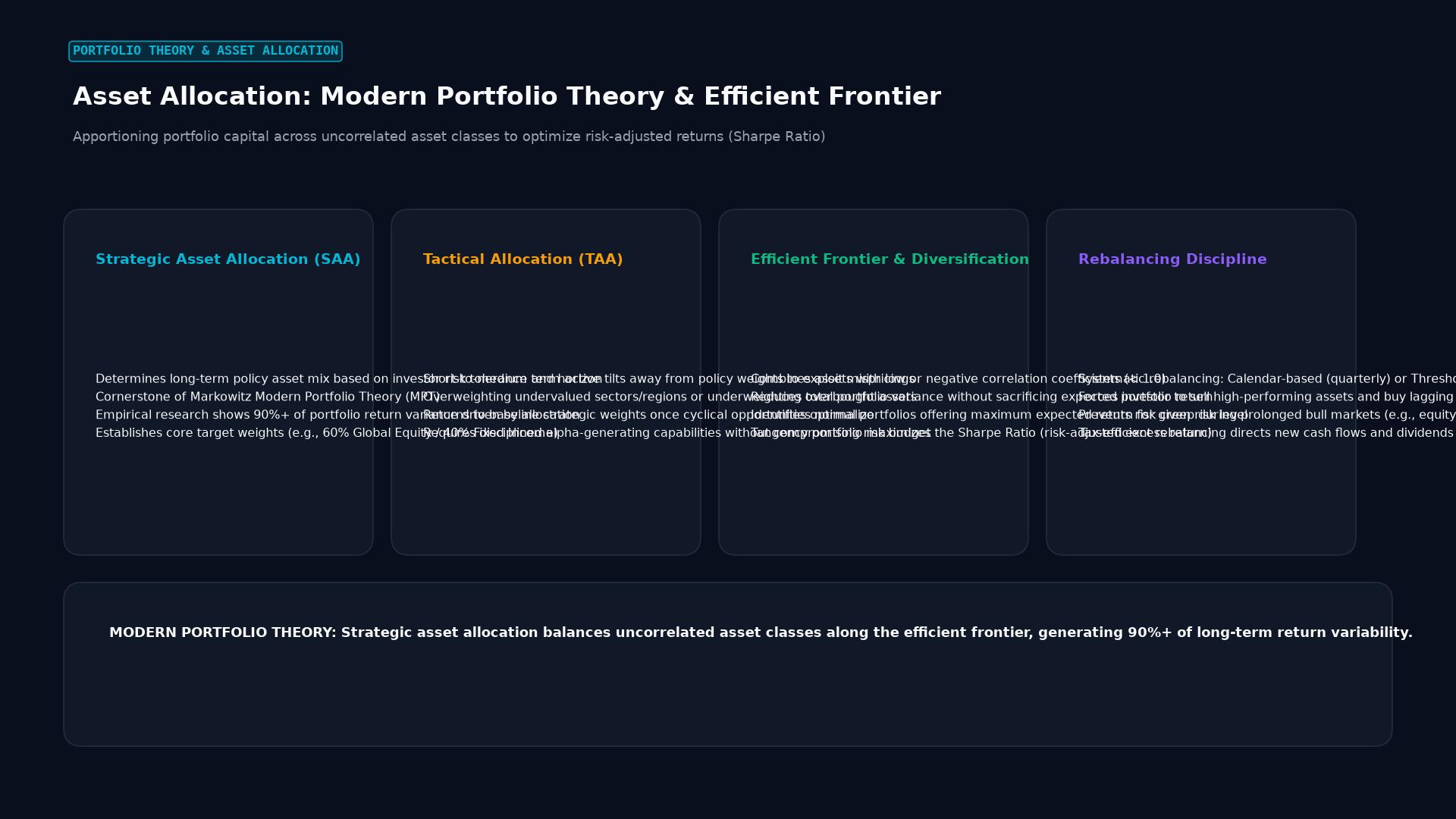 Figure: Apportioning portfolio capital across uncorrelated asset classes to optimize risk-adjusted returns (Sharpe Ratio)
Asset Allocation: The Core Engine of Portfolio Returns
In institutional wealth management and pension fund administration, asset allocation is recognized as the single most critical factor determining long-term investment performance. Landmark empirical research by Brinson, Hood, and Beebower (1986) demonstrated that asset allocation policy accounts for more than 90% of the variation in quarterly portfolio returns, far outweighing the impact of individual security selection or short-term market timing.
Determinants of Portfolio Performance (Brinson Study):
┌────────────────────────────────────────────────────────┐
│ [ Asset Allocation Policy: 91.5% ]                     │
│ [ Security Selection: 4.6% ] [ Market Timing: 1.8% ]   │
└────────────────────────────────────────────────────────┘
Institutional asset managers utilize three primary allocation frameworks:
1. Strategic Asset Allocation (SAA)
A long-term target portfolio structure established based on an investor’s risk tolerance, time horizon, and return objectives, anchored in Markowitz Modern Portfolio Theory (MPT). The portfolio is rebalanced periodically (quarterly or annually) back to target weightings (for example, 60% global equities, 35% investment-grade fixed income, and 5% cash).
2. Tactical Asset Allocation (TAA)
An active management strategy that allows short-term deviations from the strategic baseline to capitalize on temporary macroeconomic mispricings or sector anomalies. For example, if equity valuations become extreme, a manager might temporarily trim equities from 60% to 50% and raise cash to 15%, reverting to the baseline once market conditions normalize.
3. Dynamic Asset Allocation
An algorithmic approach that continuously adjusts portfolio weights in response to changing market volatility and economic regimes, frequently utilizing trend-following rules or risk-parity weighting.
Corporate Capital Allocation: The CEO’s Core Mandate
In corporate finance, capital allocation is widely considered the ultimate test of executive leadership. As Warren Buffett famously observed in his Berkshire Hathaway shareholder letters, the primary responsibility of a chief executive officer is allocating the cash generated by operations:
Executive Capital Allocation Alternatives:
┌────────────────────────────────────────────────────────┐
│ Corporate Free Cash Flow Generated by Operations       │
└──────────────────────────┬─────────────────────────────┘
                           │
             ┌─────────────┼─────────────┬─────────────┐
             ▼             ▼             ▼             ▼
 ┌───────────────┐ ┌───────────────┐ ┌───────────┐ ┌───────────┐
 │ Organic Capex │ │ Mergers &     │ │ Debt      │ │ Return to │
 │ & R&D Growth  │ │ Acquisitions  │ │ Reduction │ │ Sharehldrs│
 ├───────────────┤ ├───────────────┤ ├───────────┤ ├───────────┤
 │ Internal plant│ │ Strategic     │ │ Pay down  │ │ Dividends │
 │ expansion &   │ │ buyouts of    │ │ high-cost │ │ or share  │
 │ tech pipelines│ │ competitors   │ │ bank debt │ │ buybacks  │
 └───────────────┘ └───────────────┘ └───────────┘ └───────────┘
A disciplined capital allocator compares the expected return on capital across all options. If the company’s stock is undervalued in public markets, share repurchases deliver superior long-term returns. If debt carries onerous interest rates, paying down principal de-risks the enterprise. If internal projects yield high Returns on Invested Capital (ROIC), cash should be plowed back into organic research and development.
Cost Allocation in Management Accounting
In cost accounting and managerial control, cost allocation involves tracing indirect corporate overhead to specific departments, products, or service lines:
| Cost Classification | Nature of Expense | Allocation Methodology |
|---|---|---|
| Direct Costs | Traced directly to product (raw materials, factory labor) | Direct identification with product unit |
| Indirect Overhead | Shared facility expenses (plant electricity, machine depreciation) | Allocated via cost drivers or machine hours |
| Corporate SG&A | Executive compensation, legal department retainers | Allocated via revenue percentage or headcount |
Under Activity-Based Costing (ABC), accountants replace arbitrary allocation formulas (such as distributing overhead simply based on direct labor hours) with causal activity drivers (such as number of purchase orders processed or machine setup hours), preventing distorted product profit margins.
Key Takeaways
- Allocation involves the structured distribution of scarce financial capital, investment assets, or operational costs.
- Asset allocation explains over 90% of long-term portfolio return variation, far exceeding security selection.
- Strategic Asset Allocation (SAA) establishes permanent baseline weightings, while Tactical Asset Allocation (TAA) exploits short-term market anomalies.
- Chief executives demonstrate capital allocation discipline by directing cash flows toward options that maximize return on invested capital.
Frequently Asked Questions
What is portfolio rebalancing in asset allocation?
Rebalancing is the systematic process of selling portions of asset classes that have outperformed and purchasing underperforming asset classes to return the portfolio to its original strategic target weights. This enforces a disciplined “sell high, buy low” investment methodology.
How does asset correlation impact asset allocation?
Modern Portfolio Theory demonstrates that combining asset classes with low or negative correlation (such as equities and long-duration Treasury bonds) reduces aggregate portfolio volatility without sacrificing expected returns, creating a more efficient investment portfolio.
When should a company choose share buybacks over dividend allocation?
A company should allocate capital to share buybacks when its stock is trading at a significant discount to its intrinsic business value, and management believes repurchasing shares provides a higher return on capital than alternative investments. If the stock is overvalued, paying cash dividends is more prudent.
Ready to trade forex?
Open a free demo account with a regulated broker. Practice with virtual funds before risking real money.