Activity Driver
An Activity Driver is a quantitative metric in Activity-Based Costing that measures the frequency and intensity of demands placed on an operational activity by products, services, or customers, linking activity costs to cost objects.
What Is an Activity Driver?
In managerial accounting, cost allocation, and enterprise performance management, an Activity Driver (often referred to as an activity cost driver) is the specific, quantifiable unit of measurement that tracks how much of a given business activity is consumed by a particular product, service, customer, or business unit.
Activity drivers represent the critical causal link in the two-stage Activity-Based Costing (ABC) framework. While traditional accounting arbitrarily dumps overhead onto products using generic labor hours, ABC recognizes that products do not directly consume corporate dollars; products consume activities, and activities consume resources.
The activity driver measures the output of an activity pool. For instance, if an accounting team performs the activity Process Inbound Vendor Invoices, the total expense of that department is divided by the activity driver, the Number of Vendor Invoices Processed, establishing an exact, mathematically sound cost per invoice that is charged to the specific business lines generating those invoices.
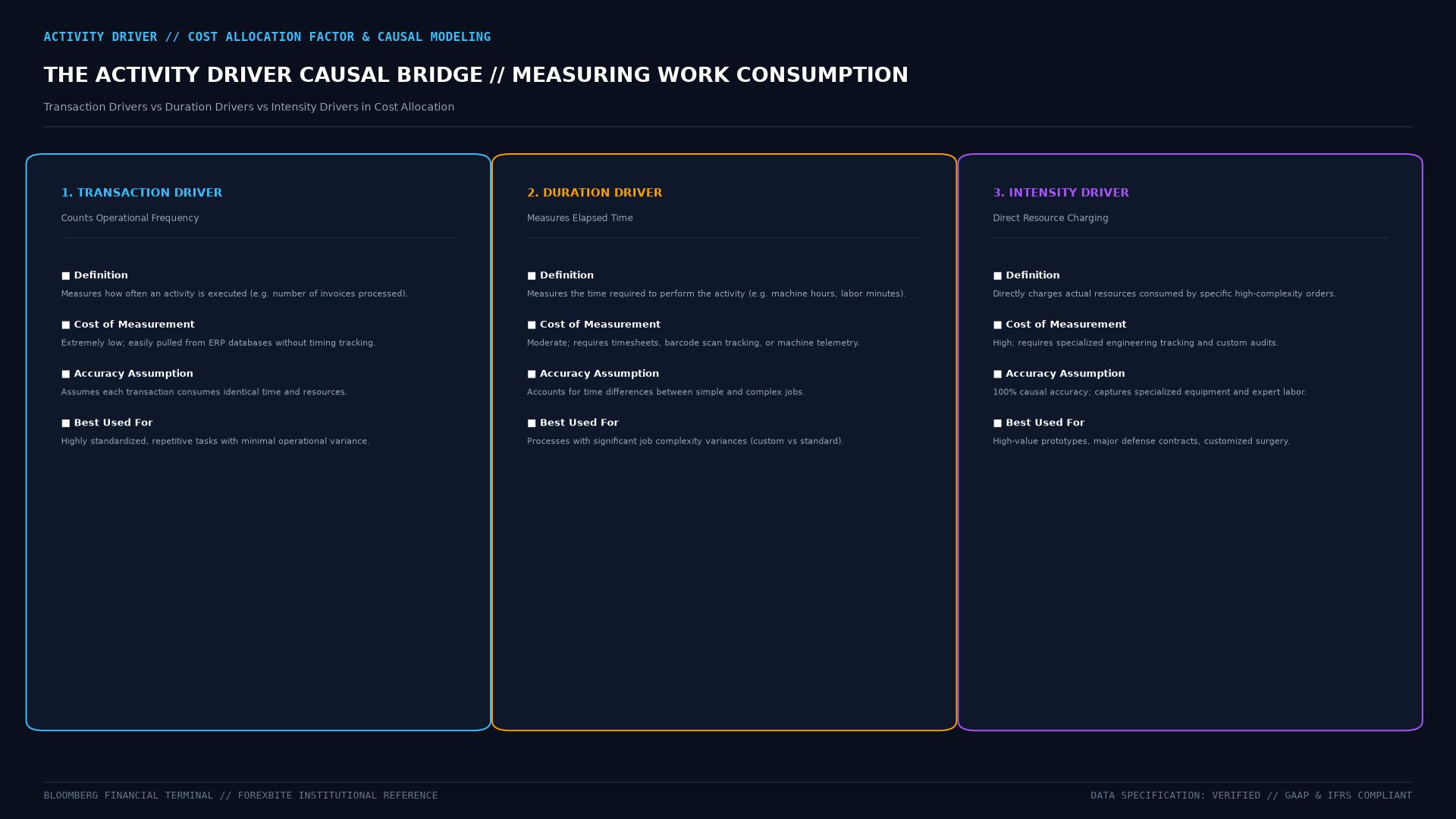 Figure: Classification matrix of Activity Drivers comparing Transaction, Duration, and Intensity drivers by accuracy, measurement cost, and variance impact across operational environments.
Technical Mechanics: The Three Classes of Activity Drivers
Cost accountants select activity drivers based on the required trade-off between measurement accuracy and data collection expense. Drivers fall into three distinct classifications:
1. Transaction Drivers
Transaction drivers simply count how many times an activity is executed, under the assumption that each occurrence consumes roughly the same quantity of resources:
- Examples: Number of purchase orders issued, number of machine setups performed, number of customer service calls received, number of customer shipments dispatched.
- Advantages: Highly accessible; easily extracted from standard ERP databases with minimal tracking overhead.
- Limitations: Distorts costs if the time required per transaction varies widely (for example, if one complex machine setup takes six hours while another takes twenty minutes).
2. Duration Drivers
Duration drivers measure the actual time required to execute an activity, providing greater accuracy when transaction effort is uneven:
- Examples: Machine setup hours, inspection labor hours, engineering design hours, direct technical support minutes.
- Application: Essential when customized jobs consume significantly more time than standardized high-volume jobs.
3. Intensity (Direct Charge) Drivers
Intensity drivers directly track and charge the precise physical resources, specialized tooling, and senior personnel committed to an activity:
- Examples: Specialized computer server compute hours, clinical operating room minutes with specialized surgical staff, customized laboratory chemical testing time.
- Application: Deployed for high-value, bespoke contracts where duration alone does not capture the extreme variance in resource expense.
Calculating the Activity Driver Rate
The activity driver rate is calculated by dividing the total budgeted cost of the activity pool by the practical capacity of the driver (excluding arbitrary theoretical capacity that ignores maintenance and downtime):
Activity Driver Rate = Total Cost in Activity Pool / Practical Capacity of Activity DriverOnce the rate is established, the cost allocated to an individual product or customer is calculated:
Allocated Activity Cost = Units of Driver Consumed by Object × Activity Driver RateComparative Matrix: Driver Types Across Cost Accounting
| Driver Category | Measurement Focus | Typical Complexity | Relative Accuracy | Best Applied To |
|---|---|---|---|---|
| Transaction Driver | Frequency count (# of events) | Very Low | Moderate | Uniform, repetitive administrative tasks |
| Duration Driver | Elapsed time (Hours / Minutes) | Moderate | High | Variable tasks (repairs, custom setups) |
| Intensity Driver | Exact resource mix and cost | High | Extreme | Bespoke aerospace, clinical medicine, legal work |
| Traditional Driver | Plant volume (Labor/Machine hrs) | Very Low | Very Poor | Simple single-product factories |
Real-World Case Study: Aerospace Parts Supplier Setup Driver Calibration
In 2023, a precision aerospace machining contractor with $40 million in revenue was losing bids on standard titanium fasteners to European rivals while consistently winning bids for complex, custom turbine housing components. Despite winning complex bids, net profits declined.
The company re-evaluated its machine setup activity:
- The Flawed Transaction Driver: The company had been using a simple transaction driver (Number of Machine Setups), dividing a $2,400,000 setup pool by 1,200 annual setups to apply a flat $2,000 setup fee to all jobs.
- The Duration Driver Audit: Engineering time studies revealed that setting up a standard titanium fastener run took only 45 minutes (0.75 hours), while setting up the complex 5-axis CNC mill for a turbine housing required 8.5 hours of specialized laser calibration.
- The Recalibration: Management switched to a duration driver (Setup Hours), establishing a driver rate of $350 per setup hour:
- True Fastener Setup Cost: $350 × 0.75 hours = $262.50 (previously over-costed at $2,000!).
- True Turbine Setup Cost: $350 × 8.5 hours = $2,975.00 (previously under-costed at $2,000!).
- Outcome: By aligning quotes with the duration driver, the company repriced standard fasteners competitively, recapturing $6 million in high-volume contracts, while adjusting custom turbine pricing to protect operating margins.
Frequently Asked Questions (FAQ)
What is the difference between a resource driver and an activity driver?
A resource driver is the metric used to assign organizational costs from the general ledger to specific activity pools (for example, using square footage of floor space to assign facility rent to departments). An activity driver is the metric used in the second stage to assign the accumulated activity costs to specific products, services, or customers.
How does an enterprise determine which activity driver to use?
Cost accountants evaluate three criteria: causality (the driver must logically cause the cost), correlation (driver volume must correlate closely with resource consumption), and measurability (the data must be collectible from existing enterprise systems without excessive manual auditing expense).
Can an activity have multiple activity drivers?
An individual activity cost pool typically operates with a single primary activity driver to maintain computational simplicity. If an activity exhibits multiple conflicting cost behaviors (e.g., both transaction frequency and machine duration drive costs independently), accountants divide the activity into two separate sub-pools, each with its own designated driver.
Ready to trade forex?
Open a free demo account with a regulated broker. Practice with virtual funds before risking real money.