Allonge
An allonge is a slip of paper firmly affixed to a negotiable commercial instrument to provide space for additional endorsements when the original physical document has run out of room.
What Is an Allonge in Commercial Law?
In commercial paper, banking law, and negotiable instruments, an allonge (derived from the French verb allonger, meaning “to lengthen” or “to draw out”) is an auxiliary piece of paper firmly attached or affixed to a physical negotiable instrument (such as a promissory note, draft, or bill of exchange). Its legal purpose is providing additional surface area for written endorsements when the reverse side of the original instrument is completely filled with prior signatures and stamps.
Transferring ownership of an order instrument requires both delivery of possession and a valid endorsement. When a promissory note changes hands multiple times across banks, secondary mortgage aggregators, and institutional trusts, the physical margins of the original paper document quickly run out of room. The allonge extends the physical boundaries of the document, legally becoming an integral part of the instrument itself.
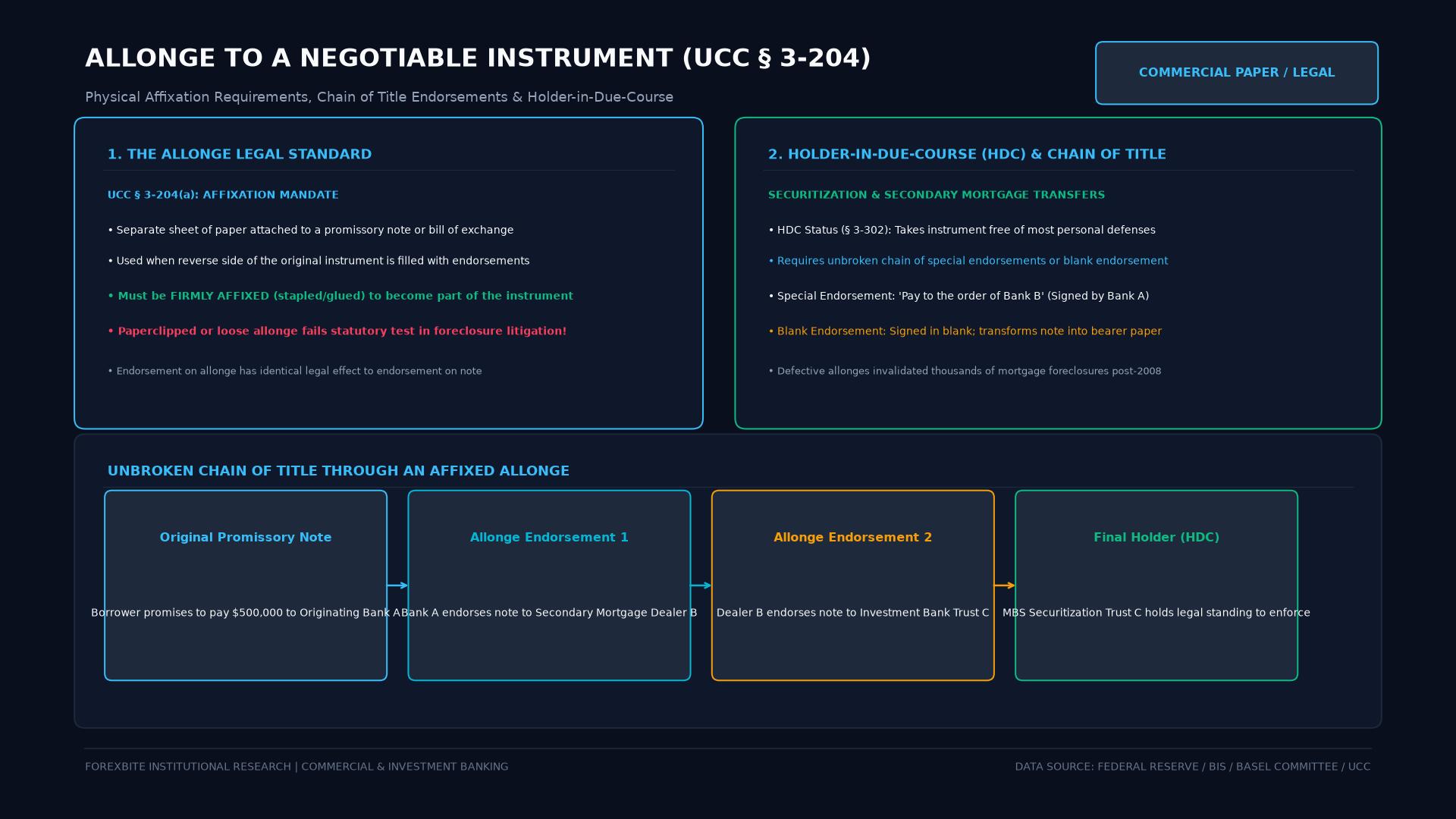 Figure: Formal endorsement protocol for negotiable instruments under UCC 3-204(a): legal attachment criteria, unbroken chain of title, and securitization transfer.
Legal Requirements Under the Uniform Commercial Code (UCC)
In the United States, the validity and legal effect of an allonge are governed by Article 3 of the Uniform Commercial Code (UCC Section 3-204(a)):
- The Affixation Requirement: The statute explicitly declares: “For the purpose of determining whether a signature is made on an instrument, a paper affixed to the instrument is a part of the instrument.”
- Permanence of Attachment: Commercial courts have interpreted the word “affixed” with strict physical precision. The allonge must be permanently attached to the underlying note (traditionally via staples, glue, or binding).
- The Loose Paper Trap: A loose sheet of paper stored inside a file folder alongside the note, or an allonge attached merely with a removable paperclip, fails the statutory affixation test. An unattached allonge is legally invalid, rendering any signature on it ineffective as an endorsement.
Holder in Due Course (HIDC) Status and Negotiation
An allonge plays a decisive role in establishing whether a secondary loan purchaser qualifies as a Holder in Due Course (HIDC) under UCC § 3-302:
- Order Paper vs. Bearer Paper: A promissory note payable to a specific lender is “order paper.” To transfer legal title, the lender must endorse the note. If the endorsement appears on an allonge that was never physically affixed to the note, legal negotiation failed to occur.
- Defenses to Payment: Without a valid endorsement on the note or a firmly affixed allonge, the purchaser is a mere transferee rather than a Holder in Due Course. As a result, the borrower can assert personal contract defenses (such as fraud in the inducement, predatory lending, or lack of consideration) that would otherwise be barred against an HIDC.
The 2008 Mortgage Securitization and Robo-Signing Crisis
The legal scrutiny surrounding allonges intensified dramatically during the aftermath of the 2008 global financial crisis:
The Securitization Chain of Title Failure:
┌────────────────────────┐         ┌────────────────────────┐
│ Originating Mortgage   │ Sold to │ Wall Street Investment │
│ Lender (Countrywide)   ├────────►│ Bank Conduit           │
└────────────────────────┘         └───────────┬────────────┘
                                               │ Bundled into RMBS
                                               ▼
┌────────────────────────┐         ┌────────────────────────┐
│ Unattached Allonge     │ Missing │ Residential Mortgage-  │
│ Fabricated Years Later ├────────►│ Backed Securities Trust│
│ to Foreclose in Court  │ Endorse.│ (Empty Trust Problem)  │
└────────────────────────┘         └────────────────────────┘
During the housing boom, millions of mortgages were rapidly pooled into Residential Mortgage-Backed Securities (RMBS) trusts. In their rush to securitize loans, investment banks and custodians routinely failed to endorse the original physical promissory notes before transfer deadlines.
When loan servicers subsequently initiated foreclosure proceedings against defaulting homeowners between 2009 and 2013, state appellate courts (most notably in Florida, Ohio, and New York) demanded proof of standing:
- Servicers frequently produced allonges executed by specialized document-processing firms years after the trust had closed.
- Many allonges were signed by “robo-signers” who had no personal knowledge of the underlying records.
- In landmark decisions, judges dismissed foreclosure lawsuits with prejudice because the allonges were not physically affixed to the original notes, or because blank space still existed on the original note, rendering an auxiliary allonge legally improper.
Key Takeaways
- An allonge is a slip of paper permanently affixed to a negotiable instrument to provide room for additional endorsements.
- Under UCC Section 3-204(a), an allonge must be firmly affixed (stapled or permanently bound) to be considered part of the instrument.
- Paperclips or unattached loose sheets fail the legal affixation test, rendering endorsements invalid.
- Flawed, unattached, and backdated allonges led to the dismissal of thousands of foreclosure actions during the 2008 housing crisis.
Frequently Asked Questions
Can an allonge be used if there is still blank space on the original promissory note?
Under traditional commercial law and earlier versions of the UCC, an allonge was legally permitted only if there was no remaining physical space on the original document. While modern UCC revisions removed the strict “lack of space” prerequisite, many state courts continue to view allonges with skepticism if the original promissory note contains ample blank margins for endorsement.
What is the difference between an assignment and an allonge?
An assignment is a separate contractual agreement that transfers contractual rights and economic interests in a debt. An allonge is a physical extension of the negotiable instrument itself that carries an endorsement, which is required under UCC Article 3 to negotiate order paper and confer Holder in Due Course protections.
Are digital allonges used in electronic mortgages (e-Notes)?
In electronic mortgage transactions registered on the Mortgage Electronic Registration System (MERS eRegistry), physical promissory notes and allonges are replaced by an authoritative digital e-Note. Electronic endorsements and transfers of control are executed via cryptographic digital signatures, eliminating physical affixation disputes entirely.
Ready to trade forex?
Open a free demo account with a regulated broker. Practice with virtual funds before risking real money.