Allotment
An allotment is the formal distribution of new shares, bonds, or securities among underwriting syndicate members and subscribing investors during a public offering.
What Is an Allotment in Capital Markets?
In equity underwriting, sovereign bond issuance, and corporate finance, an allotment is the formal distribution and legal assignment of new shares, debt debentures, or financial securities among participating investment banks and prospective investors.
The allotment process occurs during the primary market phase of an Initial Public Offering (IPO), rights issue, or seasoned equity offering. After the issuing corporation and its lead underwriter establish the final offering price, the underwriting syndicate reconciles the aggregate order book and distributes shares to institutional pension funds, mutual funds, sovereign wealth entities, and retail applicants.
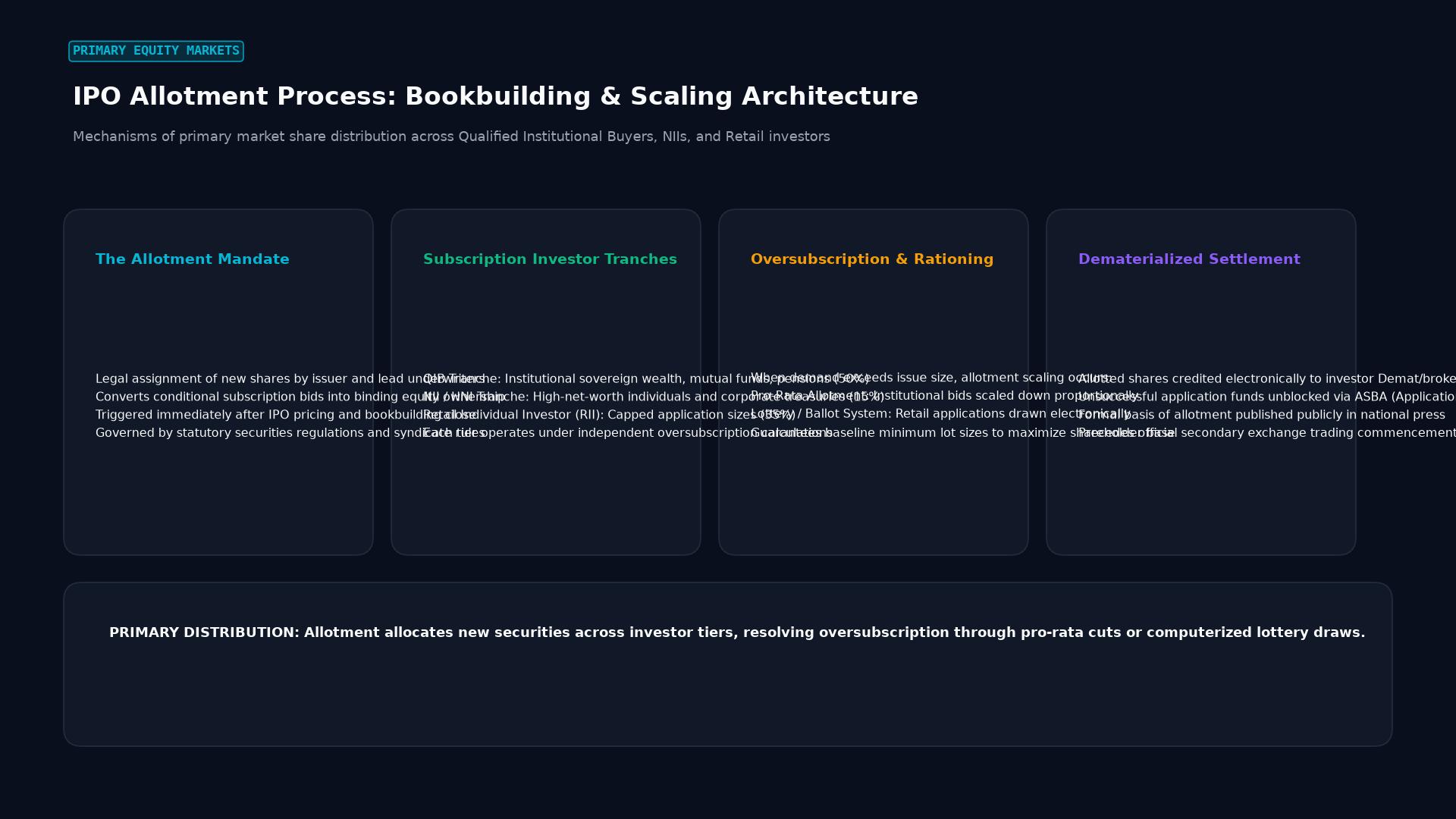 Figure: Mechanisms of primary market share distribution across Qualified Institutional Buyers, NIIs, and Retail investors
The Bookbuilding Phase and Allotment Discretion
The allotment volume granted to an individual investor depends heavily on the offering’s demand dynamics and regulatory jurisdiction:
1. The Institutional Order Book
During an IPO roadshow, the lead underwriter (bookrunner) compiles an order book recording expressions of interest from institutional funds. Investors specify the number of shares desired and the maximum price they are willing to pay.
2. Discretionary Allocation in the United States and Europe
In the United States and the United Kingdom, underwriters possess wide legal discretion regarding allotments:
- Long-Term Anchor Investors: Underwriters deliberately favor institutional asset managers (such as sovereign wealth funds and pension managers) known for holding shares for years. These institutions receive generous allotments because their patient capital stabilizes post-IPO trading.
- Penalizing Flipped Accounts: Hedge funds with a track record of “flipping” allocations into the secondary market on opening day receive minimal or zero allotments.
3. Retail Rationing in Emerging Markets (SEBI Framework)
In emerging markets such as India, regulators enforce mathematical retail quotas. The Securities and Exchange Board of India (SEBI) mandates that a fixed percentage (typically 35%) of an IPO be reserved for retail individual investors. When the retail tranche is heavily oversubscribed, allotments are distributed via automated computerized lotteries to guarantee democratic participation rather than underwriter favoritism.
Allotment Mechanics: Pro-Rata vs. Lottery Allocation
When total investor demand exceeds available share volume (an oversubscribed offering), the syndicate resolves the imbalance using structured rationing mechanisms:
| Rationing Mechanism | Operational Methodology | Typical Application Market |
|---|---|---|
| Pro-Rata Allotment | Every applicant receives a uniform percentage of requested shares | Institutional tranches and corporate rights issues |
| Computerized Lottery | Random electronic drawing for minimum fixed share lots | Retail tranches in quota-governed emerging markets |
| Tiered Discretion | Underwriter evaluates investor quality, relationship, and tenure | US and European institutional bookbuilding |
Numerical Example of Pro-Rata Allotment
Suppose an institutional credit fund bids for 1,000,000 shares in an offering that is four times oversubscribed (oversubscription ratio = 4.0):
$$\text{Allotment Percentage} = \frac{1}{\text{Oversubscription Ratio}} = \frac{1}{4.0} = 25.0%$$
$$\text{Final Share Allotment} = 1,000,000 \times 25.0% = 250,000 \text{ Shares}$$
The fund receives 250,000 shares, and its excess deposited cash balance is refunded via automated clearinghouse transfer.
Oversubscription Rationing Matrix:
┌────────────────────────┐         ┌────────────────────────┐
│ Total Bid Volume:      │ 4x      │ Available Offering:    │
│ 40,000,000 Shares      │ Oversub.│ 10,000,000 Shares      │
└───────────┬────────────┘         └───────────┬────────────┘
            │                                  │
            └─────────────────┬────────────────┘
                              ▼
                ┌───────────────────────────┐
                │ Pro-Rata Allotment Factor │
                │ 25% of Bids Filled        │
                │ 75% Cash Refunded         │
                └───────────────────────────┘
Syndicate Retention vs. The Institutional Pot
In multi-bank underwriting syndicates, allotments are divided between shared institutional pools and individual broker allocations:
- The Institutional Pot: A centralized pool of shares managed directly by the lead left bookrunner. Institutional orders are filled directly out of the pot, allowing the lead manager to coordinate orderly distribution.
- Syndicate Retention: The specific quota of shares granted to each junior syndicate member to sell directly to their private wealth clients. The revenue earned from selling these retained shares constitutes the selling concession established in the Agreement Among Underwriters (AAU).
Key Takeaways
- An allotment is the formal distribution of securities to syndicate members and subscribing investors in a public offering.
- In oversubscribed offerings, underwriters ration shares using discretionary allocation, pro-rata formulas, or retail lotteries.
- US and European underwriters favor long-term institutional holders to prevent opening-day share flipping.
- The institutional pot centralizes share distribution under the control of the lead bookrunner.
Frequently Asked Questions
What is the Basis of Allotment document?
The Basis of Allotment is an official regulatory document published by the stock exchange and registrar following an IPO. It outlines the exact mathematical rules, oversubscription ratios, and lottery algorithms used to determine how many shares each category of investor received.
What happens to an investor’s money if they receive a zero allotment?
If an investor’s subscription bid is rejected or unsuccessful in an oversubscribed lottery, the underwriting bank or registrar must release the blocked funds or refund the escrowed subscription deposit in full without interest deductions.
What is the difference between an allocation and an allotment?
In capital markets, an allocation is the provisional decision by the bookrunner designating how many shares an applicant should receive based on order book analysis. An allotment is the final, legally binding distribution that transfers corporate share ownership to the investor.
Ready to trade forex?
Open a free demo account with a regulated broker. Practice with virtual funds before risking real money.