Allottee
An allottee is an individual, corporate entity, or institutional fund to whom new shares or debt securities are legally awarded in a primary capital offering.
What Is an Allottee in Capital Markets?
In securities law, corporate jurisprudence, and public equity offerings, an allottee is an individual subscriber, retail trader, or institutional investment fund to whom newly issued shares, convertible debentures, or debt bonds are legally assigned by a company or its underwriting syndicate.
The status of allottee represents a critical transitional phase in the formation of a corporate ownership contract. Under contract law, an investor who submits a bid or subscription form during an Initial Public Offering (IPO) or rights issue is legally making an offer to purchase shares. When the corporate issuer and its board of directors approve the allotment schedule and transmit a Letter of Allotment, the company legally accepts the investor’s offer. This event binds both parties to a valid commercial contract, transforming the applicant into an allottee.
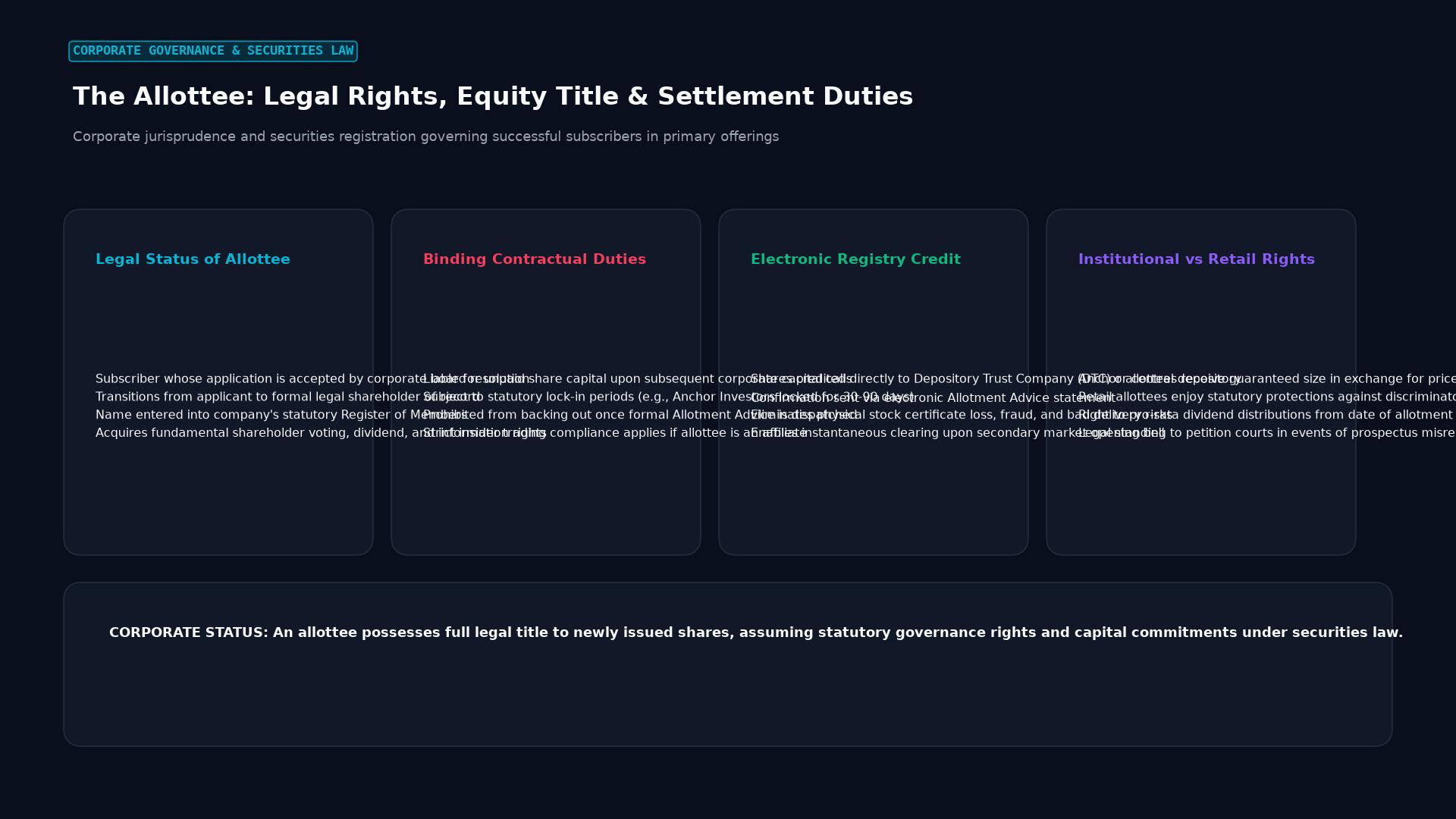 Figure: Corporate jurisprudence and securities registration governing successful subscribers in primary offerings
Legal Rights of an Allottee
Once capital is formally allotted, the allottee acquires statutory rights protected under corporate and securities legislation:
1. Right to Timely Securities Delivery
The allottee has the legal right to receive physical share certificates or, in modern electronic markets, direct electronic book-entry credit to their depository account (such as the Depository Trust Company in the US, Euroclear in Europe, or NSDL/CDSL in India) within statutory time limits (typically two to six business days post-allotment).
2. Right of Rescission and Civil Damages
If the public offering prospectus or registration statement contained material misrepresentations, fraudulent balance sheet figures, or misleading forward omissions, the allottee possesses the legal right of rescission under federal securities statutes (such as Section 11 of the US Securities Act of 1933). The allottee can return the allotted shares to the issuer and recover the full purchase price paid, plus statutory interest and legal fees.
3. Right of Renunciation in Rights Issues
When a public corporation issues a rights offering to existing equity holders, each shareholder is an allottee of subscription rights. The allottee has the right to either exercise the rights to buy new shares at a discount or renounce the allotment in favor of a third party by selling the rights on a secondary exchange.
Legal Liabilities and Obligations of an Allottee
The legal status of allottee carries enforceable financial obligations:
| Allottee Obligation | Underlying Legal Mechanism | Consequence of Breach |
|---|---|---|
| Payment of Call Monies | Fulfilling installment payments on partly paid shares | Monetary interest charges and debt collection |
| Indemnification for Bidding Fraud | Bidding under multiple fictitious identities | Forfeiture of shares and criminal fraud charges |
| Forfeiture Risk | Failure to satisfy secondary capital calls | Permanent cancellation of shares & loss of deposit |
In jurisdictions where shares are issued on a partly paid basis, an allottee pays an initial subscription amount (for example, 25% of the offering price upon application). The allottee is legally obligated to satisfy subsequent capital calls issued by the corporate board. If the allottee fails to pay remaining installments by the designated due date, the company retains the statutory authority to declare the shares forfeited, canceling the allottee’s ownership while retaining all previously paid subscription deposits.
Partly Paid Allotment and Call Mechanics:
┌────────────────────────┐         ┌────────────────────────┐
│ Application Payment:   │ Board   │ Final Call Notice:     │
│ $2.50 per share (25%)  │ Issues  │ $7.50 per share (75%)  │
│ Paid by Allottee       ├────────►│ Due within 30 days     │
└────────────────────────┘ Call    └───────────┬────────────┘
                                               │
                               ┌───────────────┴───────────────┐
                               ▼                               ▼
                     Call Satisfied in Full          Call Defaulted / Unpaid
                     ┌───────────────────────┐       ┌───────────────────────┐
                     │ Full Shareholder      │       │ Board Forfeits Shares │
                     │ Status; Fully Paid    │       │ Initial $2.50 lost;   │
                     │ Stock Certificate     │       │ ownership extinguished│
                     └───────────────────────┘       └───────────────────────┘
Retail vs. Institutional Allottee Dynamics
Capital markets regulations establish distinct classifications of allottees during public offerings:
- Qualified Institutional Buyers (QIBs): Institutional asset managers, mutual funds, and insurance syndicates. QIB allottees are assumed to possess sophisticated financial knowledge and are not afforded the same paternalistic retail disclosure protections.
- Non-Institutional Investors (NII) / High-Net-Worth Individuals: Wealthy private investors submitting large ticket subscriptions (often exceeding $25,000 to $100,000 equivalent).
- Retail Individual Investors (RII): Small retail participants who receive preferential allotment quotas and simplified electronic payment processing (such as ASBA - Application Supported by Blocked Amount).
Key Takeaways
- An allottee is an investor to whom new shares or bonds are legally assigned following an application in a public offering.
- The transmission of an allotment advice constitutes formal legal acceptance of the applicant’s offer, creating a binding contract.
- Allottees possess statutory rights to timely electronic share delivery and rescission rights in cases of prospectus fraud under Section 11.
- In partly paid share structures, allottees remain legally liable for future capital calls, facing share forfeiture if payments lapse.
Frequently Asked Questions
When does an allottee officially become a shareholder?
An allottee officially becomes a legal shareholder when their name is entered into the company’s formal Register of Members and the allotted shares are credited to their electronic depository securities account (such as a brokerage account held through DTC).
What happens if an allottee does not receive their allotted shares?
If an allottee fails to receive electronic delivery of shares by the scheduled listing date, the investor can file a formal complaint with the stock exchange and national securities regulator. Issuers face mandatory daily penalty interest payments payable to allottees if securities distribution is delayed beyond statutory deadlines.
Can an allottee sell shares immediately on listing day?
Yes. Unless the allottee is an insider, employee, or institutional anchor investor bound by a formal regulatory lock-up agreement (typically spanning 30 to 180 days), the allottee is free to sell the allotted shares on the secondary exchange the moment trading commences.
Ready to trade forex?
Open a free demo account with a regulated broker. Practice with virtual funds before risking real money.