Allowance for doubtful accounts
The allowance for doubtful accounts is a contra-asset account offsetting gross accounts receivable to present the estimated net cash value a company expects to collect from customers.
What Is the Allowance for Doubtful Accounts?
The allowance for doubtful accounts (often abbreviated as AFDA, and formally termed the allowance for credit losses) is a contra-asset account presented on the balance sheet that directly offsets gross accounts receivable. Its accounting purpose is to reduce total customer invoices to their Net Realizable Value (NRV): the precise dollar amount of cash management reasonably expects to collect.
Under standard commercial accrual accounting, companies deliver goods and services on trade credit terms (such as net 30 or net 60 days), booking gross revenue and accounts receivable simultaneously. However, because a certain percentage of credit customers inevitably default due to insolvency, bankruptcy, or contract disputes, reporting gross receivables without an allowance would artificially overstate enterprise assets and financial health.
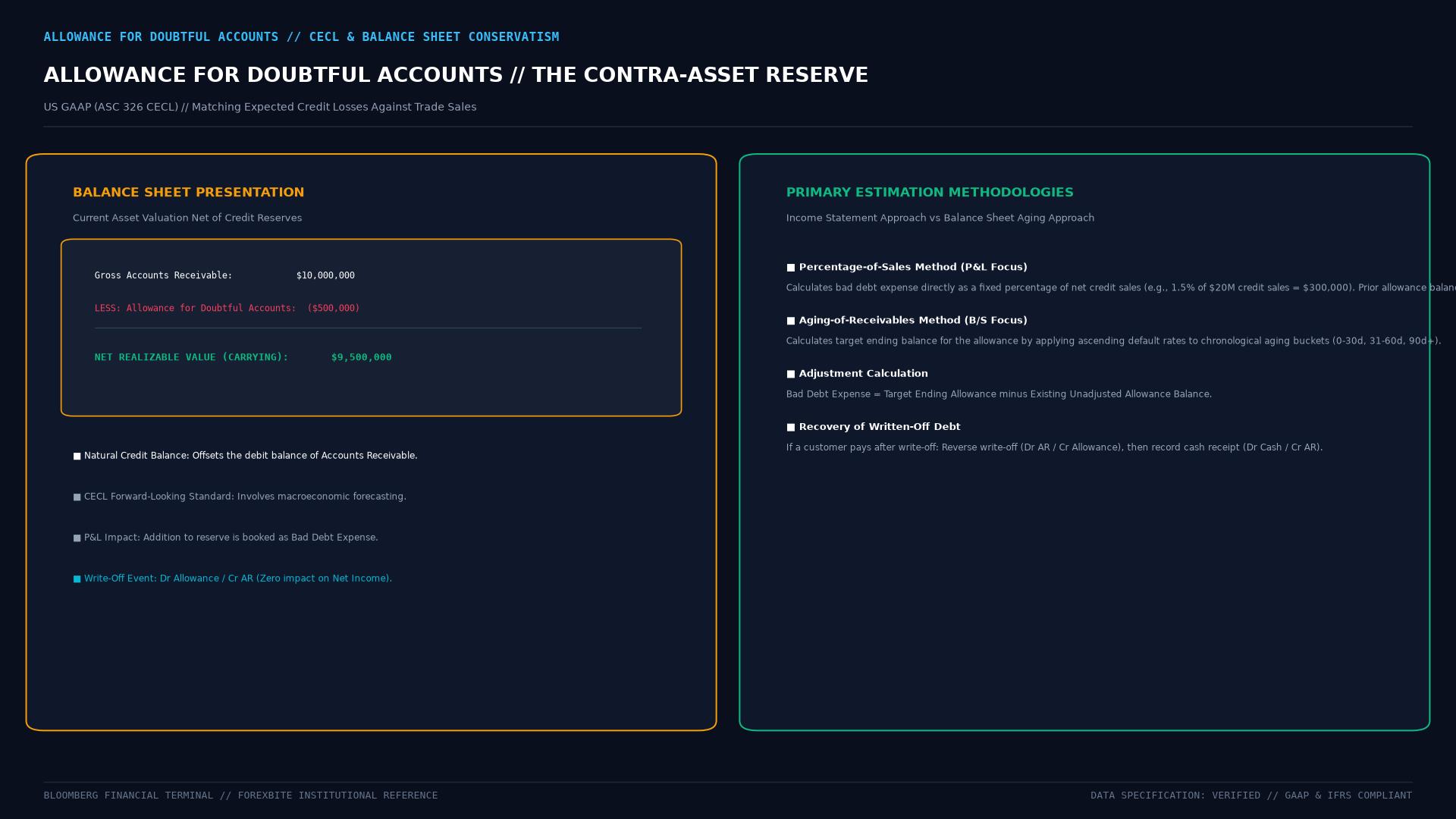 Figure: Accounting mechanisms for doubtful debt under the CECL (Current Expected Credit Loss) lifetime probability framework versus the legacy Incurred Loss model, illustrating reserve journal entries and recovery flows.
Accounting Standards: Incurred Loss vs. CECL Model
The accounting methodology governing bad debt allowances underwent a historic regulatory overhaul following the 2008 financial crisis:
1. The Legacy Incurred Loss Model (ASC 310)
Historically, US GAAP permitted companies and commercial banks to recognize bad debt reserves only when an observable “loss event” occurred (such as a customer missing consecutive payments or filing for bankruptcy). Critics labeled this approach “too little, too late,” because balance sheet reserves lagged behind deteriorating economic conditions during downturns.
2. The Modern CECL Framework (ASC 326)
Under FASB Accounting Standards Codification Topic 326 (ASC 326), public and private companies must utilize the Current Expected Credit Losses (CECL) standard. Rather than waiting for a customer to default, companies must estimate lifetime expected credit losses immediately upon booking a trade receivable or originating a loan. The CECL model mandates that management incorporate:
- Historical default and loss-rate experience
- Current macroeconomic and customer payment conditions
- Reasonable and supportable forward-looking economic forecasts
Estimation Methodologies: Balance Sheet vs. Income Statement
Corporate finance departments calculate the required allowance balance using two primary mathematical techniques:
| Estimation Method | Primary Focus | Analytical Technique | Preferred Under GAAP |
|---|---|---|---|
| Aging Schedule Method | Balance Sheet NRV | Multiplies overdue receivables buckets by loss rates | Mandated under CECL |
| Percentage of Sales Method | Income Statement Matching | Applies fixed bad debt percentage to gross credit sales | Interim reporting only |
The Aging Schedule Calculation
Under the aging method, open receivables are grouped into aging intervals. Higher default percentages are applied to older, overdue invoices:
- $6,000,000 Current (0–30 days) × 1.0% = $60,000
- $2,500,000 Past Due (31–60 days) × 4.0% = $100,000
- $1,000,000 Past Due (61–90 days) × 15.0% = $150,000
- $500,000 Past Due (90+ days) × 50.0% = $250,000
- Total Required Ending Allowance: $560,000
If the pre-adjustment allowance account holds an existing credit balance of $110,000, the accountant books an adjusting entry of $450,000 ($560,000 target minus $110,000 existing) to Bad Debt Expense on the income statement.
The Complete Accounting Cycle: Accrual, Write-Off, and Recovery
Managing the allowance account follows a structured three-step cycle across the life of customer receivables:
The Bad Debt Accounting Lifecycle:
┌────────────────────────────────────────────────────────┐
│ 1. RECOGNITION (Adjusting Journal Entry)               │
│ Debit: Bad Debt Expense (Income Statement)             │
│ Credit: Allowance for Doubtful Accounts (Contra-Asset) │
└──────────────────────────┬─────────────────────────────┘
                           │ Customer Confirms Complete Bankruptcy
                           ▼
┌────────────────────────────────────────────────────────┐
│ 2. DIRECT WRITE-OFF (Specific Account Extinguished)    │
│ Debit: Allowance for Doubtful Accounts                 │
│ Credit: Accounts Receivable (Specific Debtor Ledger)   │
│ *NET ASSETS AND NET INCOME REMAIN COMPLETELY UNCHANGED*│
└──────────────────────────┬─────────────────────────────┘
                           │ Customer Unexpectedly Sends Payment Later
                           ▼
┌────────────────────────────────────────────────────────┐
│ 3. RECOVERY OF PREVIOUSLY WRITTEN-OFF DEBT             │
│ Step A: Reverse original write-off to restore ledger   │
│ Step B: Record standard cash collection debit/credit   │
└────────────────────────────────────────────────────────┘
The Neutral Effect of a Write-Off
A critical accounting principle frequently misunderstood by investors is that writing off a specific bad account has zero impact on net income and zero impact on net working capital.
Because the financial loss was already expensed when the allowance was established, the write-off merely reduces gross receivables and the contra-asset allowance by the exact same dollar amount simultaneously, leaving net realizable receivables unchanged.
Forensic Accounting: The Cookie-Jar Reserve Risk
Forensic equity analysts examine trends in the allowance for doubtful accounts to detect earnings manipulation:
- Aggressive Earnings Inflation: A struggling executive team might deliberately cut its bad debt allowance percentage during a weak quarter (for example, lowering reserves from 5% to 2% of receivables). This reduces Bad Debt Expense on the income statement, manufacturing an artificial boost to reported operating earnings (EBITDA).
- Cookie-Jar Reserves: During exceptionally profitable years, management might over-fund the allowance account, hiding excess profit. In future lean quarters, management releases these excess reserves back into earnings, artificially smoothing corporate performance.
Key Takeaways
- The allowance for doubtful accounts is a balance sheet contra-asset account offsetting gross accounts receivable.
- It reduces trade receivables to their Net Realizable Value, ensuring corporate assets are not overstated.
- Under ASC 326 (CECL), companies must estimate lifetime expected credit losses using forward-looking economic data.
- Writing off a delinquent customer invoice reduces gross receivables and the allowance equally, having zero impact on net earnings.
Frequently Asked Questions
Does the allowance for doubtful accounts have a debit or credit balance?
Under normal operating conditions, the allowance for doubtful accounts maintains a credit balance. Because it functions as a contra-asset account, its credit balance directly reduces the normal debit balance of the gross accounts receivable account.
What causes the allowance account to have a temporary debit balance?
A temporary debit balance occurs if actual customer write-offs during an accounting period exceed the total balance previously estimated and credited to the allowance account. Management must immediately record an adjusting journal entry to Bad Debt Expense to replenish the reserve to its required credit balance.
How does the allowance for doubtful accounts differ from bad debt expense?
Bad Debt Expense is an operating expense on the income statement that recognizes the cost of uncollectible sales in the current period, reducing net income. The Allowance for Doubtful Accounts is a cumulative reserve on the balance sheet that offsets total gross receivables across accounting periods.
Ready to trade forex?
Open a free demo account with a regulated broker. Practice with virtual funds before risking real money.