Allowance of depreciation
An allowance of depreciation is the cumulative accounting reserve or statutory tax deduction used to allocate the capitalized cost of physical fixed assets across their productive economic lifespan.
What Is an Allowance of Depreciation?
In corporate accounting, capital budgeting, and taxation, an allowance of depreciation (conventionally designated on corporate balance sheets as accumulated depreciation) represents the cumulative allocation of a tangible fixed asset’s capitalized cost over its estimated productive service life.
The concept operates across two distinct corporate disciplines:
- Financial Book Accounting (US GAAP & IFRS): A non-cash expense and contra-asset account designed to satisfy the matching principle, ensuring the cost of long-term property, plant, and equipment (PP&E) is expensed across the exact fiscal periods that benefit from the asset’s productive operation.
- Tax Accounting (IRS MACRS & Tax Codes): A statutory annual tax deduction authorized by government tax authorities, permitting enterprises to deduct capital investments from taxable gross income, generating vital depreciation tax shields that preserve corporate cash flow.
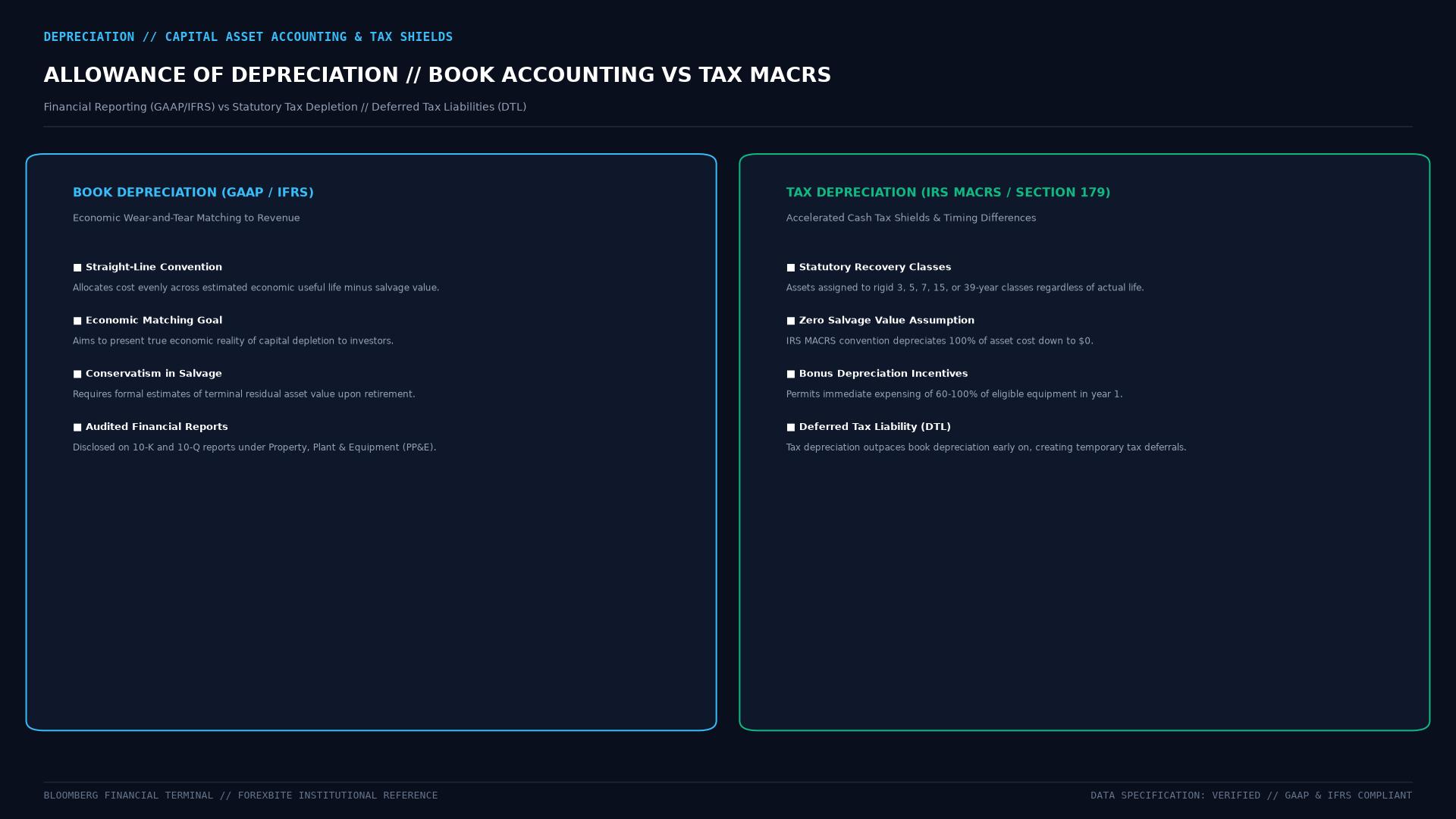 Figure: Fixed asset capitalization and accumulated depreciation reserve trajectory over useful asset life, showing straight-line vs accelerated MACRS write-downs and salvage value convergence.
Balance Sheet Presentation and Book Value Calculation
On the corporate balance sheet, the allowance of depreciation functions as a contra-asset account. It is paired directly with the corresponding gross fixed asset account, possessing a natural credit balance that reduces historical cost to Net Book Value (Carrying Value):
$$\text{Net Book Value} = \text{Historical Gross PP&E} - \text{Allowance of Depreciation}$$
If an industrial manufacturing plant cost $50,000,000 to construct and has accumulated $20,000,000 in depreciation allowances over eight operating years, its net carrying value on the balance sheet is reported as $30,000,000.
Tax Depreciation Allowances: MACRS and Section 179
In the United States, tax depreciation rules diverge sharply from financial accounting standards to stimulate commercial capital investment:
1. The Modified Accelerated Cost Recovery System (MACRS)
Established under the Tax Reform Act of 1986, MACRS assigns capital assets into statutory recovery classes independent of their actual physical lifespan:
- 3-Year Property: Specialized industrial tools and racehorses.
- 5-Year Property: Automobiles, light trucks, computer systems, and semiconductor manufacturing equipment.
- 7-Year Property: Office furniture, fixtures, agricultural machinery, and railroad track.
- 27.5-Year Property: Residential rental real estate.
- 39-Year Property: Non-residential commercial office buildings and industrial warehouses.
MACRS uses the 200% declining balance method switching to straight-line, allowing businesses to deduct the vast majority of equipment costs in the earliest years of asset deployment.
2. Section 179 and Bonus Depreciation
Under IRC Section 179, eligible businesses can elect to deduct the entire purchase price of qualifying equipment and software as an immediate current-year tax expense (up to statutory inflation-indexed limits exceeding $1,000,000).
In addition, the Tax Cuts and Jobs Act of 2017 instituted 100% Bonus Depreciation, allowing enterprises to immediately write off eligible capital investments in the first year of deployment, before initiating a scheduled phase-down.
Corporate Finance: The Depreciation Tax Shield
Because depreciation is a non-cash expense (no actual cash leaves the corporate treasury when depreciation is booked), its primary financial value in Discounted Cash Flow (DCF) valuation is the tax shield:
$$\text{Depreciation Tax Shield} = \text{Depreciation Allowance} \times \text{Marginal Corporate Tax Rate } (T_c)$$
Numerical Case Study:
Consider an enterprise with $10,000,000 in pre-tax operating income facing a combined 25% corporate income tax rate:
| Financial Metric | Without Depreciation Allowance | With $2,000,000 Depreciation Allowance |
|---|---|---|
| Operating Income (EBITDA) | $10,000,000 | $10,000,000 |
| Depreciation Allowance | $0 | ($2,000,000) |
| Taxable Income (EBT) | $10,000,000 | $8,000,000 |
| Cash Taxes Owed (25%) | $2,500,000 | $2,000,000 |
| Net Operating Cash Flow | $7,500,000 | $8,000,000 (+$500,000 Cash Saved) |
By claiming a $2,000,000 depreciation allowance, the enterprise reduces its cash tax obligation by $500,000 ($2,000,000 × 25%), directly expanding corporate free cash flow and boosting project Net Present Value (NPV).
Deferred Tax Liabilities (ASC 740)
Because companies utilize rapid, accelerated depreciation for tax returns (MACRS) while using slow, straight-line depreciation for shareholder financial statements (GAAP), a temporary timing difference emerges:
- In early asset years, tax depreciation exceeds book depreciation, resulting in lower current cash taxes than reported on the income statement.
- The company records the unpaid tax obligation as a Deferred Tax Liability (DTL) on its balance sheet under ASC 740.
- In later asset years, tax depreciation drops below book depreciation, reversing the timing difference and consuming the deferred tax liability.
Key Takeaways
- An allowance of depreciation is the cumulative allocation of a fixed asset’s capitalized cost across its useful life.
- In financial reporting, it functions as a contra-asset account offsetting gross PP&E to display Net Book Value.
- In taxation, IRS MACRS rules allow accelerated depreciation deductions that generate valuable cash tax shields.
- Timing differences between accelerated tax depreciation and straight-line book depreciation create Deferred Tax Liabilities (DTL).
Frequently Asked Questions
Can land be depreciated under financial or tax rules?
No. Under both US GAAP and international tax codes, land has an indefinite useful lifespan and does not suffer physical wear and tear or economic obsolescence. Therefore, land can never be depreciated, although commercial natural resource properties (such as timberland, oil wells, and mineral deposits) are subject to depletion allowances.
What happens to the allowance of depreciation when an asset is sold?
When an asset is sold or retired, the company removes both the asset’s historical cost and its entire accumulated depreciation allowance from the balance sheet. Any difference between the net sales proceeds and the asset’s Net Book Value is recognized as a realized gain or loss on disposal on the income statement.
Does depreciation affect a company’s cash balance?
Depreciation itself is a non-cash accounting entry that does not directly consume cash. However, it affects cash indirectly by reducing taxable income on tax filings, thereby lowering the amount of cash taxes paid to the government.
Ready to trade forex?
Open a free demo account with a regulated broker. Practice with virtual funds before risking real money.