Allowance
An allowance in finance represents a contra-valuation accounting reserve reducing asset balances to net realizable value, a revenue reduction granted for product defects, or a budgetary stipend.
What Is an Allowance in Finance and Accounting?
In financial accounting, commercial operations, and corporate treasury management, the term allowance operates across three distinct operational functions:
- Contra-Asset Valuation Reserves: A balance sheet reserve established to reduce the recorded gross carrying value of an asset to its estimated Net Realizable Value (NRV) (such as an allowance for doubtful accounts or an inventory obsolescence reserve).
- Sales Adjustments (Contra-Revenue): A price reduction, concession, or credit granted to a customer after product delivery to compensate for minor defects, damaged goods, or shipping errors without requiring the customer to physically return the merchandise.
- Budgetary and Payroll Allocations: A designated, periodic cash stipend disbursed to an employee or executive for specific business purposes, such as a per diem travel allowance or corporate vehicle stipend.
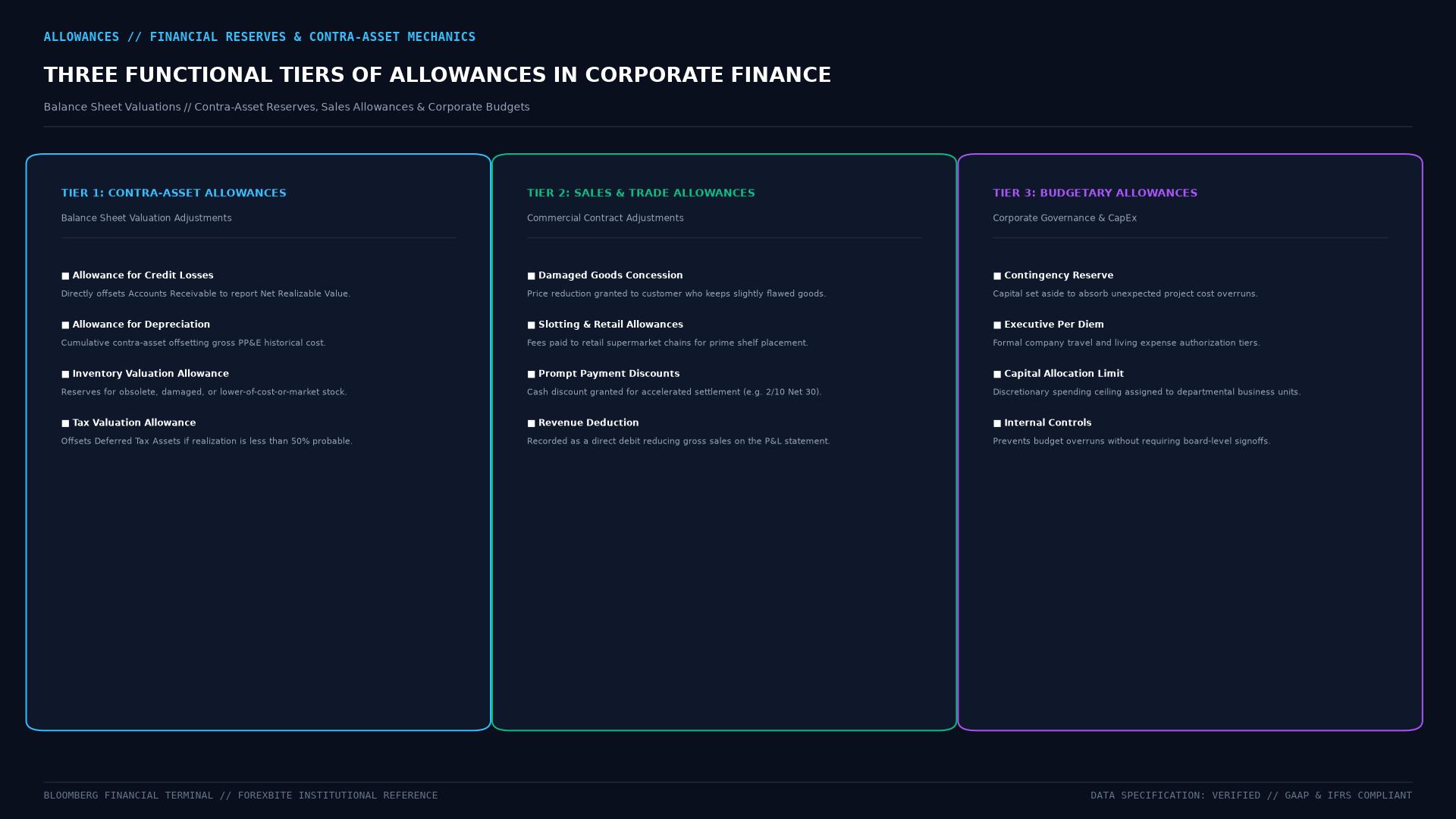 Figure: Structural hierarchy of financial allowances as contra-asset accounts, highlighting uncollectible accounts, inventory obsolescence, depreciation allowances, and their balance sheet presentation.
Balance Sheet Valuation Allowances
In financial reporting under US GAAP and IFRS, valuation allowances prevent corporations from overstating assets:
1. Sales Returns and Allowances (ASC 606)
Under ASC Topic 606 (Revenue from Contracts with Customers), companies that sell products with return rights or defect guarantees cannot record 100% of gross billings as recognized net revenue. Management must estimate probable post-delivery price concessions and establish a Sales Allowances reserve that directly reduces gross revenue to arrive at reported Net Sales.
2. Inventory Obsolescence Allowance (ASC 330)
Under ASC Topic 330, corporate inventory must be reported at the lower of cost and net realizable value. If finished goods or raw materials become technologically obsolete, expire, or suffer physical deterioration, the enterprise must create an inventory valuation allowance, writing down the asset on the balance sheet while debiting Cost of Goods Sold (COGS).
3. Valuation Allowance for Deferred Tax Assets (ASC 740)
When a corporation generates net operating losses (NOLs), it books a Deferred Tax Asset (DTA) representing future tax savings. However, under ASC 740, if management evaluates available evidence and determines that it is “more likely than not” (greater than a 50% probability) that the firm will not generate sufficient future taxable income to utilize the tax deductions, the company must establish an offsetting Valuation Allowance, reducing or completely erasing the DTA from the balance sheet.
ASC 740 Deferred Tax Asset Valuation Test:
┌────────────────────────────────────────────────────────┐
│ Gross Deferred Tax Asset (NOL Carryforwards: $5M)      │
└──────────────────────────┬─────────────────────────────┘
                           │
             ┌─────────────┴─────────────┐
             ▼                           ▼
 Future Profits Likely (>50%)     Future Profits Unlikely (>50%)
 ┌───────────────────────────┐   ┌───────────────────────────┐
 │ Zero Valuation Allowance  │   │ Valuation Allowance Setup │
 │ Full $5M DTA asset booked │   │ Contra-asset offsets DTA; │
 │ on corporate balance sheet│   │ erases balance sheet asset│
 └───────────────────────────┘   └───────────────────────────┘
Commercial Sales Allowances vs. Discounts vs. Rebates
Corporate sales agreements utilize distinct pricing adjustment mechanisms that must be accounted for separately:
| Commercial Incentive | Point of Application | Accounting Classification | Operational Trigger |
|---|---|---|---|
| Sales Allowance | After product delivery | Contra-revenue account | Defective, delayed, or sub-standard goods |
| Cash Trade Discount | At time of invoicing | Early settlement discount | Accelerated payment terms (e.g., 2/10 net 30) |
| Volume Rebate | Retrospective year-end | Variable consideration liability | Customer hits annual volume purchase targets |
In a sales allowance, the customer agrees to keep the defective goods rather than shipping them back to the manufacturer, saving both parties expensive reverse-logistics freight costs. The seller simply issues a credit memo reducing the open invoice balance.
Treasury and Payroll Expense Allowances
In human resources and treasury administration, an allowance represents designated cash funding:
- Per Diem Travel Allowances: Fixed daily cash stipends provided to corporate employees traveling on official business to cover meals, lodging, and incidental expenses. Under US General Services Administration (GSA) guidelines, per diem payments meeting federal statutory rates are non-taxable to the employee and do not require submitting individual meal receipts.
- Corporate Vehicle Allowances: Monthly stipends disbursed to sales representatives or executives who utilize personal vehicles for business travel, providing an alternative to managing a dedicated corporate fleet.
Key Takeaways
- An allowance functions as an asset valuation reserve, a revenue reduction for customer concessions, or an expense cash stipend.
- Sales allowances reduce gross sales to net sales under ASC 606 without requiring physical product returns.
- Deferred Tax Assets require a valuation allowance under ASC 740 if realization probability falls below 50%.
- Commercial sales allowances settle customer disputes over minor defects, avoiding expensive return freight logistics.
Frequently Asked Questions
How does a sales allowance differ from a sales return?
In a sales return, the customer physically ships the defective or unwanted merchandise back to the seller’s warehouse, and the seller restores the item to inventory. In a sales allowance, the customer retains the merchandise, and the seller issues a partial price credit to compensate for the defect.
Why do equity analysts monitor Deferred Tax Asset valuation allowances?
A sudden increase in a company’s DTA valuation allowance is a major warning signal. It indicates that the company’s own management and external auditors believe the enterprise will not generate sufficient future taxable profits to benefit from its tax loss carryforwards, signaling structural earnings distress.
Are employee expense allowances taxable as income?
Under IRS “accountable plan” rules, expense allowances (such as standard per diem travel reimbursements) are completely tax-free to the employee, provided the expenses have a direct business connection and the employee substantiates the date, location, and business purpose of the trip. Allowances paid under “non-accountable plans” are treated as taxable W-2 compensation.
Ready to trade forex?
Open a free demo account with a regulated broker. Practice with virtual funds before risking real money.