American Option
An American option is an options contract that allows the holder to exercise their right to buy or sell the underlying asset at any time prior to and including the expiration date, offering maximum execution flexibility.
An American option—frequently termed an American-style option—is a derivative contract that grants the buyer the legal right, but not the obligation, to execute the transaction at the predetermined strike price at any point throughout the contract’s entire lifespan. Unlike European options, which can be exercised only on their exact expiration date, American options provide total temporal flexibility.
This early exercise privilege makes American options structurally more valuable than European options with identical terms, as holders can lock in intrinsic profits immediately when an underlying asset experiences a favorable price spike or when macroeconomic interest rate conditions favor early cash settlement.
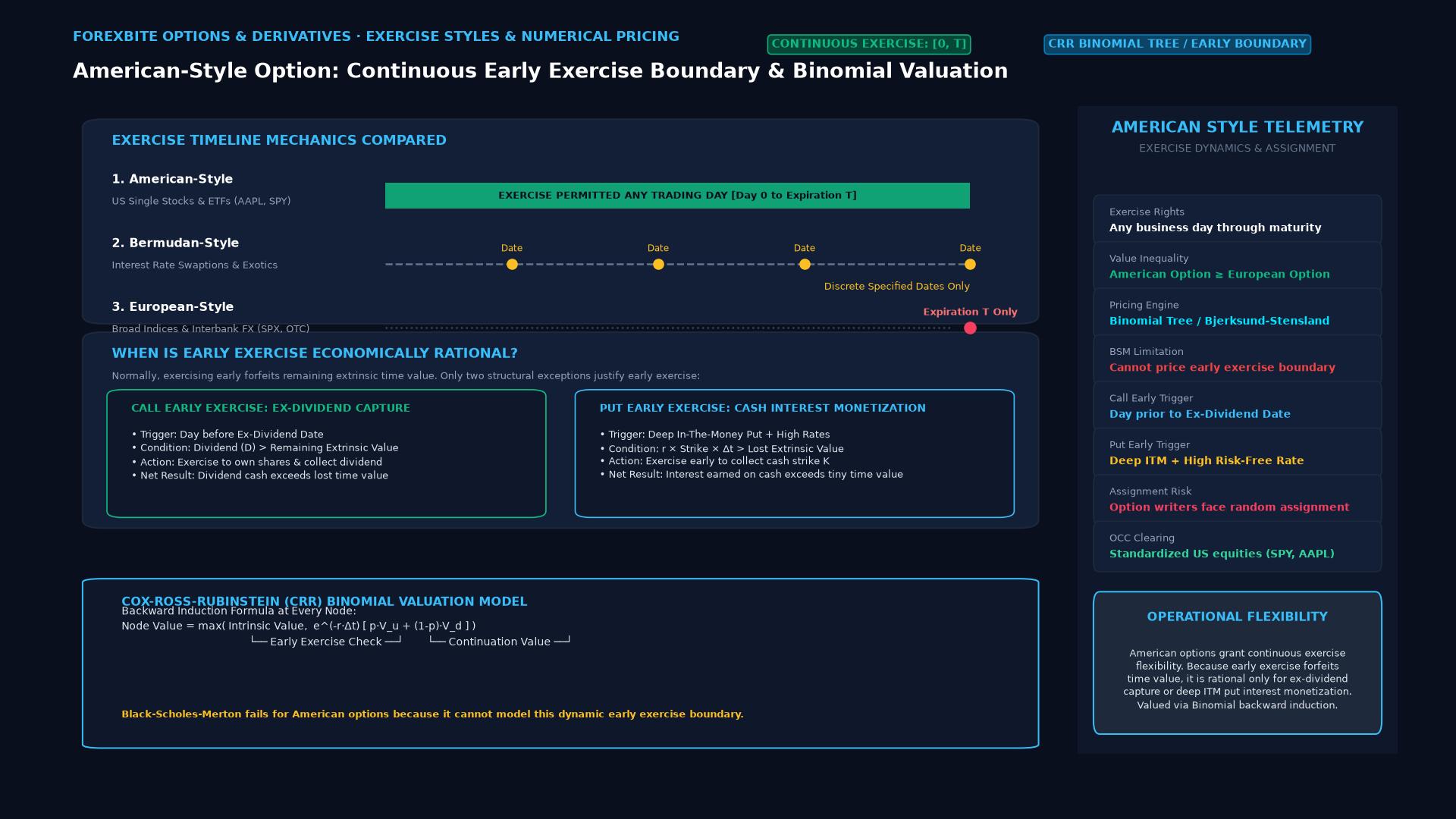
American vs. European vs. Bermudan Options
The geographical names of options styles do not reflect where the contracts are traded; they describe the rules governing when the contract can be exercised:
| Option Style | Exercise Window | Premium Valuation | Dominant Markets |
|---|---|---|---|
| American Option | At any time prior to or on the expiration date | Highest (contains early exercise premium) | Single-stock options (NYSE, Nasdaq), physical commodity options |
| European Option | Strictly on the exact expiration date | Lower (no early exercise option) | Broad-market index options (S&P 500, VIX), over-the-counter (OTC) foreign exchange options |
| Bermudan Option | At specified, pre-scheduled dates prior to expiration | Intermediate (between European and American) | Exotic interest rate swaps, specialized corporate currency hedges |
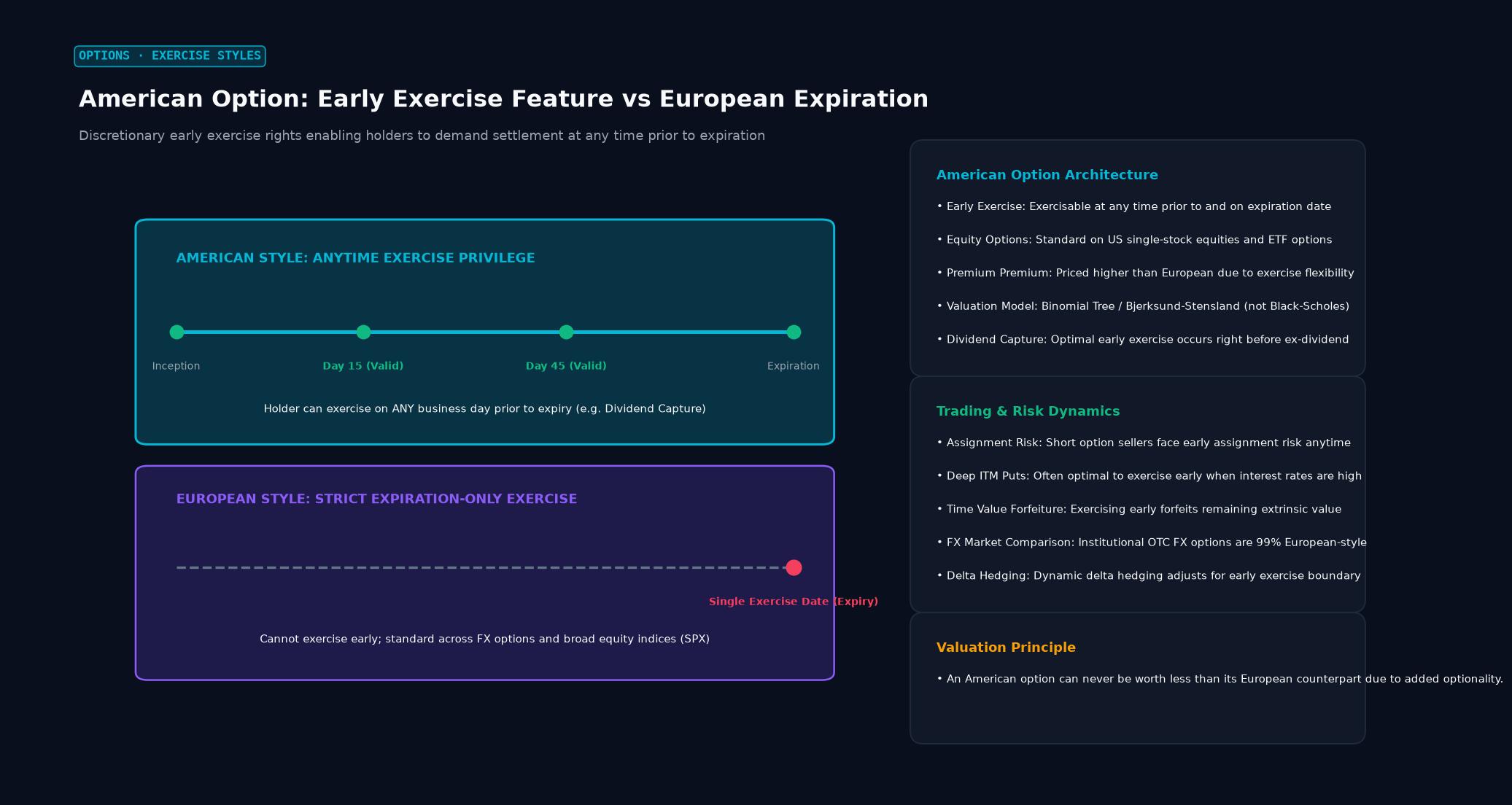 Figure: Discretionary early exercise rights enabling holders to demand settlement at any time prior to expiration
The Mechanics of Early Exercise: Intrinsic vs. Extrinsic Value
While an American option permits exercise at any time, professional options traders rarely exercise early. The reason lies in the distinction between an option’s two pricing components:
$$\text{Total Option Premium} = \text{Intrinsic Value} + \text{Extrinsic (Time) Value}$$
- Intrinsic Value: The immediate tangible profit if exercised right now (for a call option, $\text{Spot Price} - \text{Strike Price}$).
- Extrinsic Value (Time Value): The premium reflecting the time remaining until expiration and implied volatility.
When an investor exercises an option early, they receive only the intrinsic value, instantly forfeiting all remaining extrinsic time value. Under normal market conditions, a trader seeking to exit a profitable position achieves a higher financial return by simply selling the option back to the open market rather than exercising it early.
When is Early Exercise Mathematically Optimal?
Early exercise becomes rational only when the benefit of holding the physical underlying asset outweighs the lost time value:
- Deep In-the-Money Puts in High Interest Rate Regimes: When benchmark interest rates are elevated, exercising a deep in-the-money put option yields immediate cash. The interest earned by investing that cash in short-term Treasury bills often exceeds the negligible remaining time value of the put.
- Currency Options with Favorable Carry Differentials: In foreign exchange options, if an investor holds an in-the-money call option on a high-yielding currency against a low-yielding currency, exercising early allows them to hold the physical currency and collect daily positive rollover swap interest.
- Equities Prior to Ex-Dividend Dates: In equity options, exercising deep in-the-money call options the day before an ex-dividend date captures the cash dividend payout.
Pricing American Options: Why Black-Scholes Fails
The celebrated Black-Scholes-Merton (BSM) formula is an analytical closed-form equation that assumes the option can be exercised only at maturity. Consequently, Black-Scholes cannot accurately price American options because it cannot model the optimal timing of early exercise.
To price American-style contracts, quantitative traders utilize numerical lattice algorithms:
- The Binomial Options Pricing Model (Cox-Ross-Rubinstein): Breaks the option’s lifespan into hundreds of discrete time steps (nodes). At every individual node, the algorithm compares the value of exercising immediately against the discounted value of holding the option into the next time step, accurately determining the early exercise frontier.
- Finite Difference Methods: Solve the partial differential equations across continuous price and time grids, widely deployed on institutional trading desks.
Practical Example: Exercising a Currency Option
Consider an institutional corporate treasurer holding an American-style EUR/USD call option:
- Option Terms: Strike price of 1.0600, expiring in 60 days, purchased when EUR/USD traded at 1.0550.
- The Macro Move: A hawkish European Central Bank surprise propels spot EUR/USD to 1.1000 with 30 days still remaining until maturity.
- The Valuation:
- Intrinsic Value: $1.1000 - 1.0600 = \mathbf{400 \text{ pips}}$ ($4,000 per standard contract).
- Extrinsic Time Value: Still carries approximately 45 pips of time value due to high market volatility.
- The Strategic Decision:
- If the treasurer exercises early, they receive physical delivery of euros at 1.0600, locking in the 400 pips of intrinsic value but extinguishing the 45 pips of time value.
- If the treasurer does not need physical deliverable currency, they sell the option contract back to the market maker for 445 pips ($4,450), maximizing their financial return.
Key Takeaways
- Unrestricted Exercise: American options can be exercised at any time throughout their lifespan up to expiration.
- Valuation Premium: Because of their early exercise flexibility, American options trade at a premium over equivalent European options.
- Time Value Preservation: Exercising early destroys extrinsic time value; selling the contract back to the market is usually the superior financial choice.
- Rational Early Exercise: Early exercise makes mathematical sense primarily for deep in-the-money puts under high interest rates or to capture substantial currency carry differentials.
- Lattice Pricing: Pricing American options requires iterative numerical models (such as the Binomial lattice) rather than the standard Black-Scholes formula.
Frequently Asked Questions
Are foreign exchange options typically American or European style?
In the institutional interbank currency market, over-the-counter (OTC) forex options are almost universally European-style due to simplified settlement and standardized risk management. However, currency options traded on centralized exchanges (such as CME foreign exchange futures options) are frequently structured as American-style.
What happens if an American option expires in the money?
If an American option expires in the money and the holder takes no action, modern brokerage clearinghouses automatically exercise the contract at expiration under standard Options Clearing Corporation (OCC) protocol.
Why does an American call option rarely get exercised early on non-dividend assets?
Because holding the call option gives the investor upside participation while keeping their purchase capital invested in interest-bearing cash. Exercising early requires paying the strike price immediately and surrendering the option’s protective floor against a future market crash.
Ready to trade forex?
Open a free demo account with a regulated broker. Practice with virtual funds before risking real money.