European-Style Option
A European-style option is a derivative contract that restricts the holder to exercising their right to buy or sell the underlying asset strictly on the contract's designated expiration date, serving as the institutional standard for over-the-counter forex options.
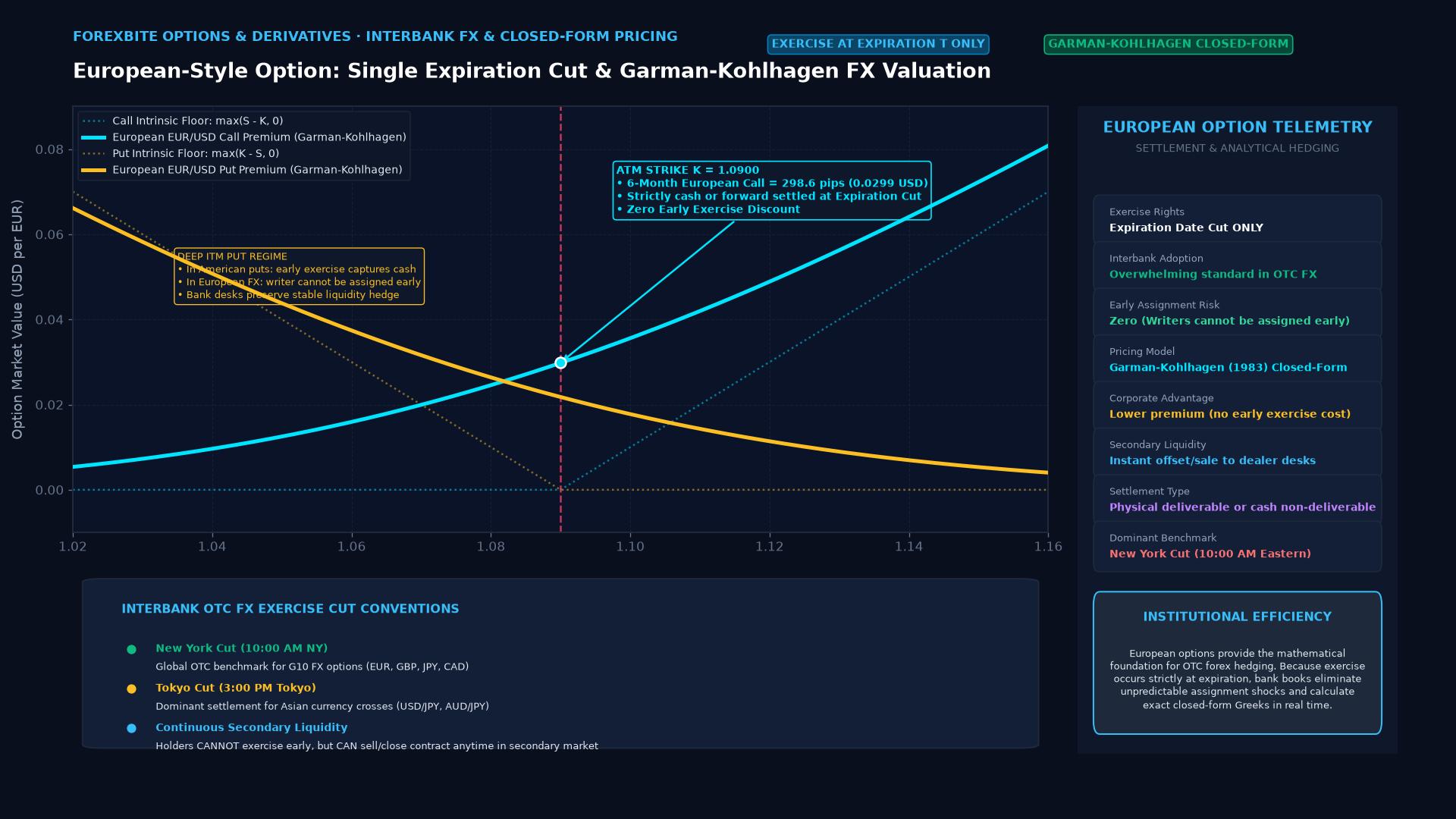
A European-style option—universally known in derivatives markets as a European option—is a financial contract that can be exercised by the holder solely and exclusively on its exact expiration date. Unlike an American option, which grants the holder the freedom to demand settlement at any point prior to maturity, a European option restricts execution to the final maturity cut (commonly 10:00 AM New York time or 3:00 PM Tokyo time).
Despite its geographical name, the “European” label describes contractual exercise timing rather than where the instrument trades. European options represent the overwhelming global standard for over-the-counter (OTC) foreign exchange options, sovereign interest rate options, and broad-market equity indices (such as the S&P 500 SPX and VIX).
A Common Misconception: Trading vs. Exercising
A frequent point of confusion among novice traders is assuming that holding a European option traps them until expiration:
- Exercise Restriction: You cannot forcibly exercise the option early to take delivery of the physical underlying currency before the agreed maturity date.
- Open Secondary Liquidity: You can close, liquidate, or sell the option back to the market maker or exchange at any moment prior to expiration. If you purchase a 3-month European EUR/USD call option and spot prices explode higher three days later, you can instantly sell the option back to the dealer to capture the surge in intrinsic and extrinsic value.
Why the Interbank Forex Market Uses European Options
In the multi-billion-dollar interbank currency options market, institutional dealing desks predominantly trade European-style contracts for three compelling structural reasons:
| Institutional Driver | Impact on Market Participants | Commercial Advantage |
|---|---|---|
| No Early Assignment Risk | Option sellers (writers) cannot be unexpectedly forced into delivering currency early | Eliminates overnight inventory disruption for bank dealing desks |
| Lower Premium Costs | Absence of the early exercise feature removes the “early exercise premium” | Cheaper corporate hedging for multinational import-export firms |
| Exact Mathematical Hedging | Prices conform precisely to closed-form analytical models without lattice approximations | Banks can dynamically hedge options books using standard Delta and Gamma formulas |
The Garman-Kohlhagen Pricing Model for Currency Options
Because foreign currencies carry continuous interest rates on both sides of the pair (unlike equities, which pay discrete quarterly dividends), European currency options are priced using the Garman-Kohlhagen model (an extension of the Black-Scholes equation developed in 1983):
$$C = S \cdot e^{-r_f T} \cdot N(d_1) - K \cdot e^{-r_d T} \cdot N(d_2)$$
$$P = K \cdot e^{-r_d T} \cdot N(-d_2) - S \cdot e^{-r_f T} \cdot N(-d_1)$$
Where:
- $S$ = Current spot exchange rate.
- $K$ = Option strike price.
- $r_d$ = Domestic risk-free interest rate (quote currency).
- $r_f$ = Foreign risk-free interest rate (base currency).
- $T$ = Time to expiration (in annualized years).
- $N(d)$ = Cumulative standard normal distribution function.
Because European options have a single fixed exercise date, the Garman-Kohlhagen formula computes exact, instant analytical valuations, allowing bank algorithms to calculate Greeks ($\Delta, \Gamma, \Theta, \text{Vega}$) across millions of positions in milliseconds.
Practical Example: A Corporate Currency Hedge
Consider a U.S.-based technology company anticipating €10,000,000 in European software sales to be repatriated in six months:
- The Currency Risk: Spot EUR/USD trades at 1.0900. If economic weakness drags EUR/USD down to 1.0200 over the next six months, the company’s converted revenue drops by $700,000 USD.
- The European Option Solution: The corporate treasurer purchases a 6-month European-style EUR/USD put option with a strike price of 1.0800 from an investment bank for a premium of 120 pips ($120,000 USD).
- Outcome A (Severe Euro Depreciation):
- At expiration, EUR/USD trades at 1.0300.
- The option is exercised on expiration day at 1.0800, allowing the company to sell its €10,000,000 for $10,800,000 USD, completely shielding the firm from the 500-pip market crash.
- Outcome B (Euro Rallies to 1.1500):
- The put option expires worthless.
- The firm converts its €10,000,000 at the favorable open market rate of 1.1500 ($11,500,000 USD), absorbing the $120,000 option premium simply as a necessary corporate insurance expense.
Key Takeaways
- Expiration-Only Exercise: European-style options can be exercised strictly on their designated maturity date.
- Active Secondary Trading: Holders can sell their contract back to the open market at any time before expiration to realize capital gains.
- Institutional Forex Benchmark: Over 90% of interbank and over-the-counter currency options are European-style.
- Cost Efficiency: European options trade at lower premiums than American options because sellers face no early assignment risk.
- Garman-Kohlhagen Pricing: Analytical closed-form mathematical models allow institutions to price and hedge European FX options with extreme precision.
Frequently Asked Questions
Can I close a European option before expiration?
Yes. Exercising an option (demanding delivery of the underlying currency) is completely different from closing the trade. You can sell your European option back to your broker or market maker at any point prior to expiration to lock in accumulated profits.
What is the difference between an American option and a European option?
An American option allows the holder to exercise at any time before or on expiration day. A European option allows exercise strictly on the expiration day itself. Because American options offer greater exercise flexibility, they command higher upfront premiums.
What happens if a European option is in the money at expiration?
Most institutional and retail options brokers automatically exercise or cash-settle any European option that expires in the money by at least 1 cent or 1 tick, crediting the net intrinsic profit directly to the trader’s account.
Ready to trade forex?
Open a free demo account with a regulated broker. Practice with virtual funds before risking real money.