At Best
An order instruction directing a broker, exchange, or dealer to execute a transaction immediately at the most favorable current price obtainable across the marketplace, prioritizing rapid execution certainty over price protection.
What is an At Best Order?
An at best order is an execution instruction given to a broker, dealing desk, or electronic trading venue to execute a buy or sell transaction immediately at the best price currently available in the market. In modern retail and institutional terminology, an at best instruction is functionally synonymous with an unconstrained market order.
When a trader issues an at best order, they surrender all control over the final execution price in exchange for immediate execution certainty. The order cannot be rejected due to price movement; the broker is contractually and algorithmically bound to match the order against resting counterparty orders in the limit order book until the full size of the order is filled, regardless of whether prices have slipped adversely.
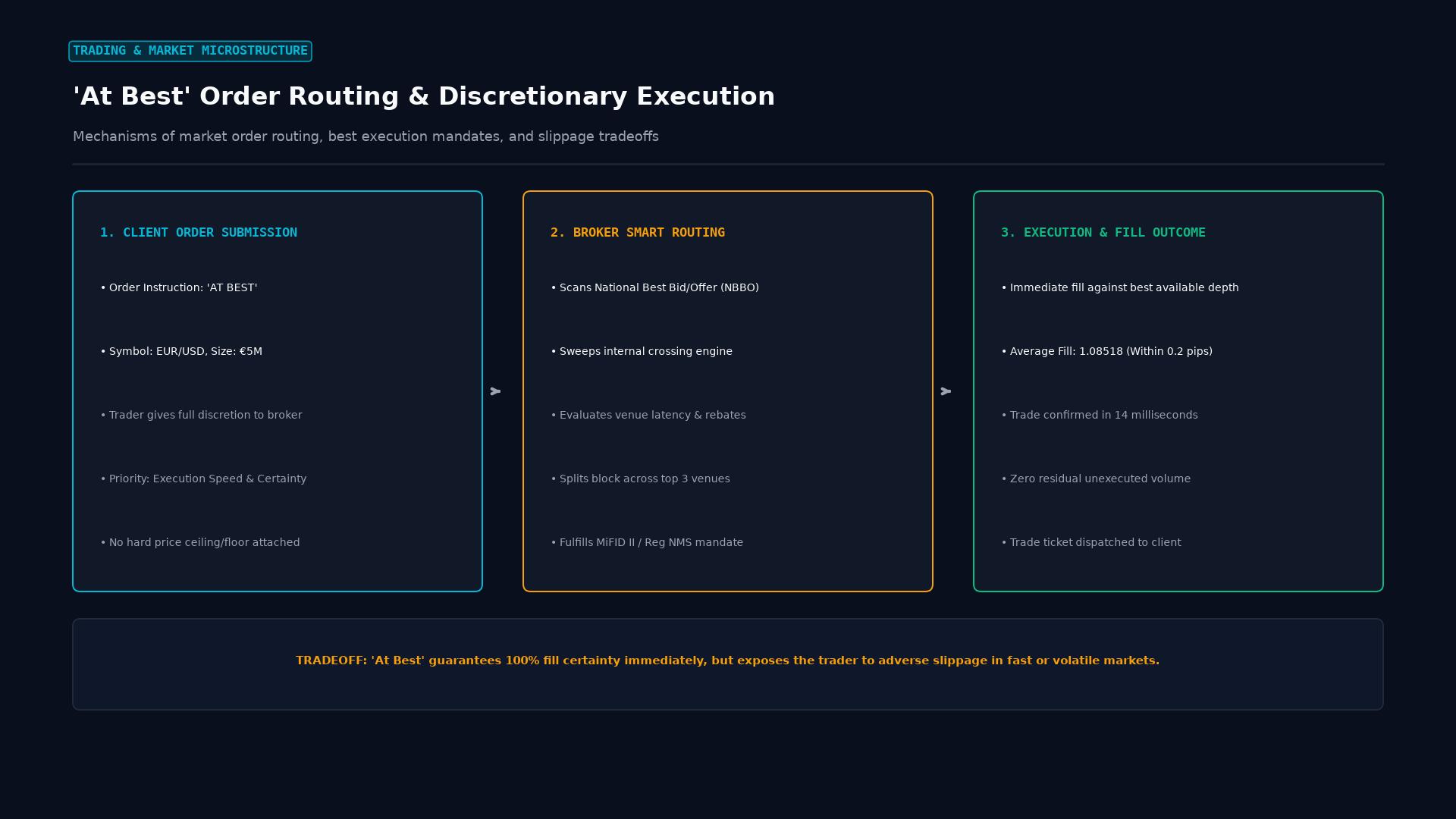 Figure: Order execution protocol: submitting ‘At Best’ instructions for guaranteed execution speed across smart order routers, balancing fill certainty against market slippage.
Historical Origins vs. Electronic Smart Order Routing
The phrase “at best” originated in traditional pit trading and voice brokerage. An institutional investor would call a desk and instruct the pit broker to buy 100 contracts “at best,” leaving it to the floor broker’s skill and discretion to secure the tightest spread among shouting market makers.
In modern high-frequency financial architecture, the human element has been replaced by Smart Order Routers (SORs):
- When an at best order enters an electronic communications network (ECN) or interbank platform (such as EBS or Currenex), the algorithm scans all connected liquidity pools.
- The order is routed instantaneously to the venues showing the tightest bid or ask prices.
- If the total order size exceeds the volume displayed at the National Best Bid and Offer (NBBO), the router consumes multiple liquidity tiers down the book until the fill is complete.
Step-by-Step Order Execution: The Impact of Book Depth
Consider a hedge fund executing an At Best Buy Order for 20 Standard Lots ($2,000,000 notional) of GBP/USD during the quiet Asian trading session. The interbank order book displays the following ask depth:
| Order Book Tier | Available Volume | Ask Price Quote | Notional Liquidity |
|---|---|---|---|
| Tier 1 (Top of Book) | 8 Standard Lots | 1.27500 | $800,000 |
| Tier 2 | 7 Standard Lots | 1.27510 | $700,000 |
| Tier 3 | 5 Standard Lots | 1.27525 | $500,000 |
| Tier 4 | 10 Standard Lots | 1.27540 | $1,000,000 |
Order Fill Sequence
- The matching engine consumes all 8 lots at Tier 1 (1.27500).
- It immediately walks up the book, consuming all 7 lots at Tier 2 (1.27510).
- It takes the remaining 5 lots at Tier 3 (1.27525), completing the 20-lot order.
Trade Financials and Blended Rate
$$\text{Average Execution Price} = \frac{(8 \times 1.27500) + (7 \times 1.27510) + (5 \times 1.27525)}{20} = \frac{10.20000 + 8.92570 + 6.37625}{20} = 1.2750975 \approx 1.27510$$
Although the quoted market price on the trader’s screen was 1.27500 when they hit “Buy,” their actual filled price was 1.27510—incurring a 1.0 pip slippage cost ($200) due to market depth exhaustion. Under an at best mandate, this slippage is fully legal and expected.
Comparative Matrix: At Best vs. Alternative Order Types
| Order Parameter | At Best (Market Order) | At or Better (Limit Order) | Stop Order | Fill-or-Kill (FOK) |
|---|---|---|---|---|
| Primary Objective | Immediate execution | Strict price protection | Directional breakout trigger | All-or-nothing execution |
| Execution Certainty | 100% Guaranteed | Low (Conditional on price) | High (Once triggered) | Low (Fails if partial) |
| Price Certainty | None (Prone to slippage) | 100% Guaranteed | None (Converts to market) | High (Specified limit) |
| Book Interaction | Aggressive (Crosses spread) | Passive (Rests on book) | Conditional trigger | Aggressive or cancel |
| Partial Fills | Allowed across multiple tiers | Allowed unless marked AON | Allowed once active | Forbidden (Cancelled immediately) |
| Best Used For | Exiting emergencies, fast momentum | Accumulating positions, scalping | Setting stops, breakout trades | Large institutional block trades |
Risks and Strategic Hazards of At Best Orders
-
Flash Crashes and Liquidity Voids: During black swan market dislocations—such as the Swiss Franc de-pegging in January 2015 or the British Pound flash crash in October 2016—market makers abruptly withdraw bids and offers. An at best sell order submitted during these events can fill hundreds or thousands of pips away from the last traded price.
-
Spread Blowout at Market Open: Submitting at best orders during daily market rollovers (5:00 PM EST) or Sunday market opens is dangerous. Spreads that are normally 0.8 pips on EUR/USD can expand to 15 or 25 pips, inflicting immediate losses upon trade entry.
-
Front-Running and High-Frequency Arbitrage: In equity and crypto markets, high-frequency algorithms monitor incoming at best orders and rapidly execute ahead of them, capturing fractional tick profits at the institutional buyer’s expense.
Best Execution Regulations (MiFID II and SEC Rules)
Under regulatory frameworks such as MiFID II in Europe and SEC Rule 605/606 in the United States, brokers handling client “at best” orders are subject to strict Best Execution mandates:
- Brokers must take all sufficient steps to obtain the best possible result for their clients, taking into account price, costs, speed, execution likelihood, and settlement terms.
- Brokerages cannot deliberately route client at best orders to internal dealing desks or affiliate market makers that provide substandard fill rates without full disclosure.
Key Takeaways
- An at best order directs a broker to execute a trade immediately at the most favorable prevailing market price.
- It guarantees execution speed and certainty, but provides zero price protection.
- Large at best orders consume multi-tiered order book depth, resulting in volume-weighted price slippage.
- At best orders should be avoided during illiquid periods, weekend opens, and high-impact macroeconomic data releases.
- Global financial regulations enforce Best Execution rules to ensure brokers do not exploit client at best orders through artificial markups.
Frequently Asked Questions
What is the difference between an “at best” order and a “market” order?
In modern retail trading platforms, there is no practical difference; both instruct the broker to buy or sell immediately at the current market price. “At best” is simply the traditional institutional and banking nomenclature for a market order.
Can an at best order be canceled once submitted?
Because electronic matching engines process at best orders in microseconds, it is virtually impossible to cancel an at best order once it has reached the broker’s server. It will execute almost instantaneously.
What is the difference between “at best” and “at or better”?
“At best” guarantees immediate execution at whatever price is available in the market. “At or better” (a limit order) guarantees that the trade will only execute at the specified price or an even more favorable price, risking non-execution if the market fails to reach that level.
When is an at best order the right choice?
An at best order is appropriate when getting out of or into a position immediately is more critical than a fraction of a pip of price improvement—such as cutting losses on an invalidated trade, closing risk ahead of a weekend, or catching a fast-moving trend breakout.
Ready to trade forex?
Open a free demo account with a regulated broker. Practice with virtual funds before risking real money.