At or Better
An execution instruction specifying that a trade must only be executed at the stated limit price or at a superior, more favorable price, strictly prohibiting negative slippage and ensuring the trader never receives an inferior fill.
What is an At or Better Order?
An at or better order (frequently abbreviated as AOB) is an execution directive stipulating that a broker or electronic exchange must execute an order strictly at the customer’s specified price or at an even more advantageous price. In modern financial terminology, an at or better instruction is the defining operating principle of all standard limit orders.
Unlike market orders (which prioritize speed and execution certainty over price), an at or better order prioritizes absolute price protection. The order sets an inviolable price boundary:
- A Buy Limit (At or Better) can execute only at the stated limit price or lower.
- A Sell Limit (At or Better) can execute only at the stated limit price or higher.
If the market never trades at or through the specified threshold, the order remains dormant on the book, protecting the trader from adverse fills and eliminating negative execution slippage.
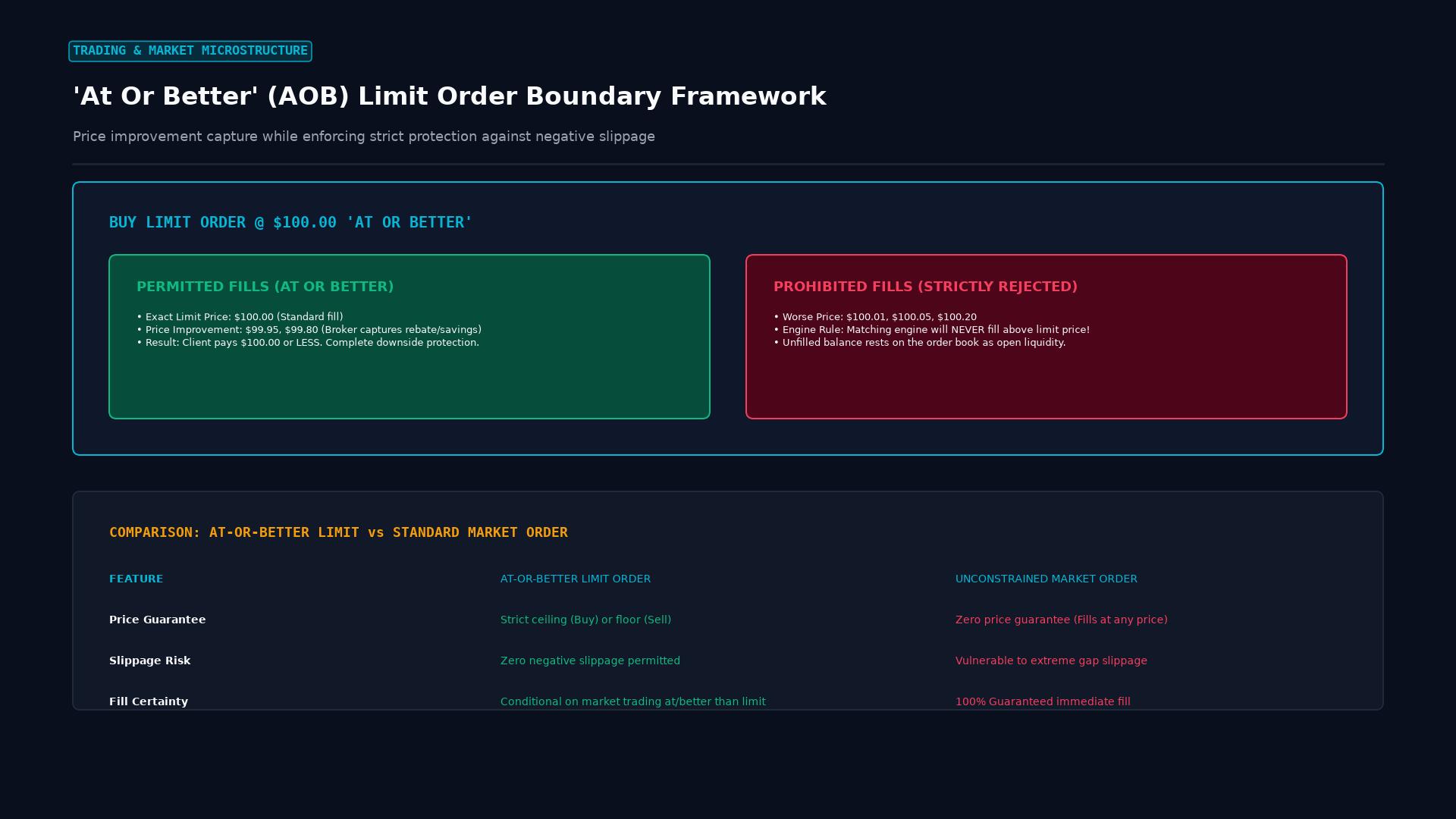 Figure: Limit order price boundaries: capturing price improvement below (buy) or above (sell) limit price while strictly prohibiting execution at inferior prices.
The Mechanics of At or Better in the Limit Order Book
When a trader places an at or better order below the current market price (to buy) or above the market price (to sell), the order is injected into the exchange matching engine as a passive limit order:
- Queue Priority (Price-Time Priority / FIFO): The order engine ranks resting orders first by price (buyers with the highest bids and sellers with the lowest offers receive priority) and second by timestamp (orders submitted earlier at that price level are filled first).
- Liquidity Maker Classification: Because an at or better order rests on the book awaiting execution, the trader acts as a liquidity maker, frequently qualifying for reduced exchange fees or maker rebates.
- Execution Condition: The order can only execute when an incoming aggressive market order (liquidity taker) arrives and matches against the resting volume.
Positive Slippage: Capturing Price Improvement
A key advantage of an at or better instruction is the ability to capture positive slippage (price improvement).
If a sudden burst of liquidity floods the market or an economic release causes the order book to reprice downward in a single millisecond tick, a resting Buy At or Better order can fill at a rate noticeably superior to the customer’s limit.
Step-by-Step Currency Example: EUR/USD Positive Slippage
A swing trader analyzes EUR/USD, currently trading at 1.08450. The trader wants to accumulate a long position if price retraces to a major support zone at 1.08200.
- Order Placed: Buy 5 Standard Lots ($500,000 notional) of EUR/USD At or Better at 1.08200.
- Market Event: A sudden Eurozone economic data disappointment causes EUR/USD to gap rapidly through the support line.
- Execution Fill: A large institutional seller sweeps the market with a massive aggressive sell order. Due to deep liquidity matching at lower tiers, the trader’s 5 lots are filled at an average price of 1.08180.
Financial Assessment
- Target Price: 1.08200
- Actual Fill Price: 1.08180
- Positive Slippage Gained: $+2.0\text{ pips}$ ($+0.00020 \times $500,000 = +$100\text{ bonus equity}$)
- The broker’s execution engine honored the “or better” clause, giving the customer the superior price. Had the price only reached 1.08201 before surging to 1.0900, the order would have remained completely unfilled.
Comparative Matrix: At or Better vs. Alternative Instructions
| Execution Attribute | At or Better (AOB / Limit) | At Best (Market Order) | Stop Order | Stop-Limit Order |
|---|---|---|---|---|
| Price Guarantee | Absolute (Specified or better) | None (Takes market price) | None (Becomes market order) | Absolute (Once triggered) |
| Execution Guarantee | None (May never fill) | Guaranteed (Fills immediately) | High (Once triggered) | None (Can be bypassed) |
| Slippage Direction | Positive only (Price improvement) | Negative or positive | Typically negative | Positive only (if filled) |
| Book Interaction | Passive (Provides liquidity) | Aggressive (Consumes liquidity) | Passive trigger $\to$ Aggressive | Passive trigger $\to$ Passive |
| Execution Speed | Latent / Conditional | Immediate (Microseconds) | Latent until trigger touched | Latent until trigger touched |
| Strategic Function | Value entry, profit taking | Urgent exit, momentum entry | Risk mitigation, stop-loss | Price-sensitive breakouts |
Strategic Trade-Off: Price Certainty vs. Non-Execution Risk
While at or better orders eliminate negative slippage, they introduce execution risk (the risk of missing the trade):
- The “Missed by a Pip” Phenomenon: Because at or better orders obey strict price boundaries, an asset may reverse within 0.1 pips of your limit price and embark on a multi-hundred pip rally without filling your position.
- Queue Exhaustion on Partial Fills: If your order is at the back of a large institutional liquidity queue at 1.08200, only a portion of your lot size may execute before incoming bids push price back upward. Unless marked with an execution constraint like All-or-None (AON), you may be left holding a tiny, sub-optimal fractional position.
- Adverse Selection (The Winner’s Curse): In quantitative market microstructure, limit orders suffer from adverse selection. An at or better buy order is most likely to be filled when a catastrophic fundamental event or massive institutional selling wave overwhelms the bid—meaning you are often filled precisely when the asset is about to collapse much further.
Key Takeaways
- An at or better order guarantees that a trade will execute only at the designated price or a more favorable rate.
- It is the core operating mechanic behind buy limit and sell limit orders.
- AOB orders provide 100% price certainty while sacrificing execution certainty.
- Traders can benefit from positive slippage (price improvement), while negative slippage is strictly prevented.
- Resting at or better orders provide passive market liquidity, making them eligible for maker fee rebates.
- The primary strategic risk of an at or better order is non-execution when the market reverses just ahead of the limit price.
Frequently Asked Questions
Can an at or better order experience negative slippage?
No. By definition and regulatory design, an at or better instruction prohibits negative slippage. The broker’s matching engine cannot fill a buy order above your limit price or a sell order below your limit price.
What is the difference between “At or Better” and “At Best”?
“At or Better” is a limit instruction that caps your price and prevents bad fills, but does not guarantee that the trade will execute. “At Best” is a market instruction that guarantees immediate execution, but accepts whatever price is currently available in the order book.
What happens if an at or better order is only partially filled?
Unless you attach an instruction such as Fill-or-Kill (FOK) or All-or-None (AON), the broker will fill as many lots as liquidity allows at your limit price or better. The remainder will remain resting in the order book until filled or canceled.
Why do institutional traders prefer at or better orders?
Institutional trading desks manage massive capital blocks. Submitting large orders “at best” would sweep the entire order book and cause immense negative slippage. Using algorithmic at or better orders allows them to patiently accumulate inventory at target prices without distorting market quotes.
Ready to trade forex?
Open a free demo account with a regulated broker. Practice with virtual funds before risking real money.