At the Price Stop-Loss Order
A conditional risk management order that automatically triggers the liquidation of an open trade once a specified price threshold is touched. Upon activation, it converts into a market order executed immediately at the best available prevailing price, guaranteeing execution certainty while accepting the risk of price slippage.
What is an At the Price Stop-Loss Order?
An at the price stop-loss order (commonly referred to simply as a standard stop-loss order) is a foundational risk management tool used by traders to cap downside exposure on open market positions. The order remains dormant on the broker’s matching engine until the market trades at or through a pre-selected price level known as the trigger price or stop level.
Once this boundary is breached, the order is instantaneously converted into an unpriced market order. The primary institutional design of an at the price stop-loss order is execution certainty over price certainty: the broker is mandated to close the position immediately at the best executable quote currently on the order book, regardless of whether liquidity has gapped or spreads have widened.
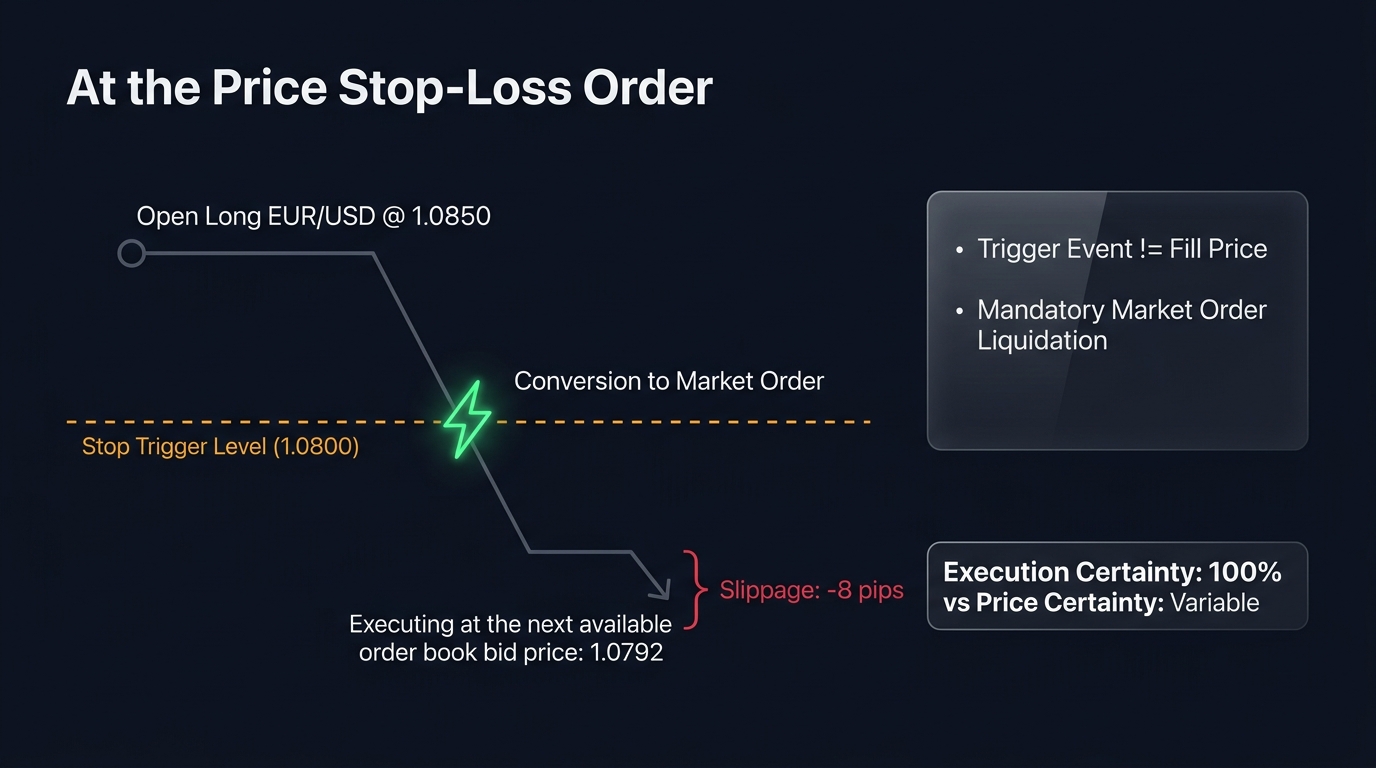
       At the Price Stop-Loss Order Execution Flow
   [Open Position: Long EUR/USD at 1.0850]
                       |
                       v
   [Stop-Loss Placed at 1.0800 Trigger Level]
                       |
                       v
         Market Drops to 1.0800 or Gaps Below
                       |
                       v
   [Order Triggers & Converts to MARKET ORDER]
                       |
                       v
   Fills at Next Available Liquidity (e.g., 1.0792)
     -> Guaranteed Exit | Variable Fill (Slippage: -8 pips)
Trigger Price vs. Execution Price: The Mechanics of Slippage
Novice traders often assume that setting an at the price stop-loss order at 1.0800 guarantees an exit price of exactly 1.0800. In live financial markets, this assumption is incorrect due to the structural separation between the trigger event and the execution fill:
- Trigger Condition: The stop level (e.g., 1.0800) merely serves as an internal trigger switch. It instructs the server: “When the bid price reaches 1.0800, execute a market sell.”
- Execution Reality: A market sell matches against the best available bids in the order book. Under calm, liquid conditions, sufficient depth exists at 1.0800, resulting in a fill at or within a fraction of a pip of the target.
- Liquidity Gaps and Slippage: During high-impact economic news releases, weekend market openings, or sudden liquidity evaporation, the order book may contain zero resting bids at 1.0800. If the next available buyer is bidding at 1.0780, the order fills at 1.0780. The 20-pip difference represents negative slippage.
Order Comparison: At the Price Stop vs. Alternative Safeguards
Traders must weigh whether their trading model prioritizes certainty of execution (getting out of the market no matter what) or certainty of price (never selling below a specific valuation).
| Order Attribute | At the Price Stop-Loss | Stop-Limit Order | Guaranteed Stop-Loss (GSLO) | Trailing Stop-Loss |
|---|---|---|---|---|
| Execution Certainty | 100% (Guaranteed fill) | Low (Fails if market gaps past limit) | 100% (Guaranteed fill) | 100% (Upon trigger) |
| Price Certainty | Variable (Prone to slippage) | High (Fills at limit or better) | 100% (Exact fill guaranteed) | Variable (Prone to slippage) |
| Execution Type | Converts to Market Order | Converts to Limit Order | Proprietary Dealer Guarantee | Dynamic Market Order |
| Direct Cost | Free (Standard commission/spread) | Free | Upfront Premium or Wider Spread | Free |
| Worst-Case Risk | Large slippage in flash crashes | Catastrophic unhedged drawdown | Zero slippage beyond strike | Large slippage during gaps |
| Optimal Use Case | Day trading, standard swing trades | Illiquid equities, range bounces | Overnight holds over major elections/NFP | Riding strong directional trends |
Practical Trading Example: Major News Slippage on USD/JPY
To observe how market microstructure dictates stop execution, evaluate a foreign exchange trader holding a leveraged position on USD/JPY ahead of a U.S. Consumer Price Index (CPI) release:
The Trade Setup
- Position: Long 5 standard lots ($500,000 notional) of USD/JPY at 155.50.
- Stop-Loss Placed: At the price stop-loss order at 154.80 (Risk tolerance = 70 pips / $3,500).
- Pip Value: ~$50 per pip across 5 lots.
Market Event and Execution
- The CPI print comes in dramatically lower than consensus, triggering an instantaneous collapse in U.S. Treasury yields and an aggressive sell-off across dollar pairs.
- Spot USD/JPY plunges from 155.10 to 154.75 in less than 200 milliseconds. No resting bids exist between 154.85 and 154.50 as institutional algorithmic market makers pull quotes to recalibrate.
- The trader’s stop-loss is triggered the moment price crosses 154.80.
- Converted to a market order, the order consumes the highest available tier of the fragmented liquidity book, filling at an average weighted price of 154.45.
Financial Assessment
- Intended Exit: 154.80 (Loss of 70 pips = -$3,500).
- Actual Realized Fill: 154.45 (Loss of 105 pips = -$5,250).
- Slippage Cost: 35 pips ($1,750 additional loss).
While the trader experienced negative slippage, the at the price stop order successfully terminated the exposure. Had the trader utilized a stop-limit order with a limit at 154.80, the order would have remained unfilled, stranding the trader as USD/JPY continued tumbling to 153.20 (a catastrophic -$11,500 loss).
Strategic Best Practices for Setting Stop-Loss Orders
1. Volatility-Adjusted Stop Placement
Avoid placing arbitrary round-number stops (e.g., exactly 20 or 50 pips). Institutional algorithms actively hunt liquidity around obvious psychological price barriers. Anchor stops outside market structure using the Average True Range (ATR): $$\text{Stop Distance} = \text{Support Level} - (1.5 \times \text{ATR}_{14})$$
2. Beware of the Weekend Rollover Gap
Forex markets close Friday afternoon (5:00 PM EST) and reopen Sunday afternoon. Weekend geopolitical surprises or unexpected central bank statements frequently create gaps of 50 to 150 pips. Standard at the price stops will fill at the Sunday opening tick, incurring substantial slippage. Either close exposure before Friday’s close or purchase a guaranteed stop contract.
3. Bid vs. Ask Execution Rules
Ensure you understand which side of the spread triggers your order:
- Long Positions: Liquidated by selling at the Bid price. Set your stop trigger relative to the broker’s Bid feed.
- Short Positions: Liquidated by buying at the Ask price. Remember that sudden spread widening at 5:00 PM EST (daily rollover) can cause the Ask to surge 10–20 pips, prematurely triggering short stops even if the mid-price never moved.
Key Takeaways
- An at the price stop-loss order converts into a market order the instant its pre-set trigger price is touched.
- Its defining benefit is guaranteed execution; its chief drawback is lack of price protection during volatile conditions.
- Slippage is an intrinsic market microstructure reality caused by liquidity vacuums, fast markets, and order book exhaustion.
- Unlike stop-limit orders, standard stops protect traders from being trapped in runaway adverse trends.
- Calculating position size based on worst-case slippage scenarios preserves capital across unexpected macroeconomic shocks.
Frequently Asked Questions
Can an at the price stop-loss order experience positive slippage?
Yes. Although less common during panic sell-offs, if liquidity suddenly floods the market or an order book improves while your stop order is being routed, you can be filled at a price superior to your trigger price, resulting in positive slippage.
Why did my stop-loss trigger when the chart never showed the price touching my level?
This routinely happens on short positions during high-spread periods, such as daily market rollover (5:00 PM EST). Trading charts typically display the Bid price by default. However, short positions are closed at the Ask price. If the spread suddenly widens from 1 pip to 15 pips, the Ask price may touch your stop while the Bid chart shows no touch.
What is the primary drawback of using a stop-limit order instead of an at the price stop?
The primary drawback of a stop-limit order is execution failure. If the market gaps or moves aggressively through your specified limit price, the order remains resting on the book unfilled. You remain trapped in an unhedged, collapsing trade that can lead to a margin call.
Does an at the price stop-loss order protect against weekend gaps?
No. An at the price stop-loss will execute at the first available market price when trading resumes on Sunday afternoon. If the market opens 100 pips below your stop level, your order will fill 100 pips worse than your trigger price.
Ready to trade forex?
Open a free demo account with a regulated broker. Practice with virtual funds before risking real money.