Auction
A competitive bidding mechanism used in financial markets to allocate securities, commodities, or foreign exchange reserves to buyers based on submitted price, yield, or quantity bids. In institutional finance, auctions are central to sovereign debt issuance and central bank liquidity management.
What is a Financial Auction?
In capital and currency markets, an auction is an organized, rules-based competitive process designed to discover prices and allocate assets to participants submitting bids. Rather than negotiating bilaterally in an over-the-counter (OTC) market, buyers and sellers submit sealed or open bids specifying the quantity and price (or yield) they are willing to accept.
Auctions serve as the ultimate bedrock of global macroeconomic liquidity. Sovereign governments rely on auctions to fund national budgets through the issuance of Treasury bills, notes, and bonds. Concurrently, central banks conduct foreign exchange and open-market repo auctions to regulate banking reserves, stabilize national currencies, and manage short-term interest rates.
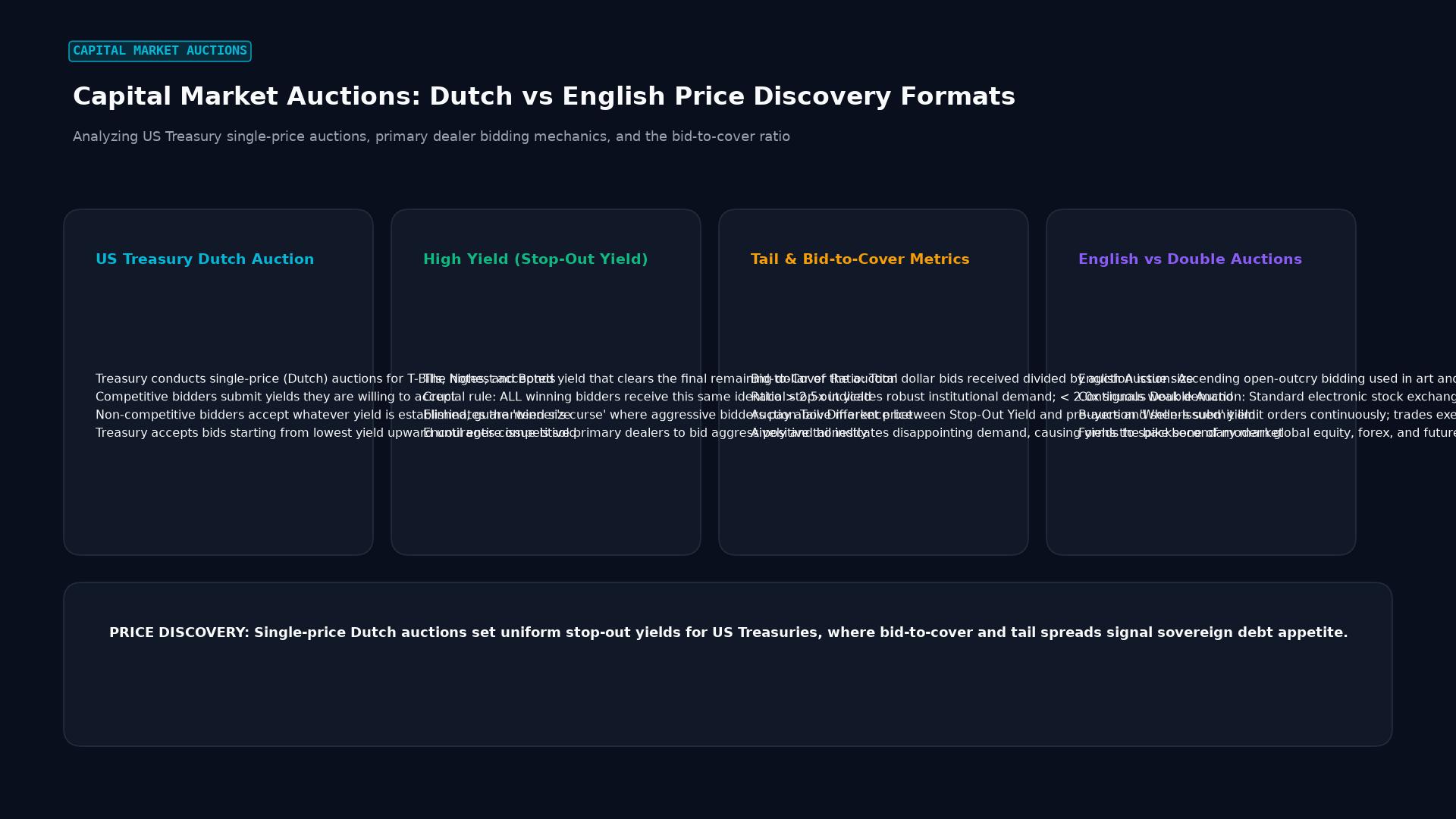 Figure: Analyzing US Treasury single-price auctions, primary dealer bidding mechanics, and the bid-to-cover ratio
Major Auction Formats in Global Finance
Financial institutions categorize auction models based on how clearing prices are established:
1. Dutch Auction (Single-Price Auction)
In a single-price or Dutch auction—the format utilized by the U.S. Department of the Treasury for sovereign debt—all successful bidders receive the identical clearing price (or highest accepted yield). Bids are ranked from lowest yield (highest price) to highest yield until the total issuance volume is fully absorbed. The highest yield accepted to clear the offering is designated as the stop-out yield, and every winning bidder pays that exact clearing yield, regardless of how aggressively they bid.
2. Discriminatory Auction (Multiple-Price / English Auction)
Commonly used in sovereign bond issuance in parts of Europe and Asia, bidders pay the exact price (or receive the exact yield) they individually submitted. While the government captures maximum revenue from aggressive buyers, bidders face the risk of paying substantially more than the clearing market price.
3. Periodic Call Auction
Utilized on major stock and futures exchanges (such as the NYSE, Nasdaq, and LSE) during daily Opening and Closing Crosses. Orders accumulate over a set pre-market window without continuous matching. An algorithm computes the single price that maximizes transacted volume, executing all crossed orders simultaneously to establish the official market open or close.
4. Continuous Double Auction
The operational engine of standard electronic order books (ECNs, interbank FX matching platforms). Bids and offers arrive continuously in real-time, executing immediately whenever a bid matches or exceeds an offer.
Anatomy of a U.S. Treasury Auction
Every week, the U.S. Treasury auctions tens of billions of dollars in sovereign debt. Global financial markets monitor these events closely, parsing institutional demand indicators:
- Non-Competitive Bidding: Retail investors and small institutions submit bids agreeing to accept whatever clearing yield is determined by the auction. These bids are guaranteed full allotment (up to $10 million) and are subtracted from the total auction offering before competitive bidding begins.
- Competitive Bidding: Primary dealer banks, foreign central banks, and hedge funds submit specific yields to three decimal places (e.g., 4.485%) and the dollar amounts they seek.
- The Stop-Out Yield (High Yield): The highest yield accepted by the Treasury to exhaust the remaining supply.
- The Auction “Tail”: The difference between the actual auction stop-out yield and the yield traded in the “When-Issued” (WI) forward market immediately prior to the auction deadline:
- Tailed Auction (Stop-out yield $>$ WI yield): Indicates weak, disappointing demand; dealers demanded a higher yield to absorb the debt.
- Stop-Through (Stop-out yield $<$ WI yield): Indicates aggressive, voracious institutional demand; buyers accepted a lower yield than expected.
- Bid-to-Cover Ratio: $$\text{Bid-to-Cover} = \frac{\text{Total Dollar Volume of Bids Received}}{\text{Total Dollar Volume Offered}}$$ A ratio above historical averages (e.g., 2.60x vs. 2.30x average) signals strong market liquidity and solid sovereign credit absorption.
Central Bank Foreign Exchange Auctions
In emerging market economies and countries managing pegged or managed-float currencies, central banks utilize FX auctions as a primary policy intervention tool:
- FX Sales Auctions: When the domestic currency faces speculative devaluation pressure, the central bank auctions U.S. Dollars from its sovereign foreign exchange reserves to local commercial banks, soaking up domestic currency liquidity.
- FX Purchase Auctions: When resource exports or foreign direct investment flood the market with dollars, the central bank buys foreign currency via auction to build reserves and prevent excessive currency appreciation that would harm domestic exporters.
- Multiple Currency Windows: Some frontier monetary authorities conduct stratified auctions, rationing scarce foreign exchange at preferential rates to essential food and medicine importers while auctioning remaining currency at market-clearing rates to commercial entities.
Comparative Matrix: Financial Auction Frameworks
| Auction Characteristic | Dutch (Single-Price) Auction | Discriminatory (Multiple-Price) | Call Auction (Cross) | Continuous Double Auction |
|---|---|---|---|---|
| Clearing Price | Single clearing price for all winners | Each winner pays their bid price | Single volume-maximizing price | Dynamic bid-ask matching |
| Dominant Usage | U.S. Treasuries, IPO share allocations | European sovereign debt, repo ops | Stock exchange open/close crosses | Real-time forex ECNs, futures |
| “Winner’s Curse” Risk | Eliminated (All pay identical stop-out) | High (Aggressive bidders overpay) | Muted | Low (Real-time book depth visibility) |
| Bidding Transparency | Sealed competitive book | Sealed competitive book | Visible indicative order book | Fully lit transparent order book |
| Execution Timing | Discrete, scheduled event | Discrete, scheduled event | Daily scheduled cross time | Millisecond continuous streams |
Institutional Hazards: The Winner’s Curse
In multiple-price auctions, institutional participants confront the econometric hazard known as the Winner’s Curse:
- The bidder who submits the highest price (lowest yield) wins the largest allocation, but only because their valuation was the most optimistic across the entire market.
- If their estimate exceeds the true secondary market-clearing price, they immediately suffer mark-to-market losses upon trading.
- To counter the Winner’s Curse, major sovereign debt issuers shifted to the single-price Dutch auction model, which encourages bidders to bid aggressively without fear of overpaying relative to their peers.
Key Takeaways
- An auction is a structured, rules-based competitive process for discovering prices and distributing assets among multiple buyers.
- In single-price (Dutch) auctions, all winning bidders receive the identical stop-out yield, eliminating the Winner’s Curse.
- In discriminatory (multiple-price) auctions, winning bidders pay the exact prices they submitted.
- Metrics like the Bid-to-Cover ratio and the auction tail provide foreign exchange and fixed-income traders with immediate insight into global investor appetite for sovereign debt.
- Central banks utilize currency auctions to allocate foreign exchange reserves, defend currency pegs, and calibrate domestic monetary liquidity.
Frequently Asked Questions
What does it mean when an auction “tails”?
An auction “tails” when the final stop-out yield accepted by the government is higher than the prevailing when-issued market rate just before the auction. It indicates that demand was softer than anticipated, forcing the debt issuer to offer a yield discount to clear the offering.
Why did the U.S. Treasury switch from multiple-price to single-price auctions?
In the 1990s, following a Treasury bidding scandal involving Salomon Brothers cornering the two-year note market, the Treasury transitioned to single-price Dutch auctions. The single-price format encourages broader participation, reduces collusion incentives, and lowers overall borrowing costs for taxpayers.
Who are the primary dealers in sovereign debt auctions?
Primary dealers are elite financial institutions (such as JPMorgan Chase, Goldman Sachs, and Barclays) authorized to trade directly with the central bank and required to bid competitively across all sovereign debt auctions, acting as liquidity underwriters for national governments.
How does an auction differ from an over-the-counter (OTC) trade?
An auction aggregates all buy and sell interest into a unified, centralized clearing process governed by explicit algorithmic rules at a single point in time. An OTC trade is a private, decentralized bilateral negotiation between two parties that occurs continuously throughout the trading day.
Ready to trade forex?
Open a free demo account with a regulated broker. Practice with virtual funds before risking real money.