Treasury Securities
Treasury securities are sovereign debt instruments issued by the United States Department of the Treasury to finance federal expenditures, functioning as the foundational risk-free asset benchmark for the global financial system.
U.S. Treasury securities—frequently referred to simply as “Treasuries”—are sovereign debt obligations issued by the federal government of the United States through the Bureau of the Fiscal Service. Backed by the “full faith and credit” of the U.S. government, Treasuries are universally treated in quantitative finance and institutional banking as default-free instruments, establishing the global risk-free rate of return.
With over $26 trillion in publicly held debt, the U.S. Treasury market is the deepest, most liquid sovereign bond market on earth. For foreign exchange traders, shifts in Treasury yields serve as the master gear driving global capital flows, interbank borrowing costs, and the valuation of the U.S. dollar against all major currencies.
The Four Primary Classes of Treasury Securities
The U.S. government issues debt across four distinct maturity profiles to satisfy different institutional investment horizons:
| Security Type | Maturity Horizon | Coupon Structure | Pricing & Yield Mechanism | Primary Investors |
|---|---|---|---|---|
| Treasury Bills (T-Bills) | 4, 8, 13, 26, or 52 weeks ($\le 1 \text{ year}$) | Zero-Coupon (No periodic interest payments) | Sold at a discount to face value; matures at full par value ($1,000) | Money market funds, corporate treasuries, commercial banks |
| Treasury Notes (T-Notes) | 2, 3, 5, 7, or 10 years | Fixed semiannual coupon payments | Issued near par; yields fluctuate with secondary bond market trading | Central banks, pension funds, asset managers |
| Treasury Bonds (T-Bonds) | 20 or 30 years | Fixed semiannual coupon payments | Long-term duration risk; sensitive to long-term inflation expectations | Life insurance companies, sovereign wealth funds |
| TIPS (Inflation-Protected) | 5, 10, or 30 years | Fixed semiannual rate applied to inflation-adjusted principal | Principal balance adjusts monthly based on the Consumer Price Index (CPI) | Institutional inflation hedgers, endowment funds |
The 10-Year Treasury Note: The Global Benchmark
Among all government debt instruments, the 10-Year U.S. Treasury Note is the undisputed anchor of international finance. Its yield dictates mortgage interest rates, corporate bond pricing, sovereign credit spreads, and the risk premium demanded by equity investors worldwide.
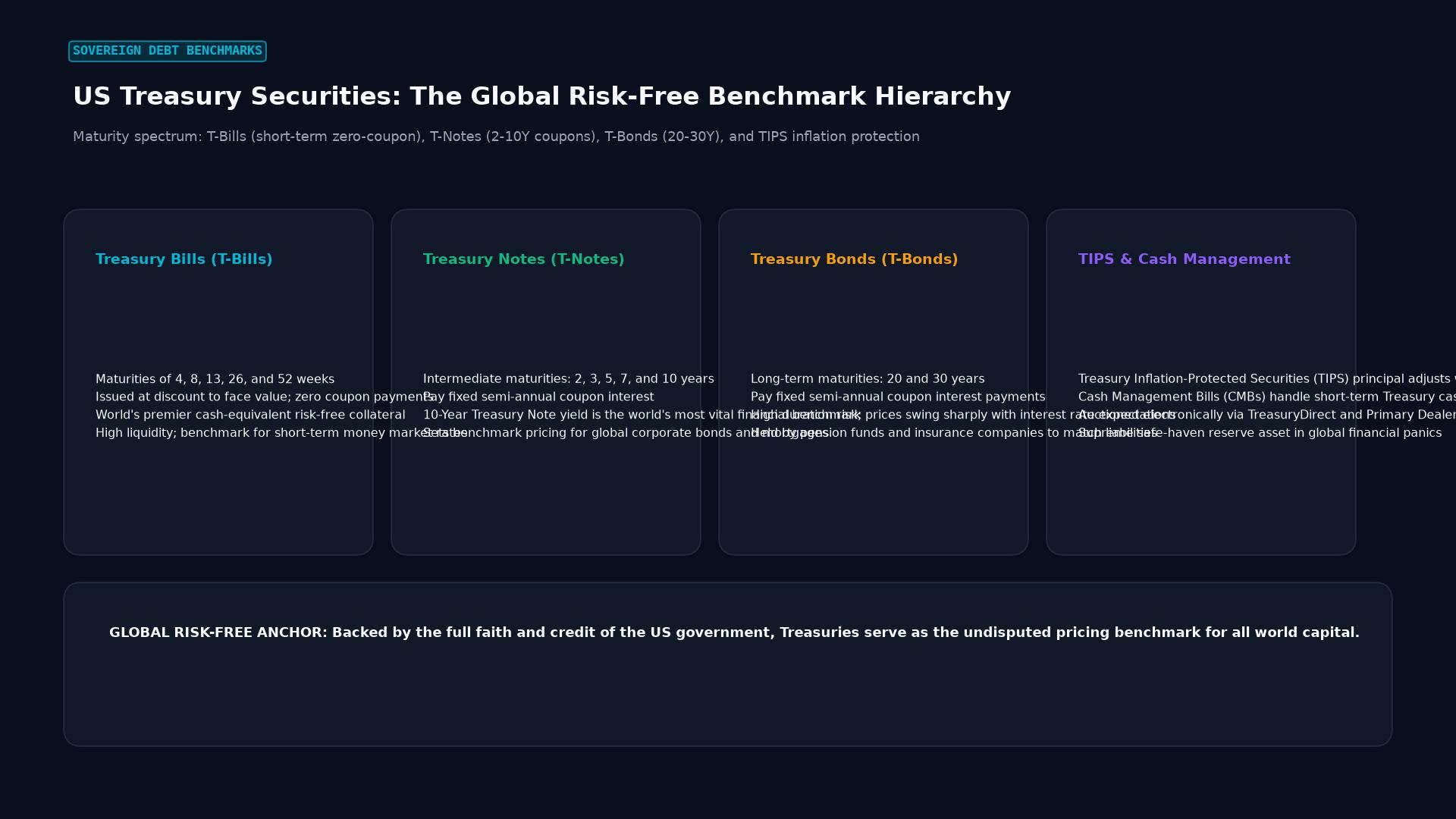 Figure: Maturity spectrum: T-Bills (short-term zero-coupon), T-Notes (2-10Y coupons), T-Bonds (20-30Y), and TIPS inflation protection
Treasuries as the Backbone of Global Collateral
Beyond serving as savings instruments, Treasury securities perform vital systemic functions in the plumbing of international capital markets:
- Pristine Repo Collateral: In the multi-trillion-dollar repurchase agreement (repo) market, commercial banks and prime dealers pledge Treasuries to borrow overnight cash. Because Treasuries carry virtually zero credit default risk, cash lenders accept them with minimal haircuts (typically 1% to 2%).
- Global Central Bank Foreign Reserves: Central banks across Asia, Europe, and Latin America hold vast reserves of U.S. Treasury notes as their primary foreign exchange buffer. When a nation needs to intervene in currency markets to defend its domestic exchange rate, it sells Treasuries to obtain dollar liquidity.
- The Risk-Free Rate ($R_f$): In modern portfolio theory and the Capital Asset Pricing Model (CAPM), short-term Treasury yields serve as the theoretical $R_f$, defining the hurdle rate that every other investment on earth must exceed to justify taking on risk.
How Treasury Yields Drive Forex Trends
In currency markets, capital flows continuously toward higher risk-adjusted returns. The relationship between U.S. Treasury yields and the U.S. Dollar Index (DXY) operates through two primary macro mechanisms:
1. The Yield Differential Spread
When U.S. Treasury yields rise faster than sovereign bond yields in Europe (German Bunds), the UK (Gilts), or Japan (JGBs), global fund managers reallocate billions into dollar-denominated fixed income. To buy those Treasuries, foreign investors must sell their domestic currencies and purchase U.S. dollars, propelling pairs like USD/JPY higher while pulling EUR/USD lower.
2. The Flight-to-Safety Dynamic
During severe international geopolitical crises, military conflicts, or emerging market sovereign defaults, institutional capital undergoes a “flight to safety.” Investors liquidate risk assets (equities, high-yield debt, emerging market currencies) and flood capital into short-term U.S. Treasury bills and cash equivalents. This surge in defensive demand drives the spot U.S. dollar higher across the board.
Key Takeaways
- Sovereign Benchmark: Treasury securities are debt instruments issued by the U.S. government, universally recognized as the global standard for risk-free assets.
- Four Maturities: Debt is structured as T-Bills (short-term discount), T-Notes (medium-term coupons), T-Bonds (long-term), and TIPS (inflation-protected).
- The 10-Year Anchor: The 10-year Treasury note serves as the definitive reference yield for global loans, mortgages, and equity discount rates.
- Financial Collateral: Treasuries form the primary collateral supporting overnight interbank repo markets and global central bank foreign exchange reserves.
- Currency Catalyst: Expanding yield spreads between U.S. Treasuries and foreign sovereign bonds generate sustained upward momentum for the U.S. dollar.
Frequently Asked Questions
What is the difference between a Treasury Bill, Note, and Bond?
The difference lies entirely in maturity duration and payment structure. T-Bills mature in one year or less and pay no periodic coupons (they are bought at a discount and mature at face value). T-Notes mature between two and ten years and pay semiannual coupons. T-Bonds mature in twenty to thirty years and pay semiannual coupons.
Why do bond prices fall when Treasury yields rise?
Bond prices and yields have an inverse mathematical relationship. When newly issued Treasuries offer higher interest rates, existing bonds with lower fixed coupon payments become less attractive. Their market price must drop on secondary exchanges until their effective yield matches the new, higher prevailing market rates.
Can the U.S. government default on Treasury securities?
Technically, because the U.S. government issues debt in its own fiat currency, it cannot involuntarily run out of domestic dollars to service its debt. While political brinkmanship surrounding the U.S. debt ceiling occasionally sparks temporary volatility, Treasuries retain the highest institutional credit standing in global finance.
Ready to trade forex?
Open a free demo account with a regulated broker. Practice with virtual funds before risking real money.