Federal Reserve Bank (Fed)
The Federal Reserve System, commonly known as the Fed, is the central banking system of the United States. Founded in 1913, it manages US monetary policy under a statutory dual mandate to foster maximum employment and stable prices, exerting unparalleled influence over global financial markets and currency exchange rates.
What Is the Federal Reserve System?
The Federal Reserve System, widely known on trading desks and across global financial media simply as the Fed, is the central bank of the United States. Established on December 23, 1913, when President Woodrow Wilson signed the Federal Reserve Act into law, the Fed was created to provide the nation with a safer, more flexible, and more stable monetary and financial architecture following a succession of devastating banking panics (most notably the Panic of 1907).
Because the United States Dollar (USD) operates as the world’s undisputed primary reserve currency and serves as the vehicle currency in roughly 88% of all global foreign exchange transactions, the Federal Reserve functions in practice as the de facto central bank to the world. A subtle shift in the Fed’s monetary policy stance, interest rate trajectory, or balance sheet strategy immediately reverberates across every equity index, sovereign bond market, and currency pair on the planet.
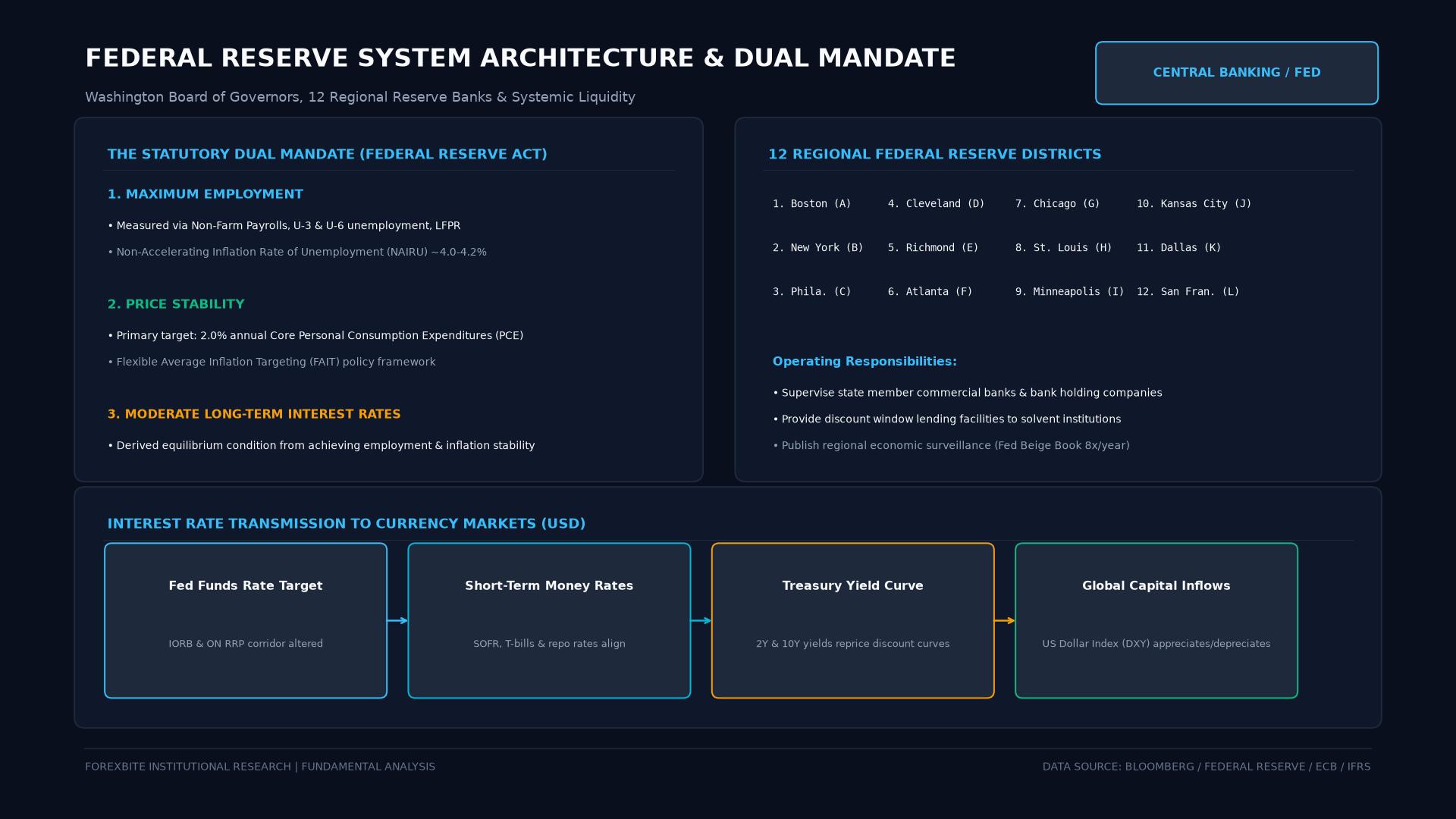 Figure: Structural hierarchy of the Federal Reserve System, spanning the Washington Board of Governors and the 12 Regional Federal Reserve Banks, alongside its statutory dual mandate (Maximum Employment and Price Stability).
The Decentralized Tripartite Structure
Unlike monolithic foreign central banks like the Bank of England or Bank of Japan, the Federal Reserve was purposefully structured as a unique hybrid combining public accountability with private regional commercial banking representation:
1. The Board of Governors (Washington, D.C.)
The federal government agency component. It consists of seven members nominated by the President of the United States and confirmed by the US Senate for staggered 14-year terms to insulate them from short-term partisan political pressure. The Board is led by the Chair of the Federal Reserve (appointed for a renewable four-year term), who serves as the public face and executive leader of the institution.
2. The 12 Regional Federal Reserve Banks
The United States is divided geographically into 12 Federal Reserve Districts, each anchored by an independently chartered regional Reserve Bank:
- Boston (District 1), New York (District 2), Philadelphia (District 3), Cleveland (District 4), Richmond (District 5), Atlanta (District 6), Chicago (District 7), St. Louis (District 8), Minneapolis (District 9), Kansas City (District 10), Dallas (District 11), and San Francisco (District 12).
- The Federal Reserve Bank of New York occupies a uniquely critical status: it executes all open market operations, manages the Fed’s multi-trillion-dollar System Open Market Account (SOMA), intervenes in foreign exchange markets on behalf of the US Treasury, and operates standing international repo and swap facilities.
3. The Federal Open Market Committee (FOMC)
The primary monetary policy-making body, comprising the seven Board Governors and five of the twelve regional Bank Presidents, responsible for setting official benchmark interest rates.
The Statutory “Dual Mandate”
Most global central banks (including the European Central Bank and Bank of England) operate under a single primary mandate: maintaining price stability.
In contrast, the US Congress formally charged the Federal Reserve with a Dual Mandate under the Full Employment and Balanced Growth Act of 1978:
- Maximum Sustainable Employment: Ensuring the US labor market achieves its highest level of employment without generating excessive inflationary pressure.
- Stable Prices: Controlling inflation to preserve the purchasing power of the US Dollar, formally defined since 2012 as an average 2.0% annual inflation rate measured by the Personal Consumption Expenditures (PCE) price index.
Balancing these two competing objectives is known as the central banker’s tightrope. When the Fed hikes interest rates to fight inflation, it risks dampening economic growth and triggering layoffs. When it cuts interest rates to stimulate employment, it risks igniting consumer price inflation.
Core Monetary Policy Instruments
The Federal Reserve conducts monetary policy through an array of conventional and unconventional policy levers:
- The Federal Funds Target Range: The primary policy tool. The Fed sets the target interest rate range at which commercial depository institutions lend surplus reserve balances to each other overnight.
- Administered Rates (The Floor System): The Fed enforces its target range through the Interest on Reserve Balances (IORB) paid to commercial banks and the Overnight Reverse Repurchase Agreement (ON RRP) facility available to money market funds.
- Open Market Operations (OMO): The outright buying and selling of US Treasury securities and agency mortgage-backed securities to regulate broad liquidity in the financial system.
- Quantitative Easing (QE) and Quantitative Tightening (QT): Large-scale asset purchases deployed during crises to inject cash and lower long-term yields (QE), followed by allowing bonds to mature without reinvestment to shrink the central bank balance sheet (QT).
- The Discount Window: The standing emergency lending facility where eligible commercial banks can borrow directly from their regional Reserve Bank as the lender of last resort.
How Federal Reserve Policy Moves the Forex Market
Every currency pair is a relative comparison of two sovereign economies. Because the US Dollar forms the base or quote currency of all major pairs (EUR/USD, USD/JPY, GBP/USD, USD/CAD, USD/CHF, AUD/USD), Federal Reserve policy shifts act as the primary directional engine of the forex market:
The Hawkish Fed (Bullish US Dollar)
When US consumer demand surges or inflation runs above target, the Fed adopts a hawkish posture—raising the Federal Funds Rate or signaling that rates will remain restrictive.
- US Treasury yields climb across all maturities.
- International institutional capital rushes into US sovereign debt to capture superior yields.
- Global demand for greenbacks expands, driving the US Dollar Index (DXY) higher, causing EUR/USD and GBP/USD to decline, while lifting USD/JPY and USD/CAD.
The Dovish Fed (Bearish US Dollar)
When the US economy contracts, unemployment rises, or banking stress emerges, the Fed adopts a dovish stance—cutting interest rates and injecting liquidity.
- US bond yields drop, eroding the dollar’s yield advantage over foreign currencies.
- Capital flows outward into higher-yielding emerging markets or higher-beta commodity currencies (AUD, NZD).
- The US Dollar depreciates broadly, fueling powerful rallies in foreign currency pairs.
Practical Trading Example: Trading a Fed Policy Pivot
Consider a swing trader analyzing EUR/USD:
- Macro Context: Following an aggressive 500-basis-point rate hiking cycle, US core inflation cools toward 2.5%, while unemployment ticks up from 3.6% to 4.3%.
- The Fed Pivot: During his opening statement at the annual Jackson Hole Economic Symposium, the Federal Reserve Chair explicitly declares: “The time has come for policy to adjust. The direction of travel is clear, and the timing and pace of rate cuts will depend on incoming data.”
- Market Interpretation: Dealing desks instantly price in a 100% probability of an immediate 50-basis-point rate cut at the upcoming September FOMC meeting, followed by multiple cuts over the coming year.
- Forex Price Action: US 2-year Treasury yields plunge 25 basis points within hours. As the US yield advantage deteriorates against European sovereign bonds, institutional funds aggressively dump US Dollars.
- Execution: EUR/USD breaks out above major daily resistance at 1.0900, surging 220 pips over the following two weeks to test 1.1120, illustrating how macroeconomic shifts in Federal Reserve forward guidance ignite sustained multi-hundred-pip trends.
Key Takeaways
- The Federal Reserve is the central banking system of the United States, founded in 1913.
- It operates under a unique statutory dual mandate: maximum sustainable employment and 2.0% price stability.
- The system consists of the presidential Board of Governors in Washington, 12 regional Reserve Banks, and the FOMC.
- The New York Fed executes all open market transactions and maintains critical international dollar liquidity facilities.
- Hawkish Federal Reserve rate hikes drive international capital into US Dollars, while dovish rate cuts trigger broad greenback sell-offs.
FAQ
Who owns the Federal Reserve? The Federal Reserve is an independent entity within the government. It is not owned by anyone. While the 12 regional Federal Reserve Banks issue shares of stock to their member commercial banks as a requirement of membership, this stock does not convey control, voting rights, or profit-sharing in the manner of private corporate shares.
Is the Federal Reserve audited? Yes. The Federal Reserve’s financial statements are audited annually by an independent major accounting firm (such as KPMG), and its operations are subject to regular, extensive audits by the Government Accountability Office (GAO).
How does the Fed Chair’s speech affect my open forex trades? During live press conferences following FOMC meetings, every word spoken by the Fed Chair is analyzed in real time by automated algorithmic news-scraping algorithms. Nuances in wording regarding inflation or economic growth can trigger 50-to-100-pip intraday spikes in major currency pairs within seconds.
Ready to trade forex?
Open a free demo account with a regulated broker. Practice with virtual funds before risking real money.