Banknotes
Physical negotiable promissory notes issued by a central bank or monetary authority, legally designated as legal tender for all public and private debts. Unlike electronic book-entry bank reserves and foreign exchange market flows, banknotes represent physical circulating cash.
What are Banknotes?
A banknote (often referred to simply as paper money, cash, or a bill) is a physical negotiable promissory note issued by a sovereign central bank or authorized monetary authority. Printed on high-durability polymer or cotton-linen paper with advanced anti-counterfeiting features, banknotes are legally established as legal tender—meaning they must be accepted under law as a valid tender for the settlement of all public and private debts within a jurisdiction.
While retail consumers associate foreign exchange with exchanging physical banknotes at airport kiosks, banknotes represent a microscopic fraction of global currency activity. Of the more than $7.5 trillion traded daily in the global foreign exchange market, virtually 99.9% occurs electronically via ledger transfers between commercial banks and central bank settlement systems.
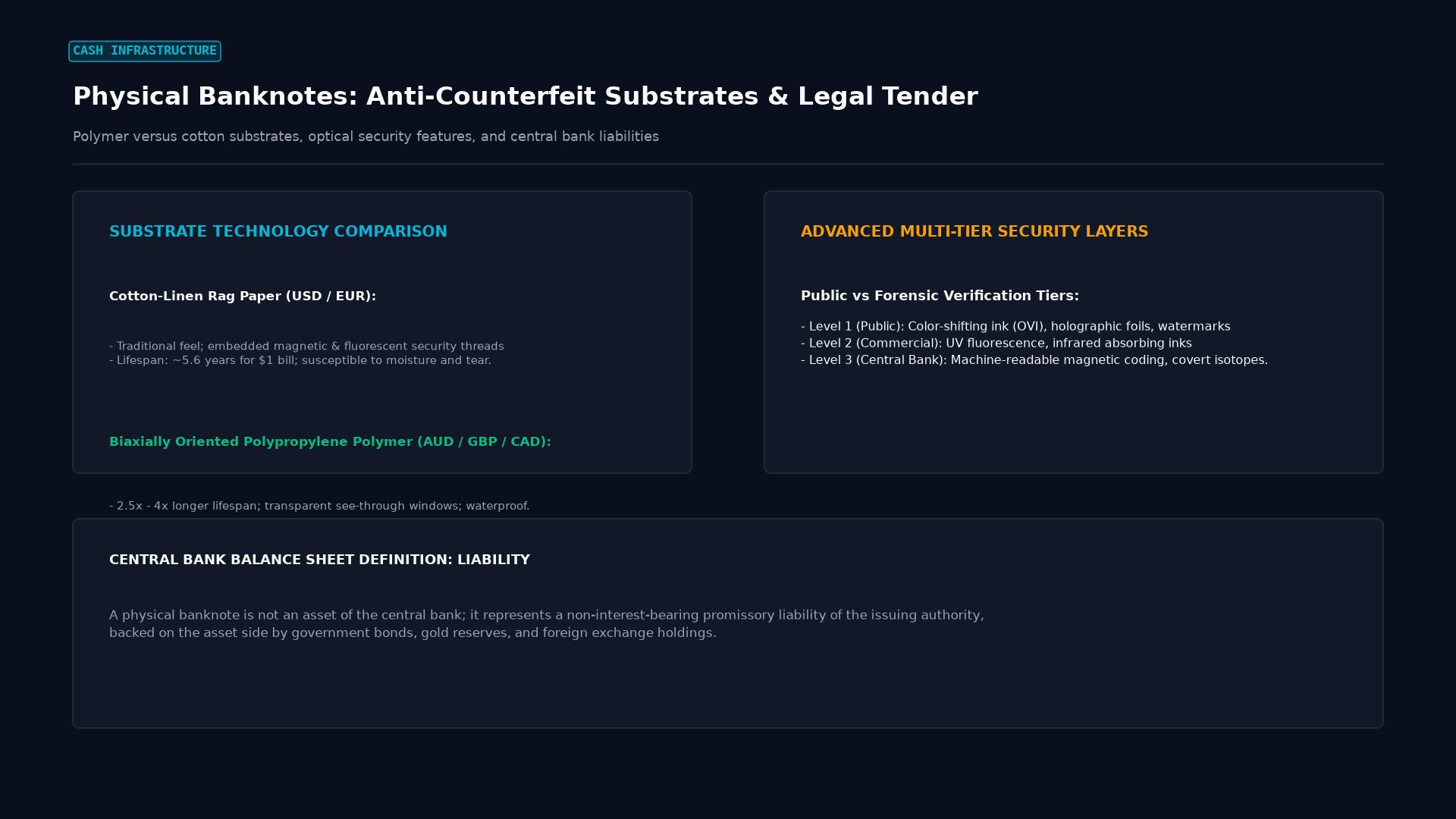 Figure: Cash infrastructure taxonomy: biaxially oriented polypropylene polymer vs cotton-linen rag substrates, multi-tier optical security, and central bank liabilities.
Physical Banknotes vs. Interbank Electronic FX
The fundamental reason physical banknotes are segregated from the institutional foreign exchange market is the extreme friction associated with handling physical commodities:
- Logistics, Freight, and Security: Moving physical banknotes between global financial centers requires armored transport, air freight, customs clearance, armed security escorts, specialized vaulting, and insurance against theft and loss.
- Authentication and Counterfeiting Verification: Every physical note must be counted, mechanically verified against counterfeit signatures, sorted by quality, and destroyed if damaged.
- The Retail Spread Penalty: Because retail currency exchange booths (such as Travelex or airport exchange counters) carry the immense overhead of physical note logistics, inventory financing, and airport real estate fees, their bid-ask spreads routinely range from 5% to 15%. In contrast, electronic retail forex trading on platforms like MetaTrader executes with spreads as low as 0.01% (0.1 pips).
The Economics of Banknote Production: Seigniorage
When a sovereign government or central bank issues physical banknotes, it earns a continuous economic profit known as seigniorage:
$$\text{Seigniorage} = \text{Face Value of Banknote} - \text{Physical Cost of Production and Distribution}$$
Numerical Example
The U.S. Federal Reserve spends approximately $0.14 to print a single $100 bill. The Federal Reserve then puts that $100 bill into circulation by exchanging it for interest-bearing U.S. Treasury securities held by commercial banks.
The U.S. government effectively receives $100 worth of interest-yielding assets in exchange for a piece of paper costing 14 cents to manufacture. The annual interest generated by those Treasury bonds represents recurring, non-tax revenue for the sovereign state.
Demonetization, Currency Controls, and High-Denomination Notes
Because physical banknotes are untraceable bearer instruments—requiring no identity verification to transfer from one person to another—they have increasingly come under intense regulatory pressure from international bodies like the Financial Action Task Force (FATF):
- The Phase-Out of High-Denomination Notes: In 2019, the European Central Bank permanently halted the issuance of the €500 banknote to combat cross-border money laundering, tax evasion, and terror financing. Similarly, the United States has not printed $500, $1,000, or $10,000 notes since 1945.
- Shock Demonetization (The India 2016 Precedent): In November 2016, the Indian government abruptly demonetized all ₹500 and ₹1,000 banknotes overnight, invalidating 86% of the nation’s cash in circulation to force undocumented black market wealth into formal electronic banking channels.
- Emergence of CBDCs: Central banks worldwide (including the Federal Reserve, ECB, and Bank of Japan) are developing Central Bank Digital Currencies (CBDCs) designed to provide the sovereign backing of banknotes with the efficiency, programmability, and traceability of electronic ledgers.
Comparative Matrix: Forms of Sovereign and Commercial Money
| Monetary Dimension | Physical Banknotes | Commercial Bank Deposits | Central Bank Reserves | Central Bank Digital Currency (CBDC) |
|---|---|---|---|---|
| Form | Physical paper / polymer | Electronic ledger entry | Electronic book-entry | Cryptographic token / ledger |
| Issuer | Central Bank | Commercial Bank | Central Bank | Central Bank |
| Legal Standing | Direct central bank liability | Commercial bank liability | Direct central bank liability | Direct central bank liability |
| Credit Risk | Risk-Free (Sovereign) | Dependent on bank & deposit insurance | Risk-Free (Sovereign) | Risk-Free (Sovereign) |
| Anonymity | Complete bearer anonymity | Fully tracked (KYC/AML) | Institutional only | Traceable / Programmable |
| FX Market Role | Tourist exchange only | Primary settlement medium | Wholesale clearing backbone | Emerging cross-border settlement |
Strategic Significance for Currency Analysts and Investors
- Banknotes as Safe-Haven Liquidity: During severe geopolitical or banking crises (e.g., bank runs, cyberattacks, or widespread electrical grid failures), physical banknotes remain the only functional settlement medium, triggering sudden surges in cash hoarding.
- Physical Cash Premiums in Frontier Economies: In economies with strict capital controls (e.g., Argentina, Nigeria, or Lebanon), physical U.S. Dollar banknotes often trade at a substantial premium over domestic electronic bank deposits due to the immediate safety of holding tangible hard currency.
Key Takeaways
- Banknotes are physical promissory notes issued by central banks that circulate as legal tender for all public and private debts.
- Physical banknotes account for virtually 0% of interbank foreign exchange volume, which is executed almost entirely via electronic ledger systems.
- The high logistical, security, and verification costs of physical cash result in wide retail exchange spreads (5% to 15%) compared to institutional electronic trading.
- Governments earn substantial revenue (seigniorage) from the difference between the production cost of banknotes and their face value.
- International regulators have steadily phased out high-denomination banknotes to suppress illicit financial flows, paving the way toward Central Bank Digital Currencies (CBDCs).
Frequently Asked Questions
Can I deposit foreign physical banknotes directly into a retail forex trading account?
No. Regulated online forex brokers do not accept physical cash. All trading accounts must be funded via electronic payment mechanisms—such as wire transfers, automated clearinghouse (ACH) transactions, or credit cards—to comply with strict international Anti-Money Laundering (AML) regulations.
Why do airport exchange booths have such bad exchange rates?
Airport exchange desks face massive fixed overheads: exorbitant airport concession rents, armored vehicle transport, armed security guards, counterfeit insurance, and holding costs on dozens of idle foreign currencies. These operational expenses are passed directly to travelers in the form of 8% to 15% bid-ask spreads.
What is the lifespan of a modern polymer banknote?
Polymer banknotes, introduced by the Reserve Bank of Australia in 1988 and now adopted by the Bank of England, Bank of Canada, and others, last approximately 2.5 to 4 times longer than traditional cotton-paper notes. They are highly resistant to moisture, dirt, and mechanical tearing, substantially reducing annual printing costs for central banks.
Are central bank banknotes backed by gold?
No. Following the collapse of the Bretton Woods system in 1971, all major global banknotes circulate as fiat currency. They are backed not by physical gold or silver, but by the legal authority, full faith, credit, and taxation powers of the issuing sovereign government.
Ready to trade forex?
Open a free demo account with a regulated broker. Practice with virtual funds before risking real money.