Spot Market
The spot market is a decentralized financial marketplace where currencies and commodities are traded for immediate settlement and physical delivery, traditionally governed by the standard two-day (T+2) settlement convention.
The spot market is the core arena of global foreign exchange, where buyers and sellers exchange one currency for another at the prevailing current market price (“on the spot”). Accounting for more than $2.1 trillion in daily transactions according to the Bank for International Settlements (BIS), the spot forex market dwarfs all global stock and commodity exchanges combined.
While spot transactions are contracted at immediate market prices, the physical settlement of cash traditionally occurs within two business days (known as T+2). For retail currency traders, modern electronic brokerages eliminate physical delivery altogether through automated overnight rollover swaps, allowing continuous speculative trading.
The Settlement Mechanics: The T+2 Standard
In financial terminology, “spot” implies immediacy, but in institutional banking, true delivery requires two clearing days to accommodate time-zone differences and cross-border bank wire verifications:
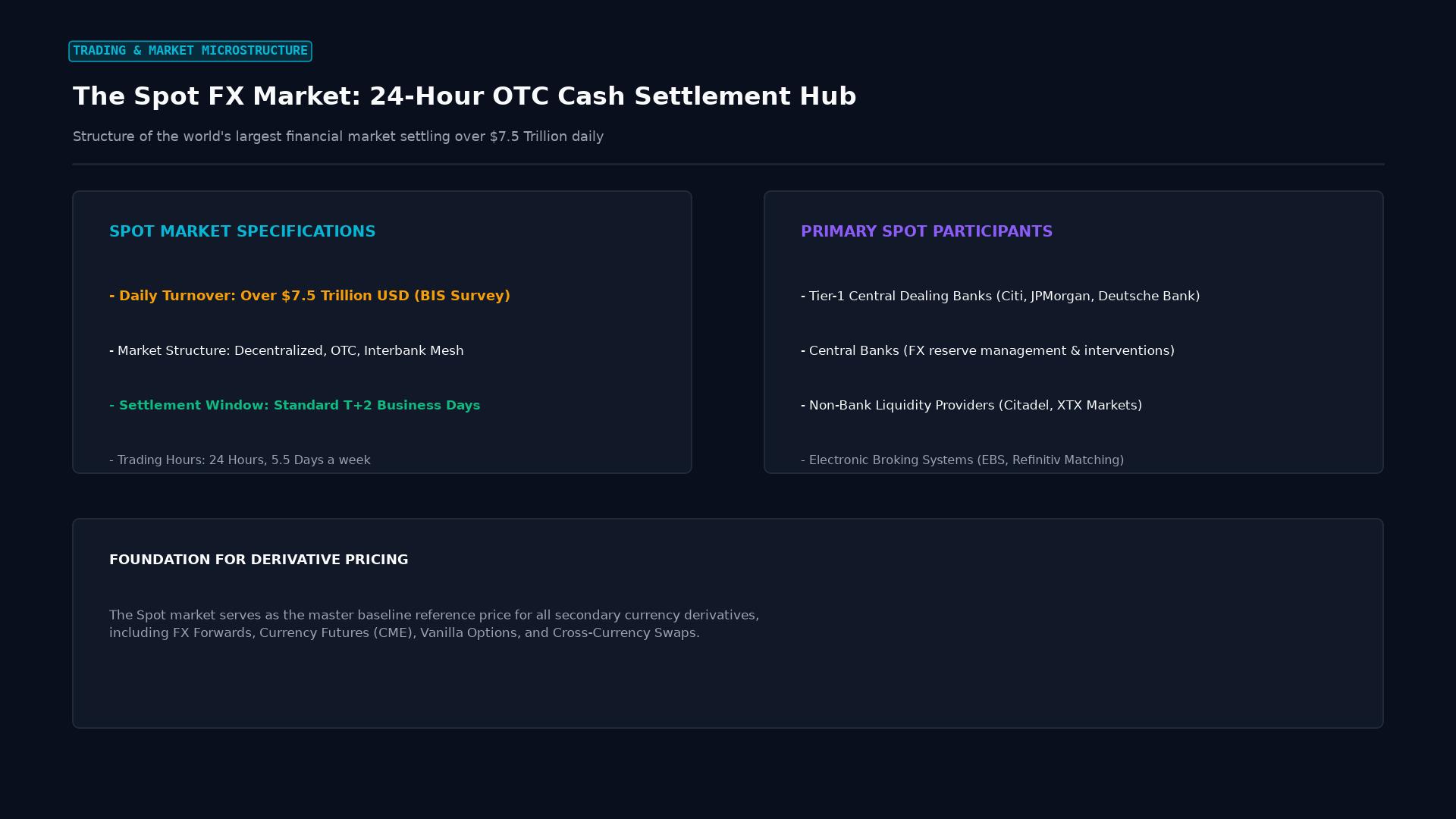 Figure: Global currency foundation: decentralized interbank network trading over $7.5 Trillion daily with standard T+2 cash delivery.
- Standard T+2 Delivery: For the majority of currency pairs (including EUR/USD, GBP/USD, and AUD/USD), funds clear two business days after trade execution.
- Exceptions to T+2 (T+1 Pairs): North American currency pairs—notably USD/CAD, as well as USD/TRY and USD/PHP—settle on the next business day (T+1) because the financial centers of New York and Toronto share synchronized operating hours and bilateral clearing arrangements.
Spot vs. Futures vs. Forward Contracts
Understanding how the spot market contrasts with derivative markets helps traders choose the appropriate trading vehicle:
| Feature | Spot Forex Market | Currency Futures | Currency Forwards |
|---|---|---|---|
| Market Type | Over-the-Counter (OTC) | Centralized Exchange (e.g., CME) | Over-the-Counter (OTC) |
| Settlement Horizon | Immediate execution, T+2 delivery | Fixed quarterly delivery dates | Bespoke customized future delivery date |
| Contract Size | Highly flexible (micro, mini, standard) | Rigid, standardized contract sizes | Fully customizable between parties |
| Pricing Basis | Live streaming spot rates | Spot price plus/minus forward carry | Spot rate adjusted by forward points |
| Primary Users | Retail traders, banks, liquidity providers | Speculators, CTAs, commodity funds | Multinational corporations, commercial hedgers |
How Retail Forex Avoids Physical Delivery: The Rollover
If institutional spot contracts mandate cash settlement in two days, how do retail traders hold EUR/USD positions for weeks without taking physical delivery of hundreds of thousands of euros?
The answer lies in the overnight rollover (swap) mechanism:
- The 5:00 PM EST Cutoff: Every business day at 5:00 PM Eastern Standard Time, any open spot position that reaches settlement must either settle physically or be extended.
- The Synthetic Swap: Retail brokers automatically close the expiring spot contract and instantly reopen a fresh spot position for the next value date.
- The Swap Interest: Because the two currencies carry different central bank interest rates, holding the position overnight generates a credit or debit (the “rollover swap”), reflecting the cost of carry between the currencies.
Global Geography of the Spot Forex Market
The spot foreign exchange market has no physical floor; it operates as an electronic continuum across major global financial capitals. Liquidity cascades continuously around the globe:
- Tokyo & Asian Hubs (Sydney, Singapore, Hong Kong): Kicks off the global trading day, managing approximately 25% of global turnover.
- London & European Hubs (Frankfurt, Zurich): The undisputed epicenter of global spot liquidity. London handles over 38% of total daily global forex turnover.
- New York: The second-largest hub, contributing approximately 19% of volume and dominating market depth during the high-volatility “London-New York overlap.”
Key Takeaways
- Immediate Execution: The spot market facilitates the immediate purchase and sale of currencies at current real-time market prices.
- T+2 Convention: Institutional settlement occurs two business days following execution to allow global interbank payment clearing (with USD/CAD settling on T+1).
- Massive Liquidity: The spot forex market handles over $2.1 trillion in daily volume, making it the most liquid financial market on earth.
- Automated Rollover: Retail brokers extend spot contracts past their T+2 settlement date using daily rollover swaps, eliminating physical currency delivery for speculators.
- Global Continuum: Trading operates 24 hours a day, 5.5 days a week, moving seamlessly across Tokyo, Singapore, London, and New York.
Frequently Asked Questions
What happens if I keep a spot forex trade open over the weekend?
Forex markets close on Friday at 5:00 PM EST and reopen on Sunday evening. Any position held over the weekend remains open, and the broker applies a triple-day rollover swap (usually charged on Wednesday or Friday depending on the broker) to account for the weekend holding period.
Can a private retail trader receive actual physical cash delivery from the spot market?
Not through a standard retail broker. Retail forex platforms are structured purely for financial speculation using Contracts for Difference (CFDs) or leveraged rolling spot facilities. Physical currency exchange must be handled through commercial banks, currency exchange kiosks, or institutional deliverable FX desks.
Why is the London session so important for spot forex trading?
London sits at the geographic crossroads of the global trading day. It overlaps with the close of the Asian trading session and the opening of the North American market, concentrating the highest volume of institutional liquidity, which results in the tightest bid-ask spreads of the day.
Ready to trade forex?
Open a free demo account with a regulated broker. Practice with virtual funds before risking real money.