Base Point
A standard unit of measurement in finance equal to one-hundredth of one percent (0.01%, or 0.0001 in decimal form), utilized to eliminate ambiguity when discussing changes in interest rates, bond yields, equity index margins, and financial derivatives.
What is a Base Point?
A base point (universally written as a basis point, abbreviated as bps, and pronounced colloquially as a “bip”) is a standardized unit of measure used across global financial markets to quantify changes in interest rates, bond yields, credit spreads, and derivative pricing.
One basis point is mathematically defined as:
- One-hundredth of one percentage point: $0.01%$
- One-ten-thousandth in decimal form: $0.0001$
- A fraction of a whole: $\frac{1}{10,000}$
Because financial institutions transact hundreds of billions of dollars daily, minute fractional changes in interest rates translate into massive monetary gains or losses. The basis point provides traders, central bankers, and corporate treasurers with a universally understood, granular metric that eliminates semantic confusion.
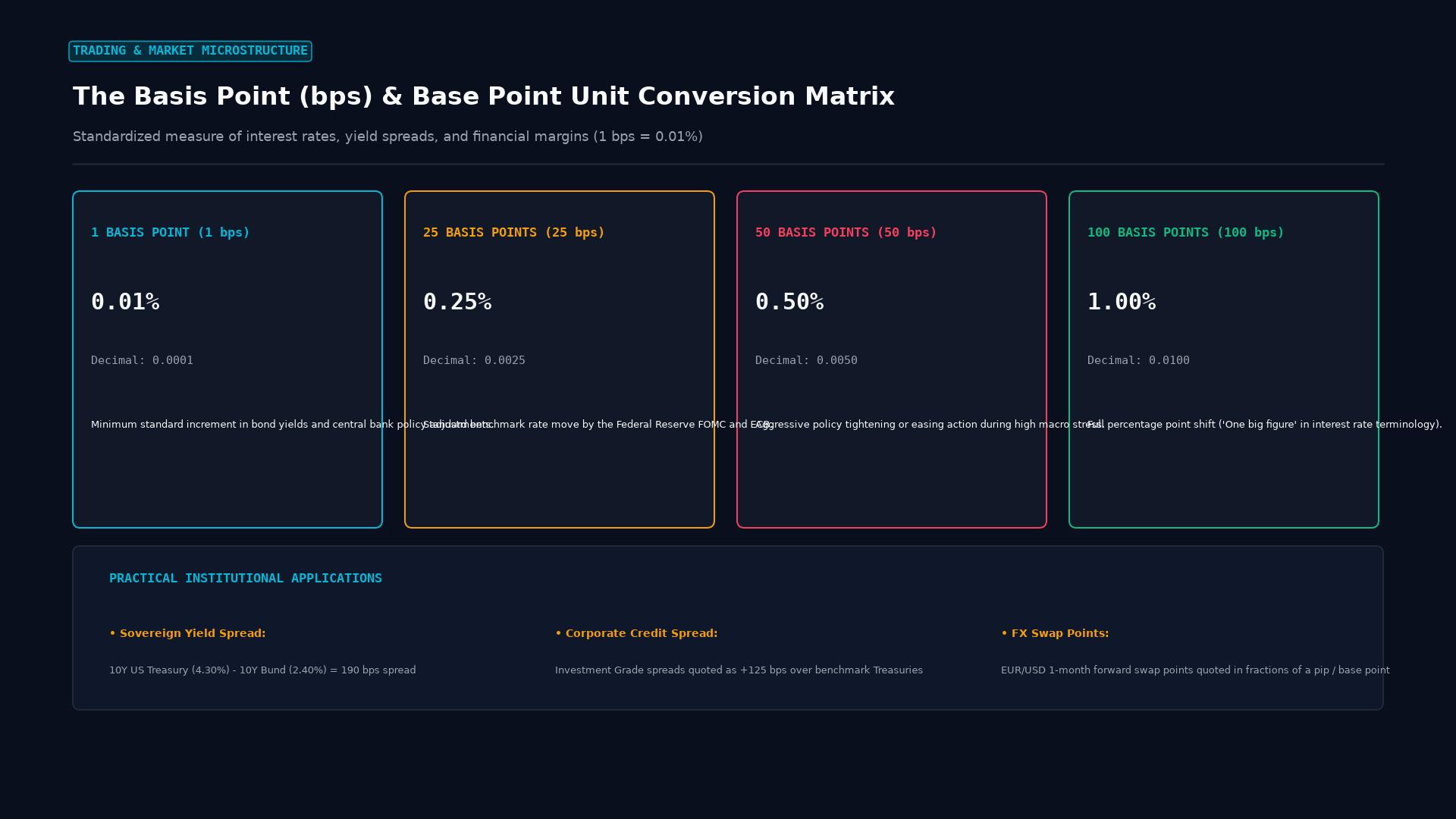 Figure: Standardized financial quotation: converting 1 basis point (0.01% = 0.0001) across central bank rate adjustments, sovereign bond yield spreads, and swap margins.
Eliminating the “Percentage Paradox”
The primary reason financial markets rely on basis points is to avoid the dangerous linguistic ambiguity inherent in standard percentage terminology:
The Ambiguity Dilemma
Imagine a central bank benchmark interest rate increases from 5.00% to 5.50%:
- If an analyst reports: “Interest rates rose by 0.5%,” an investor might calculate a 0.5% relative increase on 5.00% ($5.00% \times 1.005 = 5.025%$).
- If another analyst reports: “Interest rates rose by 10%,” they are referring to relative percentage growth ($\frac{5.50 - 5.00}{5.00} = 10.0%$).
- Both statements are mathematically defensible, yet wildly contradictory in practical execution.
The Solution: Basis Points
By stating: “The central bank raised interest rates by 50 basis points,” there is zero ambiguity. Every market participant across the globe understands that the policy rate moved exactly 50 hundredths of a percent ($0.50%$).
Mathematical Conversion Matrix
| Basis Points (bps) | Percentage Equivalent | Decimal Form | Common Real-World Example |
|---|---|---|---|
| 0.1 bps | 0.001% | 0.00001 | High-frequency trading execution rebate |
| 1 bps | 0.01% | 0.0001 | 1 pip movement in 4-decimal currency pairs (EUR/USD) |
| 5 bps | 0.05% | 0.0005 | Sovereign bond yield curve intraday fluctuation |
| 10 bps | 0.10% | 0.0010 | Corporate bond credit spread widening |
| 25 bps | 0.25% | 0.0025 | Standard Federal Reserve interest rate hike / cut |
| 50 bps | 0.50% | 0.0050 | Aggressive monetary policy adjustment |
| 100 bps | 1.00% | 0.0100 | Full percentage point macroeconomic policy shift |
| 1,000 bps | 10.00% | 0.1000 | Emerging market currency crisis rate defense |
Basis Points vs. Pips in Foreign Exchange
Forex traders frequently interchange the concepts of pips and basis points. While closely linked, their exact relationship depends on the currency quotation structure:
- Four-Decimal Currency Pairs (EUR/USD, GBP/USD, AUD/USD):
- The smallest standard price increment (one pip) is $0.0001$.
- Because $0.0001 = 0.01%$, 1 pip equals exactly 1 basis point.
- If EUR/USD advances from 1.0850 to 1.0875, it has gained 25 pips, or 25 basis points of the quote currency.
- Two-Decimal Currency Pairs (USD/JPY, EUR/JPY):
- The standard pip is located at the second decimal place ($0.01$).
- In absolute mathematical terms, $0.01$ equals $1.00%$ (100 basis points). However, forex traders still refer to this step as “1 pip” of price movement.
- Fractional Pips (Pipettes):
- Most modern brokers quote five decimals (e.g., 1.08502). The fifth digit represents one-tenth of a pip ($0.00001$), which equates to 0.1 basis points.
Institutional Fixed Income: The DV01 Metric
In institutional bond trading and interest rate swaps, traders evaluate portfolio risk using a metric called DV01 (Dollar Value of an 01, or the Dollar Value of a Basis Point):
$$\text{DV01} = -\frac{\Delta \text{Portfolio Value}}{\Delta \text{Yield in Basis Points}}$$
Practical Portfolio Application
A hedge fund manages a $100,000,000 portfolio of 10-year U.S. Treasury bonds with a DV01 of $85,000:
- If the 10-year Treasury yield rises by 1 basis point (+0.01%), the portfolio immediately loses $85,000 in market value due to bond price-yield inverse mechanics.
- If the Federal Reserve surprises markets with a hawkish announcement driving yields up by 20 basis points, the fund anticipates an immediate loss of: $$20\text{ bps} \times $85,000 = $1,700,000$$
DV01 allows risk managers to hedge multi-billion dollar portfolios by matching the basis-point sensitivity of interest rate futures against their bond holdings.
Comparative Matrix: Financial Incremental Units
| Unit of Measure | Abbreviation | Standard Value | Primary Domain | Core Function |
|---|---|---|---|---|
| Basis Point | bps / bip | 0.01% (0.0001) | Fixed income, central banking, derivatives | Yield, interest rate, and spread measurement |
| Percentage Point | pp | 1.00% (0.0100) | Macroeconomic statistics (GDP, Inflation) | Arithmetic difference between two percentages |
| Pip | pip | 0.0001 (or 0.01 for JPY) | Foreign Exchange (Spot and Forwards) | Standard unit of currency exchange rate change |
| Tick | tick | Contract-specific minimum | Futures, Equities, Commodities | Minimum allowed price movement on an exchange |
Key Takeaways
- A base point (basis point, bps) equals one-hundredth of one percent ($0.01%$ or $0.0001$).
- Basis points eliminate linguistic and mathematical confusion when communicating interest rate and yield adjustments.
- A standard central bank policy rate change is typically 25 basis points ($0.25%$).
- In major four-decimal foreign exchange pairs, 1 pip is mathematically identical to 1 basis point.
- Institutional fixed income desks utilize DV01 (Dollar Value of a Basis Point) to quantify and hedge multi-million dollar interest rate risk exposures.
Frequently Asked Questions
Why is it called a “basis” point?
The term originated in the fixed-income and futures markets, where traders quoted yields based on the “basis”—the spread or difference between two interest rates or between a cash bond and a benchmark contract. A single unit of that basis measurement became known as a basis point.
How many basis points are in 1 percent?
There are exactly 100 basis points in 1.00% (one percentage point).
What does “50 bps tightening” mean?
“50 bps tightening” means a central bank has increased its benchmark interest rate by 0.50% (50 basis points) to cool inflation and restrict monetary supply.
How do basis points affect mortgage and loan payments?
Because consumer mortgages, commercial loans, and corporate revolving debt are benchmarked to floating rates (such as SOFR or the Prime Rate), every 25 bps increase by the central bank raises annual borrowing costs by $250 for every $100,000 of outstanding debt.
Ready to trade forex?
Open a free demo account with a regulated broker. Practice with virtual funds before risking real money.