Base Price
In fixed-income and securities trading, the base price is the price of a security expressed in terms of its Yield to Maturity (YTM) or annualized rate of return, rather than as a currency dollar figure per unit. In corporate trade and derivatives, it also denotes the baseline benchmark price from which subsequent price adjustments, indexations, or premiums are calculated.
What is a Base Price?
In financial market trading and asset valuation, base price possesses two interrelated institutional applications:
- Fixed-Income and Bond Trading: The price of a debt security expressed in terms of its Yield to Maturity (YTM) or annualized rate of return, rather than as a dollar cash amount per bond. When institutional bond desks trade sovereign or corporate bonds, quotes are delivered in yield (e.g., “trading at a base price of 4.35%”), allowing participants to compare investments across disparate coupon rates, issuance dates, and maturities.
- Derivatives and Commercial Contracts: The initial reference or benchmark valuation from which subsequent variable premiums, discount adjustments, indexation escalators, or strike spreads are calculated.
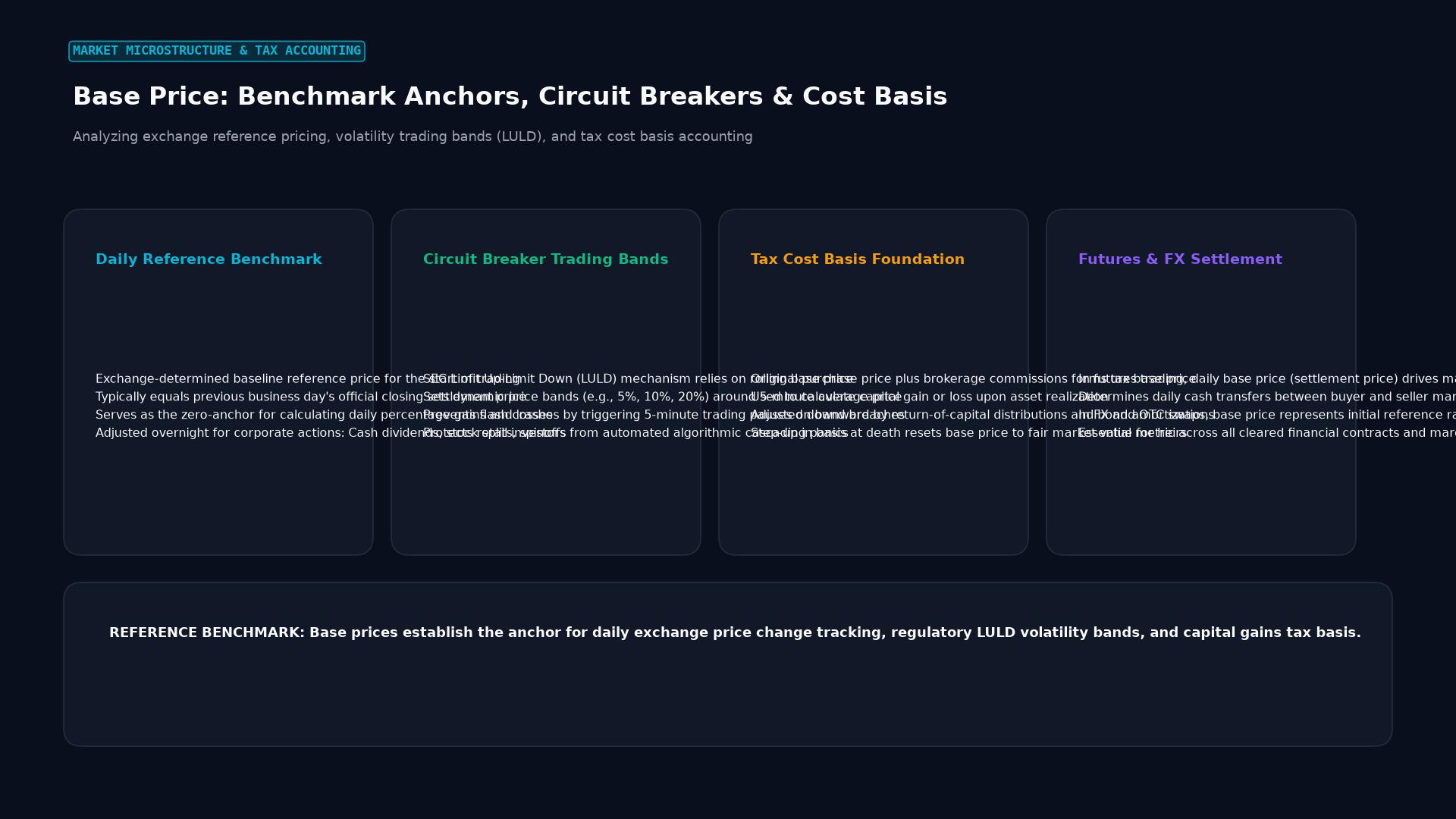 Figure: Analyzing exchange reference pricing, volatility trading bands (LULD), and tax cost basis accounting
Why Institutional Bond Markets Quote in Yield Base Price
Retail investors evaluate equities and currencies in direct dollar amounts (e.g., EUR/USD at 1.0850, or Apple stock at $180). However, quoting bonds strictly in dollar terms creates severe comparison distortion:
- A 10-year Treasury bond with a 5.0% coupon trading at $102.00 is not necessarily “more expensive” than a 10-year Treasury bond with a 2.0% coupon trading at $88.00.
- Comparing cash prices fails to reflect the stream of semi-annual coupon cash flows, the time remaining until principal maturity, and the reinvestment rate.
- By quoting the base price as a Yield to Maturity, institutional investors immediately understand the total annualized internal rate of return (IRR) generated if the bond is held to maturity.
The Inverse Price-Yield Rule
The base price (yield) shares an absolute, immutable inverse relationship with the dollar price of a fixed-income asset:
- When interest rates rise, the required yield (base price) increases, causing the bond’s cash dollar price to fall.
- When interest rates fall, the required yield (base price) decreases, causing the bond’s cash dollar price to rise.
Clean Price, Dirty Price, and the Base Price
When executing bond trades based on yield, the transaction must be converted into physical cash settlement through the mechanics of clean and dirty pricing:
$$\text{Dirty Price (Invoice Price)} = \text{Clean Price} + \text{Accrued Interest}$$
Where:
- Clean Price: The raw market price of the bond excluding interest accumulated since the last coupon payment date.
- Accrued Interest: The interest earned by the seller for the days the bond was held during the current coupon period: $$\text{Accrued Interest} = \text{Coupon Payment} \times \left( \frac{\text{Days Since Last Coupon}}{\text{Days in Coupon Period}} \right)$$
- Dirty Price: The actual cash balance wired by the buyer to the seller on settlement day.
Quoting the trade at its base price (yield) enables the automated clearing system to compute the exact clean and dirty dollar prices instantaneously based on the precise settlement date ($T+1$ or $T+2$).
Discount Base Price in Short-Term Money Markets
Short-term sovereign debt instruments—such as U.S. Treasury Bills (T-bills), UK Treasury bills, and commercial paper—do not pay periodic coupons. They are issued at a discount to face value and mature at par ($100$).
Dealers quote T-bills on a bank discount base price:
$$Y_{\text{discount}} = \left( \frac{\text{Face Value} - \text{Purchase Price}}{\text{Face Value}} \right) \times \left( \frac{360}{\text{Days to Maturity}} \right)$$
Practical Money Market Example
A 90-day U.S. Treasury Bill with a face value of $1,000,000 is quoted at a base discount price of 4.80%:
- Calculate the discount: $$\text{Discount} = $1,000,000 \times 0.0480 \times \left( \frac{90}{360} \right) = $12,000$$
- Calculate the cash purchase price: $$\text{Purchase Price} = $1,000,000 - $12,000 = $988,000$$
The investor pays $988,000 today and receives $1,000,000 in 90 days, earning a risk-free annualized return benchmarked to the quoted 4.80% base price.
Comparative Matrix: Pricing Terminology Across Financial Assets
| Pricing Term | Definition | Unit of Quotation | Primary Asset Class | Influencing Variables |
|---|---|---|---|---|
| Base Price (Yield) | Price quoted as Yield to Maturity or return | Annualized Percentage (%) | Sovereign & corporate bonds | Benchmark interest rates, credit spread |
| Clean Price | Bond price excluding accrued interest | Percentage of par ($98.50) | Institutional fixed income | Market yield changes, issuer creditworthiness |
| Dirty (Invoice) Price | Total cash price payable upon settlement | Cash currency amount | Bond settlement clearing | Clean price plus days of accrued interest |
| Strike Price | Fixed execution threshold for options | Absolute currency price | Financial options, warrants | Volatility, spot asset price, time decay |
| Spot Price | Immediate cash market delivery rate | Currency exchange quote | Forex, spot commodities | Supply and demand, liquidity order flow |
Strategic Significance for Portfolio Managers
- Cross-Market Relative Value Arbitrage: Quoting in base price allows quantitative hedge funds to identify yield curve anomalies. If a 5-year German Bund trades at a base price of 2.30% while an equivalent-maturity French OAT trades at 2.75%, the 45 bps spread represents the market’s credit and liquidity premium on French sovereign debt.
- Index Benchmarking: Passive bond exchange-traded funds (ETFs) and mutual funds track debt indices using base price yield metrics to ensure duration matching across portfolio rebalancing cycles.
Key Takeaways
- In fixed-income markets, the base price is the price of a debt security expressed in Yield to Maturity (YTM) rather than as a dollar cash amount.
- Quoting bonds in yield normalizes securities with different coupon structures, issuance dates, and maturities.
- The base price (yield) shares an inverse relationship with the cash market price of a bond.
- Cash settlement requires converting the yield base price into a “dirty price,” which combines the clean market price with accrued interest.
- In commercial contracts and derivatives, base price represents the initial reference benchmark against which subsequent price variations are measured.
Frequently Asked Questions
Why don’t stock markets use the term “base price”?
Equities do not have fixed maturity dates, guaranteed principal repayments, or contractual coupon cash flows. Consequently, stocks are valued based on earnings, book value, and growth potential, making direct unit dollar prices (and price-to-earnings multiples) the natural quotation convention.
How does a change in base price affect an existing bondholder?
If the base price (market yield) of newly issued bonds rises, existing bondholders suffer mark-to-market capital losses because their older bonds pay lower coupon rates than newly issued debt. Conversely, if market yields drop, existing bonds become more valuable, driving up their cash market price.
What is the difference between base price and par value?
Par value (face value) is the principal amount returned to the bondholder at maturity (typically $1,000 or $100 per bond). Base price is the current market yield at which the bond is actively changing hands in the secondary market.
What does “trading on a yield basis” mean?
“Trading on a yield basis” is identical to trading on a base price. It means the buyer and seller negotiate the transaction in terms of the bond’s annualized yield to maturity, after which trading algorithms automatically calculate the exact cash settlement amount based on accrued interest.
Ready to trade forex?
Open a free demo account with a regulated broker. Practice with virtual funds before risking real money.