Big Figure
In foreign exchange and capital markets, the leading whole or decimal digits of a quoted price that represent round baseline exchange rates, dropped in verbal dealing shorthand and serving as major psychological and institutional barrier levels.
Big Figure
In foreign exchange and wholesale fixed-income trading, the big figure (frequently referred to by market makers as the handle or the stem) represents the leading integer and decimal digits of an asset price that remain relatively stable during standard intraday market fluctuations. For instance, if the EUR/USD exchange rate is quoted at 1.0852, the big figure is 1.08, while the final two digits (52) represent the specific price pips.
Beyond its functional role as conversational dealer shorthand on interbank trading floors, a big figure represents a major psychological, structural, and institutional liquidity boundary in financial market microstructure. Because retail orders, commercial corporate hedges, central bank intervention lines, and multi-billion-dollar exotic barrier options cluster around major round numbers (such as parity at 1.0000 or USD/JPY at 150.00), big figures act as powerful magnetic zones and explosive volatility triggers.
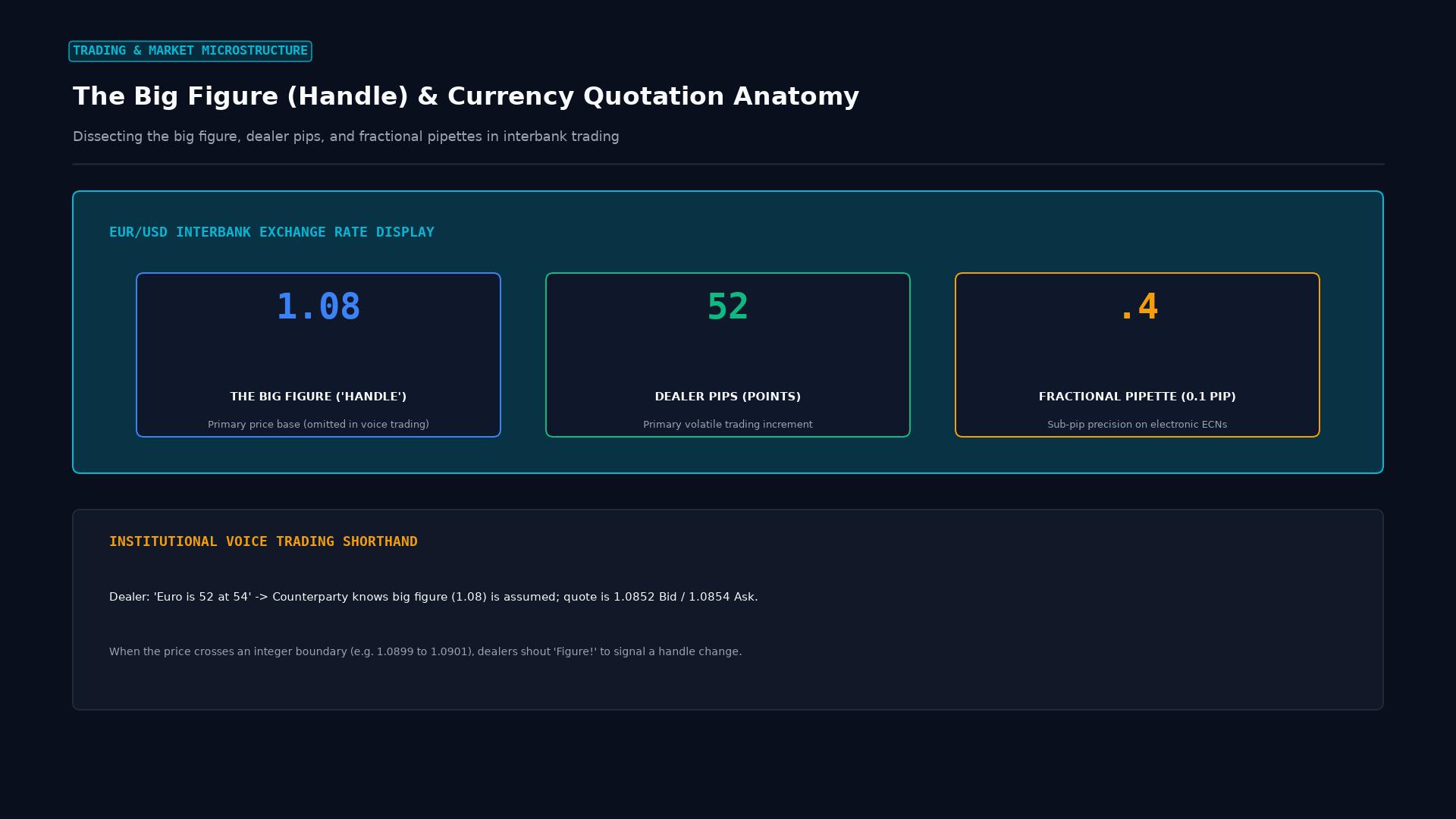 Figure: Anatomy of an interbank FX exchange rate: the big figure (handle), dealer pips, and fractional pipettes in electronic order books and voice trading shorthand.
Interbank Quoting Conventions and Trading Floor Shorthand
In high-speed institutional dealing rooms, vocal efficiency is essential to capture fleeting liquidity. During periods of heavy market flow, market makers cannot spend precious seconds pronouncing every digit of an exchange rate:
+--------------------------------------------------------------------------+
|                  Interbank Dealing Quoting Nomenclature                  |
+--------------------------------------------------------------------------+
|  Spoken Dealer Phrase        | True Full Rate Quoted | Underlying Asset  |
+------------------------------+-----------------------+-------------------+
|  "Cable is 20 / 23"          | 1.2820 Bid / 1.2823   | GBP/USD (Handle   |
|                              | Ask                   | 1.28 is assumed)  |
|  "Dollar-Yen 45 choice"      | 154.45 Bid / 154.45   | USD/JPY (Zero     |
|                              | Ask                   | spread at .45)    |
|  "Aussie 80 at the figure"   | 0.6580 Bid / 0.6600   | AUD/USD ("The     |
|                              | Ask                   | figure" = .00)    |
+--------------------------------------------------------------------------+
The Figure and the Half-Figure
Professional foreign exchange desks assign specialized vernacular to round-number subdivisions:
- The Figure: Represents the exact double-zero boundary of a currency quote (e.g., 1.0900, 1.2500, or 150.00). When price trades precisely on the round number, traders state that the pair is trading “at the figure.”
- The Half-Figure: Represents the exact midpoint of the big figure, ending in fifty pips (e.g., 1.0850, 1.2850, or 154.50). Institutional order flow concentrates heavily at half-figure markers as secondary support and resistance shelves.
Big Figures as Psychological and Institutional Barrier Levels
Human cognitive architecture displays a documented bias toward round numbers (the clustering illusion). When corporate treasurers, retail traders, and algorithmic developers configure pending orders, limit prices cluster at whole-number increments rather than arbitrary fractions:
       Order Book Liquidity Clustering Around a Big Figure
  Price
    ^
 1.1020|                                   [ Limit Sells / Stop Buys ]
 1.1010|                                   [ Limit Sells / Stop Buys ]
 1.1000+=================================== [ MASSIVE SELL ORDER WALL ] <--- Big Figure
 1.0990|                                   [ Passive Limit Bids ]
 1.0980|                                   [ Passive Limit Bids ]
 1.0970|                                   [ Passive Limit Bids ]
 1.0950+----------------------------------- [ SECONDARY BID SHELF ]   <--- Half-Figure
       +---------------------------------------------------------->
                                                      Depth of Book Volume
1. The Parity Threshold: EUR/USD in July 2022
The ultimate big figure in currency trading is parity (1.0000), where one unit of the base currency equals exactly one unit of the quote currency.
In July 2022, following decades of trading at a premium to the US dollar, macroeconomic energy shocks caused EUR/USD to descend toward 1.0000 for the first time in twenty years:
- As the pair approached 1.0050, commercial order books filled with billions of dollars in resting limit buy orders placed by corporate hedgers, sovereign wealth funds, and value investors attempting to catch the bottom.
- When price finally breached 1.0000, touching an intraday low of 0.9952, the event dominated international headlines, prompting corporate risk committees to mandate emergency currency stress tests.
- Once the initial stop-loss cascade cleared, dip-buyers aggressively defended parity, sparking a violent 250-pip short-covering rally back above 1.0200.
2. Central Bank Policy Lines
Sovereign central banks frequently utilize big figures as de facto psychological lines in the sand:
- Bank of Japan (BOJ) & Ministry of Finance: In late 2022 and again in mid-2024, Japanese monetary authorities conducted multi-billion-dollar physical market interventions whenever USD/JPY threatened to break through 150.00 and 160.00, deploying foreign reserves to punish speculative yen short sellers.
- Swiss National Bank (SNB): Between September 2011 and January 2015, the SNB maintained a mandatory minimum exchange rate floor of 1.2000 on EUR/CHF, pledging to purchase unlimited quantities of foreign currency to defend the 1.20 big figure.
Market Microstructure: Exotic Option Barriers and Gamma Pinning
The primary institutional driver behind extreme price reactions at big figures is the trading of exotic barrier options:
+--------------------------------------------------------------------------+
|                  Exotic FX Barrier Option Architecture                   |
+--------------------------------------------------------------------------+
|                                                                          |
|  [ Knock-Out Barrier Option Structure: EUR/USD at 1.1000 ]               |
|  A hedge fund purchases a multi-million-dollar call option structured to |
|  expire worthless if spot EUR/USD touches 1.1000 before expiration.      |
|                                                                          |
|  [ Institutional Investment Bank (Option Writer) Defensive Flow ]        |
|  - As spot price rallies toward 1.0980, the bank is short gamma.         |
|  - To prevent spot from touching 1.1000 (which would trigger the barrier |
|    and require payouts), the bank's algorithmic trading desks sell spot   |
|    EUR/USD aggressively into the rally.                                  |
|  - This institutional selling creates a massive artificial ceiling.      |
|                                                                          |
|  [ The Barrier Break: Gamma Unwinding Shock ]                            |
|  - If aggressive buying overwhelms the bank's sell wall and price        |
|    prints 1.1001, the barrier is knocked out.                            |
|  - The bank instantly ceases selling, and its delta-hedges unwind.       |
|  - Spot price spikes upward in a violent liquidity vacuum.               |
|                                                                          |
+--------------------------------------------------------------------------+
Option Expiry Gamma Pinning
Every trading day at 10:00 AM New York time (the official New York option cut), billions of dollars in standard vanilla options expire. When massive open interest clusters at a big figure strike (such as $3.5 billion in EUR/USD options expiring at 1.0800), options market makers must continuously dynamically hedge their delta exposures:
- If spot price moves slightly above 1.0800, market makers must sell spot currency to hedge.
- If spot price dips slightly below 1.0800, market makers must buy spot currency to hedge. This dynamic hedging activity traps price within a tight range, pinning the exchange rate to the big figure until the 10:00 AM cutoff passes.
Order Flow Dynamics: Liquidity Sweeps and Stop Hunts
Because retail traders universally configure stop-loss orders immediately beyond round numbers (e.g., placing a stop-loss at 1.0895 when shorting below 1.0900), the space immediately surrounding a big figure represents a dense pool of resting market liquidity.
Quantitative proprietary algorithms exploit this structural predictability through liquidity sweeps (often referred to by retail traders as stop hunts):
[ Downward Trend: Spot Price Approaching 1.0800 Big Figure ]
                             │
                             ▼
[ Retail Traders Place Buy Orders at 1.0800 with Stops at 1.0792 ]
                             │
                             ▼
[ Institutional Algorithm Pushes Price Down through 1.0800 to 1.0788 ]
                             │
                             ▼
[ LIQUIDITY SWEEP: Retail Stop-Losses Trigger Mass Market Sell Orders ]
                             │
                             ▼
[ Institutional Algorithms Absorb the Panic Sells at Discounted Prices ]
                             │
                             ▼
[ Price Reverses Aggressively Back Above 1.0800, Leaving a Long Wick ]
Practical Execution Protocols for Currency Traders
Professional traders implement specific execution rules to avoid common traps associated with big figures:
+--------------------------------------------------------------------------+
|                  Big Figure Systematic Trading Rules                     |
+--------------------------------------------------------------------------+
|  Strategy Component  | Operational Rule & Institutional Rationale        |
+----------------------+---------------------------------------------------+
|  Stop-Loss Placement | Never place a stop-loss directly at, or 5 pips    |
|                      | beyond, a big figure. Buffer stops by 15 to 25   |
|                      | pips (e.g., at .80 or .20) to survive liquidity   |
|                      | sweeps and predatory algorithmic wicks.           |
|  Take-Profit Orders  | Front-run large order walls. When buying toward   |
|                      | 1.1000, place limit exit orders at 1.0988 to      |
|                      | ensure execution before the sell wall stalls flow.|
|  Option Cut Calendar | Monitor the daily Depository Trust & Clearing     |
|                      | Corporation (DTCC) large option expiries schedule;|
|                      | avoid trading breakout patterns during gamma pins.|
+--------------------------------------------------------------------------+
Frequently Asked Questions
Why do market makers drop the big figure when quoting prices verbally?
Market makers drop the big figure because the integer portion of the quote changes infrequently during regular trading hours. Dropping the leading digits saves time and eliminates verbal clutter, allowing counterparties to negotiate spreads and execute high-value block trades in fractions of a second.
What is a handle in equity and futures markets?
The term handle is the North American equity and futures equivalent of the big figure in forex. If the E-mini S&P 500 futures contract moves from 5,050.25 to 5,060.25, traders state that the market has gained “ten handles,” referring to the whole-number points of movement rather than the fractional quarter-point ticks.
Why do prices often bounce repeatedly off big figures?
Prices bounce off big figures because massive concentrations of limit orders, options hedging walls, and algorithmic buy/sell programs sit waiting at round numbers. As incoming market orders hit these deep liquidity shelves, market depth absorbs the volume, temporarily exhausting momentum and driving a technical price bounce.
Ready to trade forex?
Open a free demo account with a regulated broker. Practice with virtual funds before risking real money.