Currency Pair
A currency pair is the quotation of two currencies against each other, expressing how much of the second currency (quote currency) is needed to buy one unit of the first (base currency). All forex trading occurs through currency pairs — you are simultaneously buying one currency and selling another. EUR/USD, GBP/USD, and USD/JPY are the world's most actively traded pairs.
Reading a Currency Pair Quote
When you see EUR/USD quoted at 1.0852, it means: one euro buys 1.0852 US dollars. The euro is the base currency (always the first listed). The dollar is the quote currency (always the second). The number tells you how many units of the quote currency equal one unit of the base.
If EUR/USD rises from 1.0852 to 1.0900, the euro strengthened against the dollar — you now need more dollars to buy one euro. If EUR/USD falls from 1.0852 to 1.0800, the euro weakened — fewer dollars required per euro.
When you buy EUR/USD, you’re buying euros and selling dollars simultaneously. When you sell EUR/USD, you’re selling euros and buying dollars. This is the defining characteristic of forex trading: you can never trade one currency in isolation. Every position is always a bet on the relative strength of one currency against another.
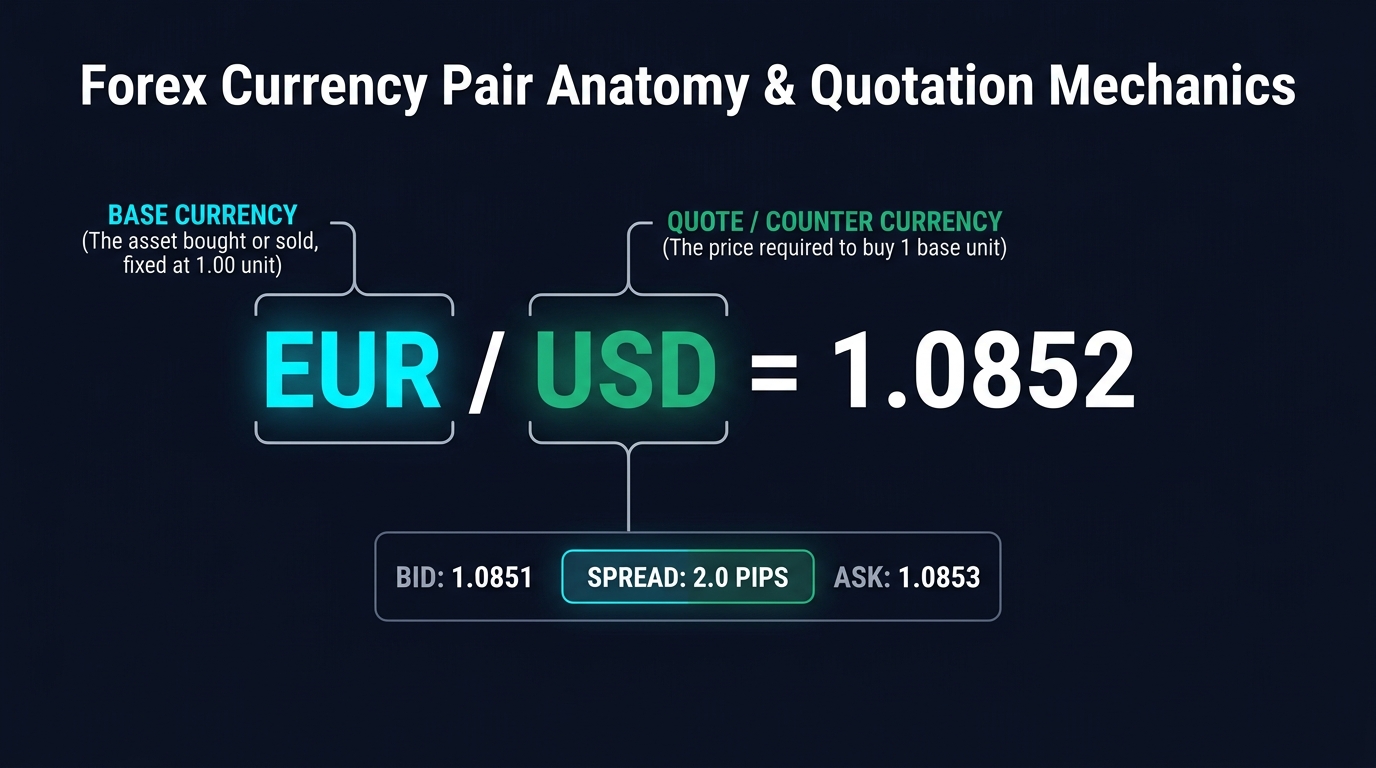
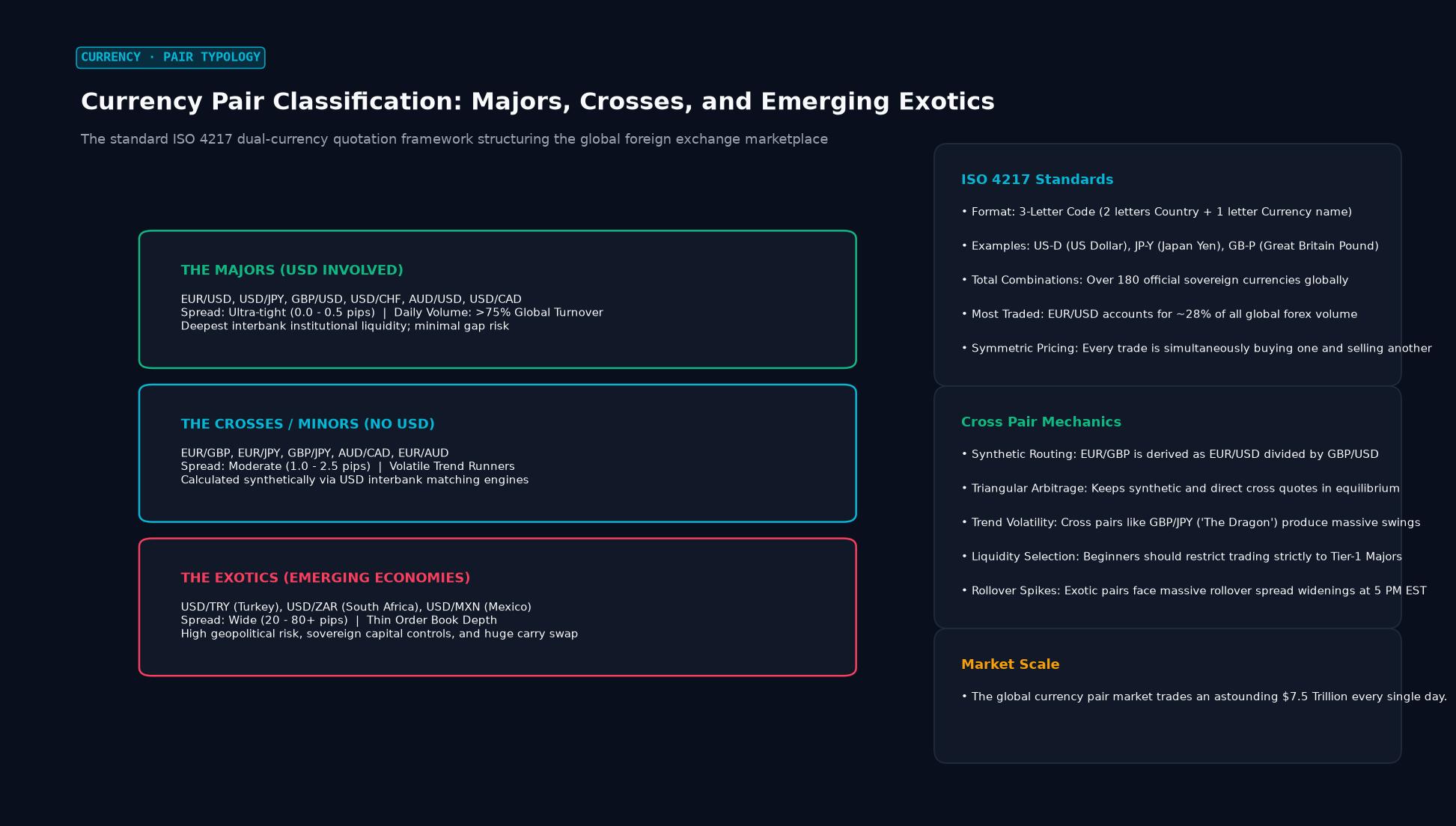 Figure: The standard ISO 4217 dual-currency quotation framework structuring the global foreign exchange marketplace
The Three Categories of Currency Pairs
Major pairs involve the US dollar on one side, combined with one of the other major currencies. They carry the highest liquidity and tightest spreads:
- EUR/USD (Euro / US Dollar) — the world’s most traded pair, ~28% of all forex volume
- USD/JPY (US Dollar / Japanese Yen) — ~13% of volume
- GBP/USD (British Pound / US Dollar) — nicknamed “Cable”
- USD/CHF (US Dollar / Swiss Franc) — nicknamed “Swissy”
- AUD/USD (Australian Dollar / US Dollar) — “Aussie”
- USD/CAD (US Dollar / Canadian Dollar) — “Loonie”
- NZD/USD (New Zealand Dollar / US Dollar) — “Kiwi”
Minor pairs (crosses) involve two major currencies but exclude the USD:
- EUR/GBP, EUR/JPY, GBP/JPY, AUD/JPY, EUR/CHF
These pairs typically carry wider spreads than the majors because they’re synthetically derived from two USD pairs. EUR/JPY, for example, is effectively EUR/USD divided by USD/JPY — the liquidity is thinner than either of those pairs individually.
Exotic pairs combine a major currency with an emerging market currency:
- USD/TRY (Turkish Lira), USD/ZAR (South African Rand), USD/MXN (Mexican Peso), USD/SGD (Singapore Dollar), EUR/PLN (Polish Zloty)
Exotics have significantly wider spreads (often 30-100+ pips), lower liquidity, and higher overnight swap costs. They suit traders who specifically understand those economies and their central bank dynamics.
Base Currency vs. Quote Currency: Why It Matters
The distinction shapes how you interpret price movement and calculate P&L.
For pairs where USD is the quote currency (EUR/USD, GBP/USD, AUD/USD):
- Pip value is roughly $10 per standard lot — easy to calculate
- When the pair rises, the dollar is weakening (you need more dollars to buy one euro)
For pairs where USD is the base currency (USD/JPY, USD/CHF, USD/CAD):
- When the pair rises, the dollar is strengthening (one dollar buys more yen, francs, or Canadian dollars)
- Pip value requires calculation based on current rate
This matters practically: a position in EUR/USD and a position in USD/JPY can both be “long the dollar,” but they look opposite on the chart (EUR/USD falls; USD/JPY rises). Keeping this straight prevents confusing your directional bias.
Correlation Between Currency Pairs
Some pairs move together; others move in opposition. Understanding these relationships prevents inadvertent doubling of risk.
Positively correlated pairs (move in the same direction):
- EUR/USD and GBP/USD: Both inverse of the dollar, often rise and fall together
- AUD/USD and NZD/USD: Both commodity-linked, highly correlated
Negatively correlated pairs (move in opposite directions):
- EUR/USD and USD/CHF: Almost perfectly inverse — when EUR/USD rises, USD/CHF typically falls
- EUR/USD and USD/JPY: Moderate negative correlation
If you’re simultaneously long EUR/USD and long GBP/USD, you effectively have two USD-short positions with correlation near 0.85. You’re not diversified — you’re doubling down on the same macro view. Traders who ignore correlations often discover they have far more directional exposure than they intended.
Choosing Which Pairs to Trade
The standard advice for beginners: start with EUR/USD. It has the tightest spread, the deepest liquidity, extensive research coverage, and it responds clearly to the most-watched fundamental drivers (Fed vs ECB policy). The technical levels are widely observed and generally cleaner than on thinner pairs.
As experience grows, expanding to GBP/USD adds more volatility (GBP moves larger in absolute pip terms). USD/JPY adds a different dynamics (Bank of Japan intervention history, carry trade influence). AUD/USD adds commodity sensitivity. Each pair has its own personality — experienced traders often specialize in 2-4 pairs they understand deeply rather than hopping between a dozen.
Key Takeaways
- Currency pairs express the exchange rate between two currencies; you always buy one and sell the other simultaneously
- Majors: involve USD + one other major currency — tightest spreads, highest liquidity
- Crosses: two majors without USD — wider spreads, thinner liquidity
- Exotics: major + emerging market currency — widest spreads, specialized market knowledge required
- Correlated pairs amplify risk; position sizing should account for inter-pair correlation
FAQ
Why do some pairs have larger daily movements than others? Liquidity and economic volatility differ by country. GBP/USD typically moves 100-120 pips per day; EUR/USD averages 70-90 pips. USD/TRY can move 300-500+ pips daily because Turkish economic and political volatility is high. Larger moves mean more opportunity but also more risk per trade.
Is it better to trade more pairs or fewer? Fewer, generally. Mastering the behavior of 2-3 pairs — their typical daily range, how they react to specific data releases, where key structural levels sit — is more profitable than shallow knowledge across many pairs. Quality over quantity applies especially in early-stage trading development.
Ready to trade forex?
Open a free demo account with a regulated broker. Practice with virtual funds before risking real money.