Bulldogs
Foreign bonds issued in the United Kingdom domestic market denominated in British Pounds (Sterling) by non-British corporations, sovereign governments, or supranational entities, subject to UK securities law and London Stock Exchange listing regulations.
What are Bulldog Bonds?
In international capital markets, Bulldogs (formally known as Bulldog bonds) are British Pound-denominated debt securities issued in the United Kingdom by non-British entities, including foreign corporations, foreign sovereign states, and supranational institutions.
Named after the British Bulldog—the traditional national symbol of the United Kingdom—Bulldog bonds are part of a vibrant, globally recognized taxonomy of foreign bonds named after cultural or national icons. Although issued by foreign borrowers, Bulldog bonds are fully registered in London, governed by English law, listed on the London Stock Exchange (LSE), and traded and settled through the UK’s domestic clearing infrastructure (Euroclear UK & International / CREST).
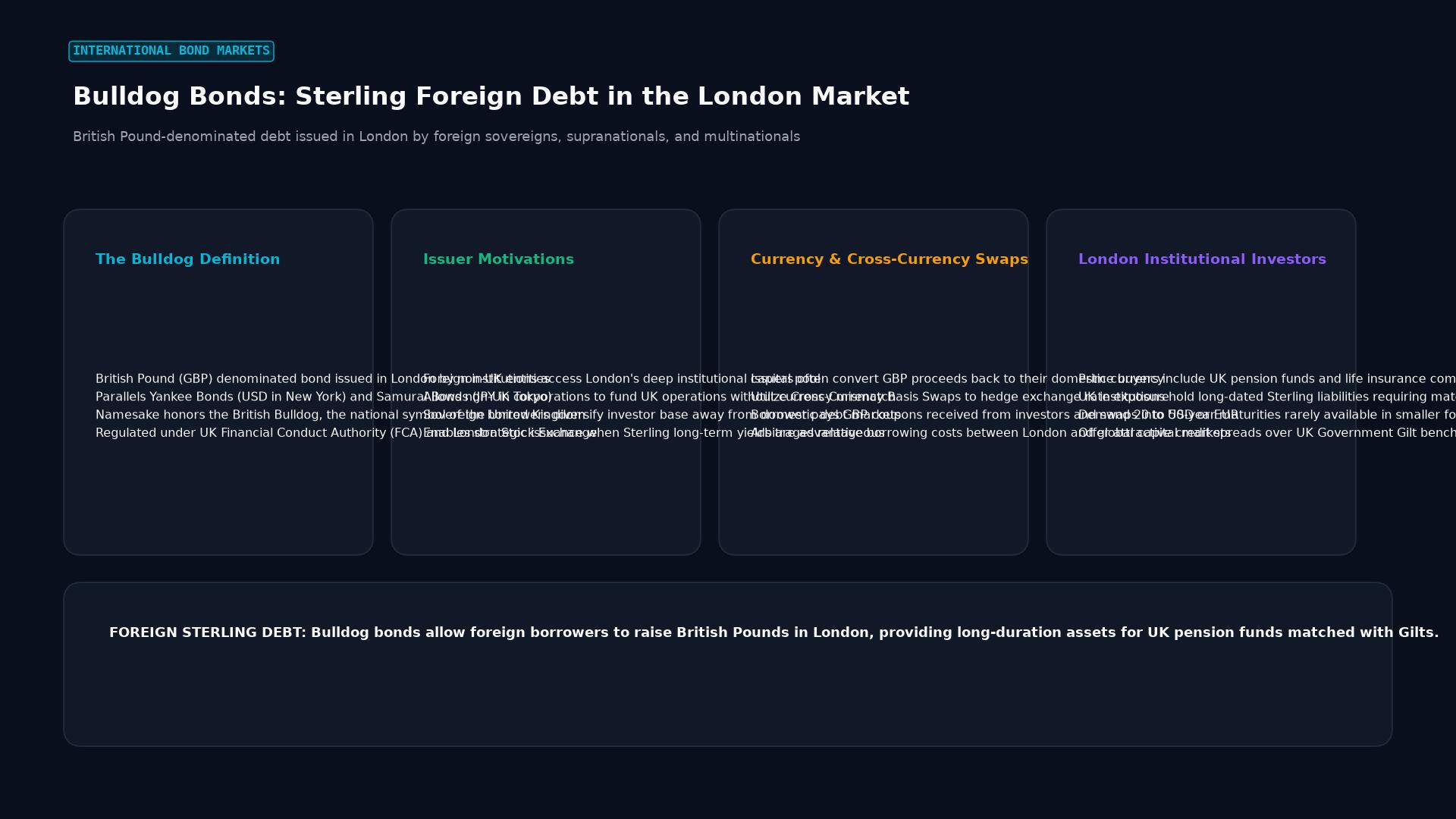 Figure: British Pound-denominated debt issued in London by foreign sovereigns, supranationals, and multinationals
Why Foreign Borrowers Issue Bulldog Bonds
Issuing debt in London denominated in British Pounds offers distinct strategic advantages for international CFOs and sovereign treasurers:
- Access to Deep UK Institutional Capital: The United Kingdom possesses one of the world’s largest institutional pension and life insurance sectors. These institutions manage massive, long-dated Sterling liabilities and exhibit enormous demand for high-yielding, investment-grade Pound-denominated debt spanning 10, 20, or even 30 years.
- Natural Balance Sheet Hedging: A foreign multinational (such as an American automaker or a German utility) operating significant manufacturing plants or retail chains in the UK generates revenues in British Pounds. By issuing a Bulldog bond in GBP, the company repays its debt using local Sterling cash flows, completely eliminating foreign exchange translation risk.
- Funding Diversification: Issuing outside one’s home market reduces over-reliance on domestic banks and local bond investors, enabling institutions to tap new investor bases during regional credit crunches.
Structure and Pricing Mechanics: The Gilt Spread
Bulldog bonds are priced relative to the risk-free benchmark of the UK sovereign debt market: UK Government Bonds (Gilts):
$$\text{Bulldog Yield} = \text{Benchmark UK Gilt Yield} + \text{Credit Spread (in Basis Points)}$$
Step-by-Step Issuance Example
An American healthcare conglomerate expanding into the UK market issues a £500,000,000 10-year Bulldog bond:
- Benchmark 10-Year UK Gilt Yield: 4.10%
- Assessed Credit Spread: 135 basis points (+1.35%) reflecting the company’s A-rated corporate credit standing.
- Bulldog Coupon Rate: $4.10% + 1.35% = 5.45%$ annual coupon.
- Investor Base: British pension funds purchase 80% of the offering to match their 10-year Sterling retirement payout obligations.
- Currency Outcome: The American borrower secures £500 million immediately for its UK hospital construction, paying £27.25 million annually in interest directly from its UK operational revenues without executing cross-currency wires.
Bulldog Bonds vs. Eurosterling Bonds
Investors frequently confuse Bulldog bonds with Eurosterling bonds. While both are denominated in British Pounds, their regulatory and clearing architectures differ fundamentally:
| Dimension | Bulldog Bond | Eurosterling Bond | Domestic UK Gilt | Yankee Bond |
|---|---|---|---|---|
| Issuer | Foreign entity (Non-UK) | Foreign or UK entity | UK HM Treasury | Foreign entity (Non-US) |
| Currency | British Pound (GBP) | British Pound (GBP) | British Pound (GBP) | U.S. Dollar (USD) |
| Issuance Market | UK Domestic Market | Eurobond / Offshore Market | UK Sovereign Market | U.S. Domestic Market |
| Governing Law | English Law | Typically English Law | English Law | New York Law |
| Clearing System | CREST / LSE | Euroclear / Clearstream | CREST / Bank of England | DTC / Fedwire |
| Tax Withholding | Governed by UK domestic tax law | Typically free of withholding tax | UK sovereign tax terms | U.S. IRS withholding rules |
Key Risk Factors for Bulldog Bond Investors
- Foreign Exchange Risk (For Non-UK Investors): If an international investor based in the Eurozone or United States purchases a Bulldog bond, they are fully exposed to fluctuations in the GBP exchange rate. If the British Pound depreciates sharply against their home currency, their total investment return drops upon conversion.
- Sovereign and Geopolitical Risk of the Issuer: While the bond is governed by English courts, the underlying cash flows depend on the economic health of the foreign issuer. If a foreign sovereign default occurs, UK legal recovery can be complicated by cross-border bankruptcy disputes.
- Sterling Interest Rate Risk (Duration): Because Bulldog bonds are frequently issued with long maturities (15 to 30 years) to satisfy pension demand, their secondary market prices are highly sensitive to shifts in the Bank of England’s benchmark interest rates.
Key Takeaways
- Bulldog bonds are British Pound-denominated debt securities issued in London by non-UK foreign corporations, governments, or institutions.
- They belong to the global family of animal-named foreign bonds, alongside Yankee (US), Samurai (Japan), and Kangaroo (Australia) bonds.
- They allow foreign issuers to tap deep UK institutional pension capital while naturally hedging their Sterling operational assets.
- Bulldog yields are structured and priced as a credit spread over equivalent-maturity UK Government Gilts.
- Unlike Eurosterling bonds (which are offshore instruments), Bulldogs are issued directly within the UK domestic legal and regulatory framework.
Frequently Asked Questions
Why are they called “Bulldog” bonds?
The name honors the British Bulldog, a historic symbol of national identity and resilience in the United Kingdom. The naming convention follows international financial tradition, where domestic markets give colorful cultural names to foreign bond issuances.
Can retail investors buy Bulldog bonds?
Yes. Bulldog bonds listed on the London Stock Exchange can be purchased by retail investors through conventional stockbrokers and bond trading platforms, though the majority of secondary liquidity is dominated by institutional pension funds.
What is the difference between a Bulldog bond and a Gilt?
A Gilt is a sovereign bond issued directly by the British Government (HM Treasury) with zero default risk. A Bulldog bond is issued by a foreign entity (such as an American corporation or a foreign government) and carries credit risk reflecting that foreign issuer.
What happens to a Bulldog bond if the British Pound crashes?
The coupon payments and principal redemption remain fixed in British Pounds. For the foreign borrower, a weaker Pound makes servicing the debt cheaper if their earnings are in foreign currencies (like USD). For non-UK investors holding the bond, a weaker Pound reduces the value of their interest payments when converted back to their domestic currency.
Ready to trade forex?
Open a free demo account with a regulated broker. Practice with virtual funds before risking real money.