Butterfly Spread
A neutral, limited-risk options trading strategy combining a bull spread and a bear spread, constructed using three strike prices with identical expiration dates: buying one lower-strike option, selling two middle-strike options, and buying one higher-strike option to profit from low volatility.
What is a Butterfly Spread?
A butterfly spread is an advanced, market-neutral options strategy designed to generate maximum profit when an underlying asset experiences minimal price movement prior to expiration. Engineered by combining four options across three equidistant strike prices with the identical expiration date, the strategy resembles the symmetrical wings and body of a butterfly on a payoff chart.
Unlike speculative directional bets, the butterfly spread is an exercise in volatility compression and time decay exploitation. The trader targets a specific price level (the “body” or middle strike) where they believe the asset will settle at expiration. In exchange for accepting a capped maximum profit, the position carries strictly defined, limited downside risk and requires significantly less capital than a short straddle.
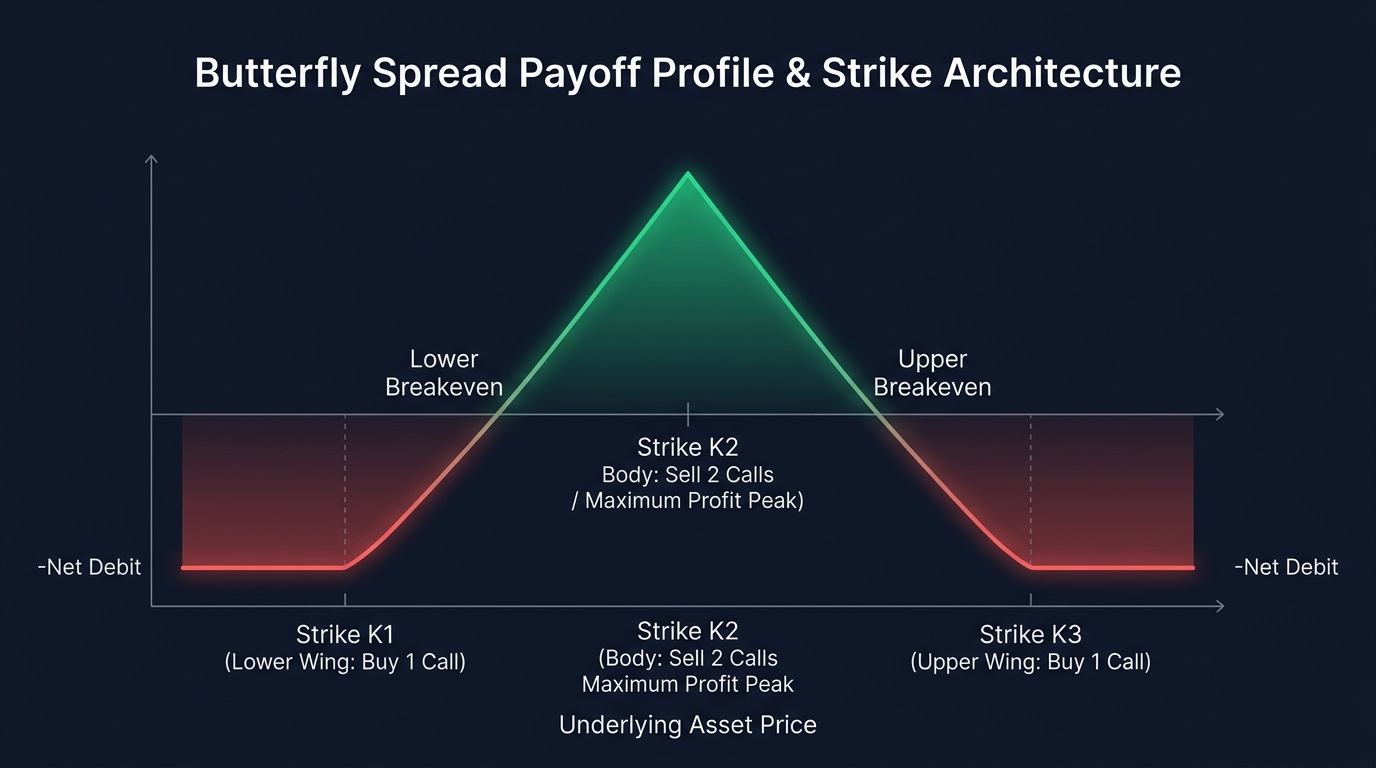
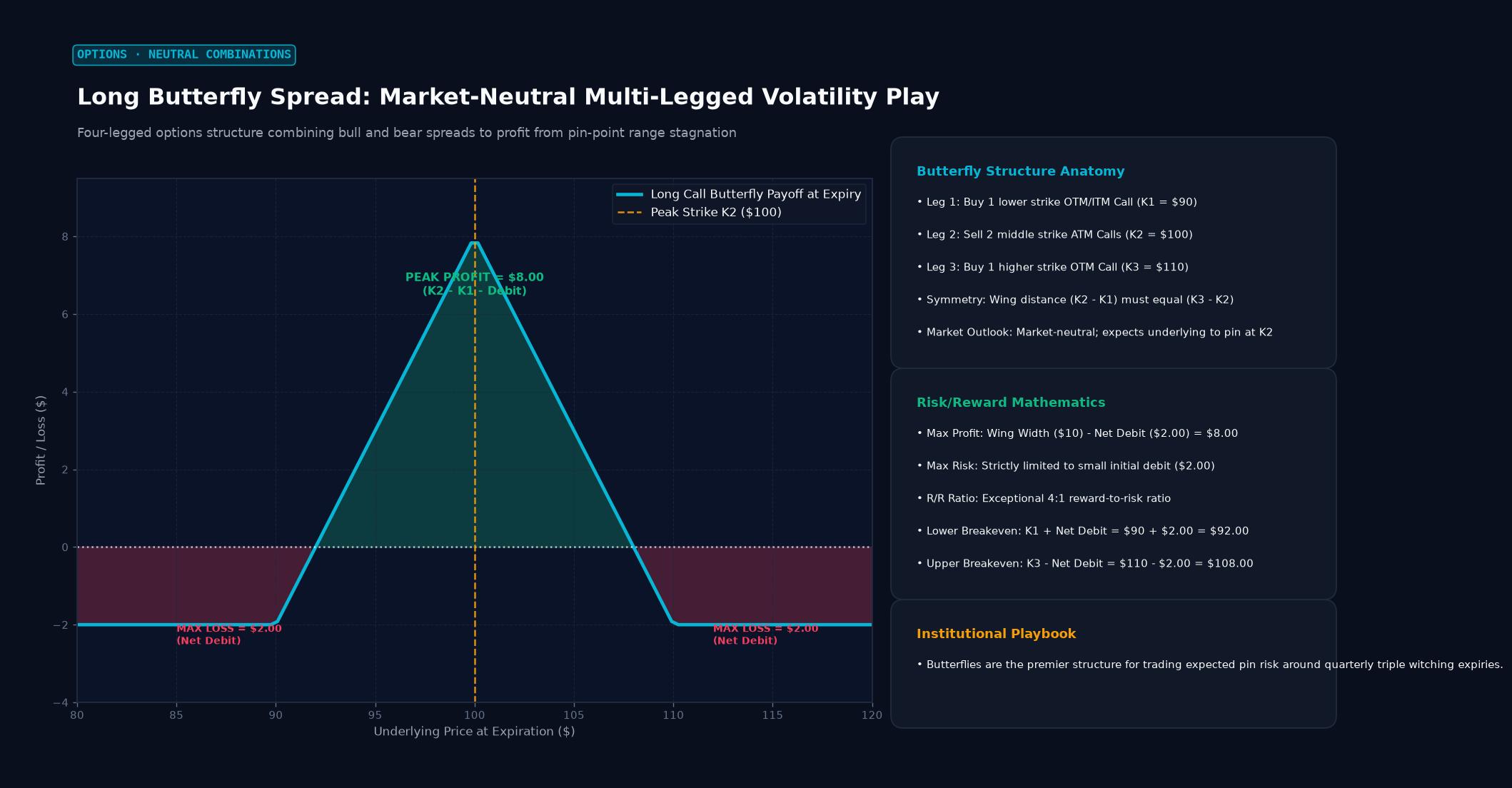 Figure: Four-legged options structure combining bull and bear spreads to profit from pin-point range stagnation
Strategy Construction: Long Call Butterfly
While butterfly spreads can be constructed using calls, puts, or iron combinations, the standard Long Call Butterfly is the most widely deployed:
- Lower Wing: Buy 1 Call at a lower strike price ($K_1$).
- Body: Sell 2 Calls at an intermediate middle strike price ($K_2$).
- Upper Wing: Buy 1 Call at a higher strike price ($K_3$).
Core Mathematical Rules
- The distance between strikes must be equidistant: $$K_2 - K_1 = K_3 - K_2$$
- Net Position Type: Net debit spread (purchased upfront).
- Maximum Profit: $$\text{Max Profit} = (K_2 - K_1) - \text{Net Debit Paid}$$
- Maximum Loss: Capped strictly at the Net Debit Paid.
- Lower Breakeven Point: $$\text{Lower Breakeven} = K_1 + \text{Net Debit Paid}$$
- Upper Breakeven Point: $$\text{Upper Breakeven} = K_3 - \text{Net Debit Paid}$$
Step-by-Step Currency Example: EUR/USD Pinning at 1.0850
Consider an institutional options trader anticipating that EUR/USD will consolidate tightly around 1.0850 over the next 21 days due to summer holiday liquidity lulls. Spot is currently trading at 1.0850.
The trader establishes a 21-day Long Call Butterfly:
- Buy 1 contract of EUR/USD 1.0750 Call ($K_1$) for 130 pips.
- Sell 2 contracts of EUR/USD 1.0850 Calls ($K_2$) for 55 pips each (collecting 110 pips total).
- Buy 1 contract of EUR/USD 1.0950 Call ($K_3$) for 15 pips.
Financial Assessment
- Net Debit Paid: $130 - 110 + 15 = 35\text{ pips}$ ($350 per standard 100,000 lot).
- Strike Width: $1.0850 - 1.0750 = 100\text{ pips}$ ($1,000 gross).
- Maximum Potential Profit: $100 - 35 = 65\text{ pips}$ ($650 per lot, an 185% return on capital).
- Maximum Potential Loss: $35\text{ pips}$ ($350 per lot).
- Breakeven Range: Between 1.0785 ($1.0750 + 0.0035$) and 1.0915 ($1.0950 - 0.0035$).
Expiration Scenarios
| EUR/USD Spot at Expiry | 1.0750 Call Value | 2x 1.0850 Calls Value | 1.0950 Call Value | Net Payoff (Pips) | Total P&L ($ per Lot) |
|---|---|---|---|---|---|
| 1.0650 (Bearish Dump) | 0 pips | 0 pips | 0 pips | -35 pips | -$350 (Capped Loss) |
| 1.0750 (Lower Wing) | 0 pips | 0 pips | 0 pips | -35 pips | -$350 (Capped Loss) |
| 1.0800 (In the Money) | +50 pips | 0 pips | 0 pips | 50 - 35 = +15 pips | +$150 |
| 1.0850 (Sweet Spot Pin) | +100 pips | 0 pips | 0 pips | 100 - 35 = +65 pips | +$650 (Max Profit) |
| 1.0900 (Above Body) | +150 pips | -100 pips (short) | 0 pips | (150 - 100) - 35 = +15 pips | +$150 |
| 1.1100 (Bullish Surge) | +350 pips | -500 pips (short) | +150 pips | (350 - 500 + 150) - 35 = -35 pips | -$350 (Capped Loss) |
Greek Sensitivities: How the Greeks Govern a Butterfly
- Theta (Time Decay): The position is strongly positive theta when the underlying asset trades near the center strike ($K_2$). The two short options decay at an accelerated rate relative to the two outer wings, generating steady daily income.
- Vega (Volatility Sensitivity): The butterfly is short vega. A collapse in implied volatility benefits the trade by compressing the value of the two short middle options faster than the outer wings.
- Delta (Directional Bias): Near the center strike, net delta is approximately zero (delta-neutral). However, if price drifts toward the lower wing, delta turns positive; if price drifts toward the upper wing, delta turns negative, pulling the trade back toward center.
Comparative Matrix: Neutral Options Strategies
| Strategy | Structure | Max Profit Potential | Max Risk Profile | Capital Outlay | Implied Volatility Outlook |
|---|---|---|---|---|---|
| Long Butterfly | 1 Long / 2 Short / 1 Long | Defined (Strike width minus debit) | Strictly Capped (Net debit paid) | Low (Net debit) | Expecting sharp drop in volatility |
| Short Straddle | 1 Short Call + 1 Short Put | Capped at total credit collected | Unlimited (Catastrophic tail risk) | High (Requires substantial margin) | Expecting dead flat market |
| Iron Condor | 1 Bull Put Spread + 1 Bear Call Spread | Capped at net credit collected | Defined (Wing width minus credit) | Low (Net credit with margin hold) | Expecting range-bound market |
| Calendar Spread | Sell short-dated / Buy long-dated | Moderate (Time decay divergence) | Defined (Net debit paid) | Moderate | Expecting neutral price + rising long vega |
Strategic Advantages and Limitations
Advantages
- Exceptional Risk-to-Reward Ratio: A well-structured butterfly frequently offers risk-reward ratios of 1:2 to 1:4, risking $300 to make $600–$1,200.
- Asymmetry Against Black Swans: Unlike a naked short straddle, if a flash crash or weekend gap occurs, the outer wings fully protect the trader from ruin.
Limitations
- Narrow Profit Target: Achieving maximum profit requires the asset to pin the middle strike precisely at expiration, which occurs infrequently.
- Frictional Commission Drag: Executing four option legs simultaneously increases bid-ask transaction costs and broker exchange fees.
Key Takeaways
- A butterfly spread is a neutral options strategy constructed by purchasing two outer wing options and selling two identical middle body options.
- The strategy achieves maximum profitability when the underlying asset pins the middle strike price ($K_2$) at expiration.
- Downside risk is strictly limited to the net debit paid upfront, eliminating the unlimited risk associated with naked option writing.
- The trade benefits powerfully from positive time decay (theta) and declining implied volatility (short vega).
- The primary operational trade-off is high execution commission friction across four option legs and a relatively narrow profitable price corridor.
Frequently Asked Questions
What is the difference between a Long Call Butterfly and an Iron Butterfly?
A Long Call Butterfly uses four call options and is entered for a net debit. An Iron Butterfly achieves the identical payoff profile using both calls and puts (buying an OTM put, selling an ATM put and ATM call, and buying an OTM call) and is entered for a net credit.
When should a trader close a butterfly spread?
Most professional options traders do not hold butterflies to expiration day. They look to exit the position when 50% to 70% of maximum potential profit is realized, avoiding the unpredictable pinning volatility and assignment risks of expiration day.
Can a butterfly spread be broken before expiration?
Yes. Traders can liquidate all four legs simultaneously as a single multileg order. Alternatively, if price trends aggressively away from the body, traders can close the losing wing and convert the position into a vertical spread.
What is a “Broken Wing Butterfly”?
A Broken Wing Butterfly (or skip-strike butterfly) is an asymmetrical variation where the distance between $K_1$ and $K_2$ does not equal the distance between $K_2$ and $K_3$. This structural asymmetry allows the trader to eliminate downside risk entirely in exchange for taking on higher risk on one side of the trade.
Ready to trade forex?
Open a free demo account with a regulated broker. Practice with virtual funds before risking real money.