Call Risk
Call risk is the exposure faced by holders of callable fixed-income securities that the issuer will exercise its contractual right to redeem the debt prior to maturity when interest rates fall, forcing investors to reinvest principal at lower prevailing market yields.
What Is Call Risk?
Call risk is the specific risk borne by fixed-income investors holding callable bonds, preferred stock, or mortgage-backed securities (MBS) that the issuing borrower will exercise its embedded call option to redeem the debt before its formal maturity date.
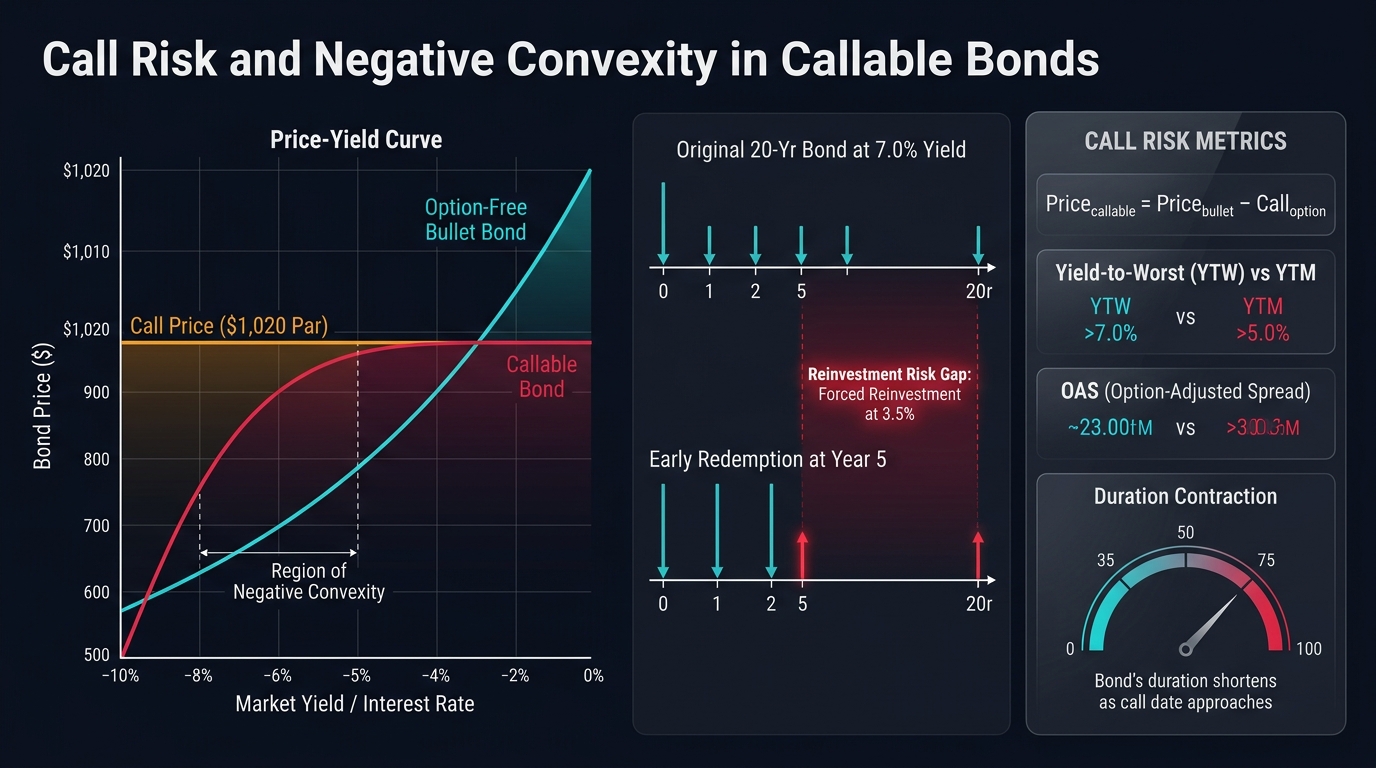
Call risk materializes almost exclusively during periods of declining macroeconomic interest rates. When benchmark borrowing yields fall, corporations and municipal agencies have an economic incentive to refinance high-coupon debt with newly issued, lower-cost bonds. For the bondholder, early redemption creates two severe financial disadvantages:
- Truncated Capital Appreciation: Unlike standard non-callable bonds, whose secondary market prices surge as interest rates plummet, a callable bond’s price appreciation is artificially compressed and capped near the call redemption price.
- Reinvestment Risk: The investor receives their principal capital back early precisely when the broader market offers substantially lower replacement yields, permanently depressing the portfolio’s future cash-flow stream.
Technical Mechanics & Reinvestment Shortfall Modeling
The financial penalty imposed by call risk can be quantified as the present value of the lost coupon differential over the bond’s remaining contractual life.
Reinvestment Shortfall Formulation
Let:
- $F$: Par value of the called bond.
- $C$: Original annual coupon rate of the called bond.
- $r_{\text{new}}$: Prevailing market reinvestment yield available on comparable replacement securities.
- $T_{\text{rem}}$: Number of years remaining until the bond’s original stated maturity.
The annual nominal income loss ($\Delta I$) is:
$$\Delta I = F \times \left( C - r_{\text{new}} \right)$$
The cumulative present value of total lost income ($\text{PV}_{\text{loss}}$) discounted at the new prevailing market rate is:
$$\text{PV}{\text{loss}} = \sum{t=1}^{T_{\text{rem}}} \frac{F \times (C - r_{\text{new}})}{(1 + r_{\text{new}})^t}$$
For example, if an institutional investor holds $10,000,000 in a 7.50% corporate bond called 10 years early when market yields drop to 3.50%:
$$\Delta I = $10,000,000 \times (0.075 - 0.035) = $400,000 \text{ annual cash loss}$$
$$\text{PV}_{\text{loss}} = $400,000 \times \left[ \frac{1 - (1 + 0.035)^{-10}}{0.035} \right] \approx $3,326,640$$
The bondholder suffers over $3.3 million in present-value economic loss as a direct consequence of call exercise.
Comparative Matrix: Fixed-Income Risk Vectors
| Risk Vector | Primary Trigger | Price Sensitivity Impact | Typical Hedging Instrument |
|---|---|---|---|
| Call Risk | Falling interest rates | Negative convexity (Price capped) | Payer Swaptions, Lockout Covenants |
| Extension Risk | Rising interest rates | Duration expands; price drops faster | Interest Rate Caps, Short Treasury Futures |
| Credit Default Risk | Deteriorating corporate solvency | Price collapses; credit spreads explode | Credit Default Swaps (CDS) |
| Inflation Risk | Surging consumer price indices | Real purchasing power eroded | TIPS, Floating Rate Notes |
Real-World Case Study: The Agency MBS Prepayment Shock (2020–2021)
Call risk is the defining structural risk of the multi-trillion-dollar US Mortgage-Backed Securities (MBS) market, issued by government-sponsored enterprises Fannie Mae, Freddie Mac, and Ginnie Mae.
Anatomy of an MBS Prepayment Wave:
1. The Rate Shock: In mid-2020, the Federal Reserve reduced benchmark interest rates to near-zero and purchased billions in agency MBS daily. US 30-year fixed mortgage rates collapsed from 3.75% to historic lows below 2.70%.
2. The Prepayment Avalanche: Millions of American homeowners exercised their embedded prepayment options (economically identical to call options) to refinance home loans.
3. Call Risk Materialization: Agency MBS pools experienced unprecedented Constant Prepayment Rates (CPR exceeding 40% annualized).
4. The Investor Squeeze: Fixed-income pension funds and insurance companies received hundreds of billions of dollars in early mortgage principal payoffs, which they were forced to reinvest into newly minted 1.50% Treasuries and 2.0% mortgage pools.
The wave demonstrated how call risk permanently impairs institutional portfolio yields when benchmark interest rates experience historic downward shifts.
Frequently Asked Questions (FAQ)
How can fixed-income investors protect their portfolios against call risk?
Investors manage call risk through four primary strategies:
- Demanding Call Protection: Purchasing bonds with long non-call periods (e.g., 10NC5 or 10NC7).
- Insisting on Make-Whole Call Covenants: Ensuring that if the bond is called, the issuer must pay a lump-sum premium compensating for all lost future coupon cash flows.
- Purchasing Non-Callable (Bullet) Bonds: Investing in standard US Treasuries or corporate bullets that cannot be redeemed prior to maturity.
- Evaluating Yield to Worst (YTW): Pricing bonds based strictly on Yield to Call (YTC) rather than Yield to Maturity (YTM).
Why do callable bonds exhibit “negative convexity”?
Convexity measures the curvature of the price-yield relationship. For a standard bond, as yields fall, price increases at an accelerating rate (positive convexity). For a callable bond, as yields decline toward the coupon rate, the probability of the bond being called approaches 100%. Investors refuse to pay significantly more than the call price for a bond that will soon be redeemed, causing the price curve to flatten and bend downward—a mathematical condition termed negative convexity.
Are municipal bonds subject to call risk?
Yes, heavily. A large majority of long-term municipal bonds (especially 20- and 30-year issues) feature standard 10-year call provisions. If a municipality’s tax revenues surge or municipal market interest rates decline after 10 years, local governments routinely issue lower-coupon refunding municipal bonds to call and retire the older, expensive debt issues, subjecting municipal bondholders to significant call risk.
Ready to trade forex?
Open a free demo account with a regulated broker. Practice with virtual funds before risking real money.