Call Provision
A call provision is a specific legal clause within a bond indenture that grants the issuing entity the contractual right to repurchase and retire all or part of the debt issue prior to maturity at a specified call schedule.
What Is a Call Provision?
A call provision (also known as a call feature or redemption clause) is a legally binding stipulation embedded within the indenture of a bond or preferred stock issue that grants the borrower (the issuer) the contractual prerogative to retire and redeem the debt obligations before their formal stated maturity date.
Because borrowing environments fluctuate across multi-decade horizons, corporations and sovereign agencies utilize call provisions to retain balance-sheet flexibility. If macroeconomic interest rates decline or the issuer’s corporate credit rating improves, the company can exercise the call provision, repay outstanding bondholders at a predetermined call price, and issue new replacement debt at substantially lower interest expense.
For fixed-income investors, a call provision introduces asymmetric downside: while the investor’s upside price appreciation is capped as yields fall, their downside risk remains fully exposed if interest rates rise or the issuer’s credit deteriorates.
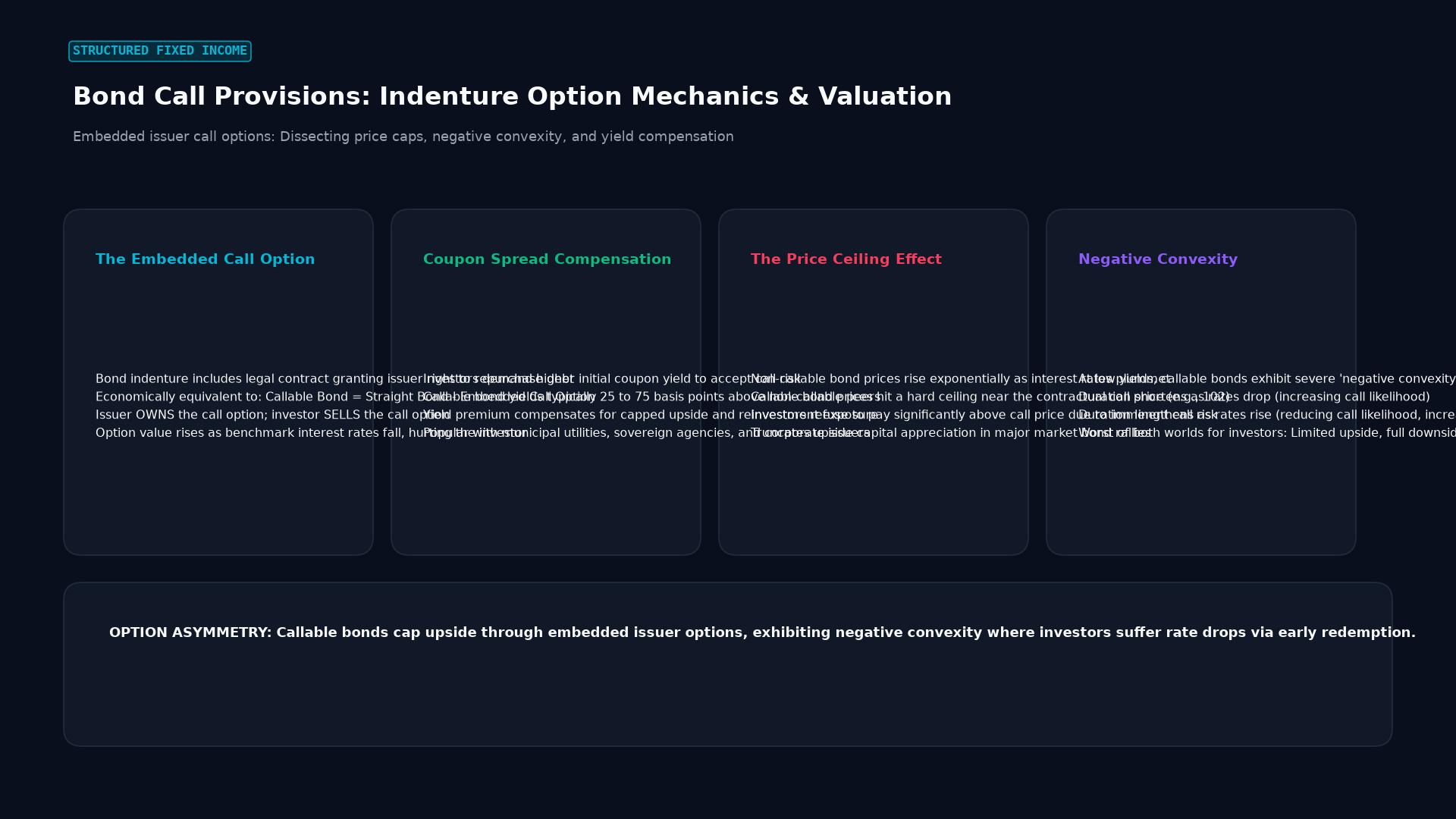 Figure: Embedded issuer call options: Dissecting price caps, negative convexity, and yield compensation
Technical Mechanics & Negative Convexity
Standard, non-callable bullet bonds exhibit positive convexity: as market yields fall, the bond’s price increases at an accelerating rate. Conversely, a bond with an active call provision exhibits negative convexity within the vicinity of the call price.
The Negative Convexity Mathematical Condition
Convexity ($C$) represents the second derivative of the bond price ($P$) with respect to yield ($y$):
$$C = \frac{1}{P} \frac{d^2 P}{dy^2}$$
- For a standard bullet bond: $C > 0$ across all yield levels.
- For a callable bond when prevailing yields drop below the coupon rate:
$$\frac{d^2 P}{dy^2} < 0 \quad (\text{Negative Convexity})$$
As interest rates fall, the price of the callable bond flattens and compresses toward the scheduled call price ($P_{\text{call}}$) because market participants know the issuer will exercise the call provision rather than allowing the bond to trade at a substantial premium.
Step-Down Call Premium Schedule
In traditional corporate bonds, the call price is structured to decline linearly over time toward par value ($100):
$$P_{\text{call}}(t) = 100 + \text{Initial Premium} \times \left( \frac{T_{\text{maturity}} - t}{T_{\text{maturity}} - T_{\text{first_call}}} \right)$$
Where the initial premium on the first call date is frequently set at one-half of the annual coupon rate.
Comparative Matrix: Call Provision Typologies
| Provision Type | Trigger Mechanism | Pricing Structure | Primary Issuers |
|---|---|---|---|
| Optional Redemption | Sole discretion of the issuer | Fixed schedule or declining premium | High-yield corporate issuers, utilities |
| Sinking Fund Call | Mandatory scheduled debt retirement | Redemptions at Par Value ($100) | Industrial corporations, municipal water districts |
| Extraordinary / Calamity Call | Triggered by catastrophic external event (fire, eminent domain) | Par Value ($100) | Municipal infrastructure & housing authorities |
| Make-Whole Call | Sole discretion of issuer | Present value of lost coupons discounted at Treasury + spread | Investment-grade corporations (Blue-chips) |
Real-World Case Study: The Housing Authority “Calamity Call” Shock
While corporate call provisions are well understood, municipal bond investors historically suffered unexpected losses through extraordinary redemption call provisions (calamity calls).
The Municipal Housing Bond Prepayment Trap:
1. The Issuance: Municipal housing authorities issue long-term 30-year tax-exempt bonds at a 6.0% coupon to fund subsidized low-interest mortgages for first-time homebuyers.
2. The Indenture Clause: The bond indenture includes an "extraordinary call provision" stating that if homeowners prepay their mortgages, the proceeds must be used to retire bonds immediately at Par ($100.00).
3. The Rate Crash: Mortgage rates plunge to 3.5%. Homeowners aggressively refinance their home loans.
4. The Investor Loss: Investors who bought these premium bonds in the secondary market at $115.00 suddenly find their bonds called at $100.00 without warning, sustaining an instant 13% capital loss.
The episode prompted rating agencies to require municipal issuers to explicitly disclose extraordinary redemption exposure on all secondary market offering sheets.
Frequently Asked Questions (FAQ)
Why do bond issuers insist on including call provisions?
Issuers include call provisions to insulate themselves against the risk of locking in high borrowing costs over long horizons. If economic conditions improve, macroeconomic interest rates fall, or the company’s credit rating is upgraded from “junk” to “investment grade,” an active call provision allows the issuer to extinguish the expensive debt and replace it with lower-cost capital, saving millions of dollars in annual interest expense.
What is a “Sinking Fund” call provision and how does it work?
A sinking fund provision requires the issuing company to retire a predetermined percentage of its outstanding debt issue each year prior to maturity (for example, retiring 5% of the total issue annually between years 10 and 20). The issuer can either buy bonds in the open secondary market if they trade below par, or randomly select bondholders via a lottery to have their bonds redeemed at exactly par value ($100).
How does an investor know whether a bond has a call provision?
All call provisions, schedules, and lockout dates are formally detailed in the bond’s official legal prospectus and indenture agreement. On financial terminals (such as Bloomberg or Morningstar), callable bonds are designated with call schedule tables detailing the “Next Call Date,” “Next Call Price,” and “Yield to Worst” (YTW) alongside standard yield metrics.
Ready to trade forex?
Open a free demo account with a regulated broker. Practice with virtual funds before risking real money.