Call Protection
Call protection is a protective covenant in a bond indenture or preferred stock agreement that prohibits the issuer from redeeming the security for a designated initial time period after issuance.
What Is Call Protection?
Call protection (often referred to as a deferred call period or call lockout period) is a contractual covenant embedded within a bond indenture or preferred equity agreement that legally bars the issuing corporation or sovereign agency from exercising its early redemption rights during a designated initial timeframe following the bond’s issue date.
When an investor purchases a fixed-income instrument, the greatest danger in a falling interest rate environment is reinvestment risk—the threat that the issuer will redeem the high-yielding bond early and return principal cash to the investor at a time when prevailing replacement yields are much lower. Call protection acts as an institutional guarantee that secures the investor’s right to receive the stated coupon payments without interference for a guaranteed baseline duration.
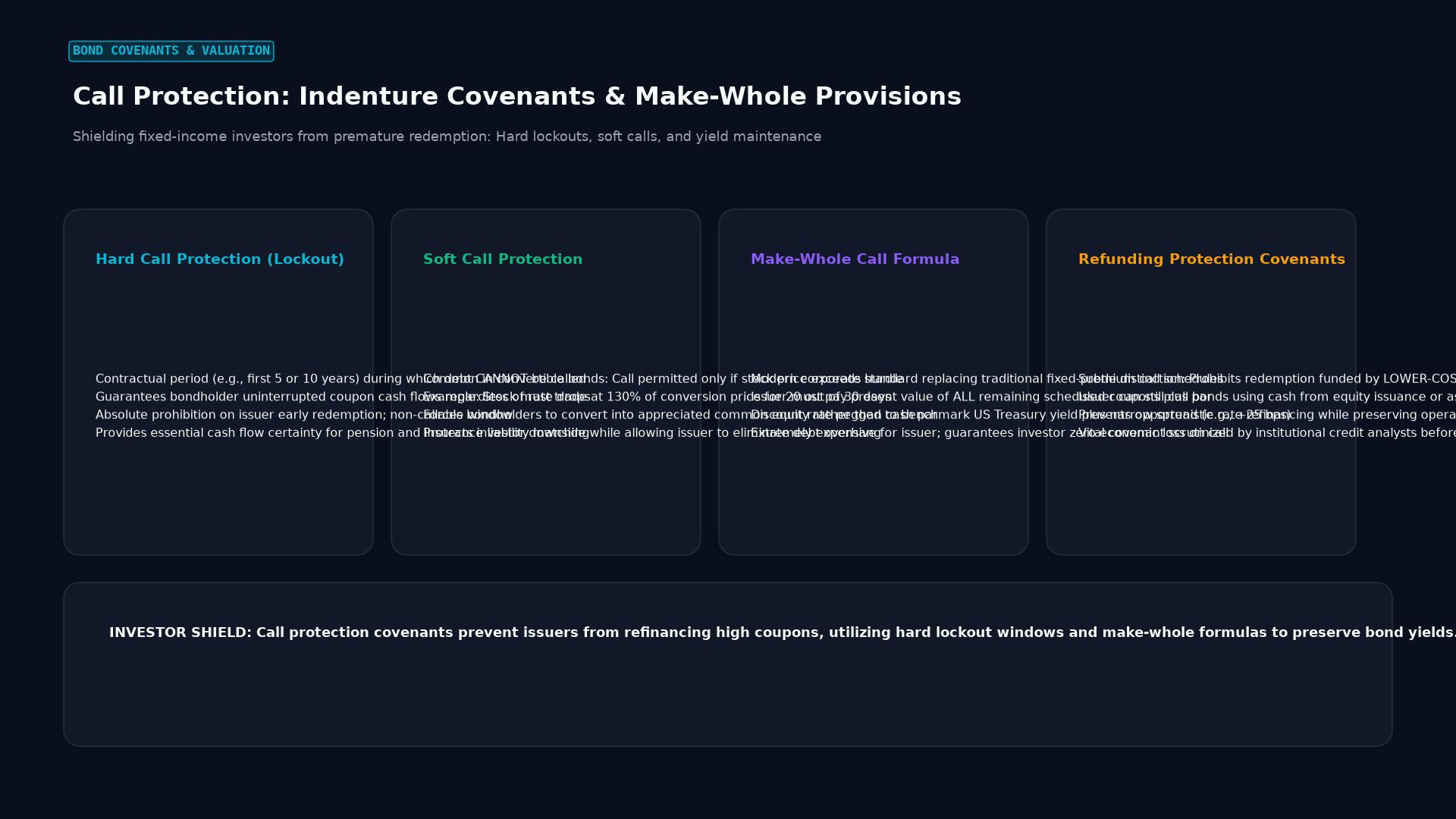 Figure: Shielding fixed-income investors from premature redemption: Hard lockouts, soft calls, and yield maintenance
Technical Mechanics & Valuation Impact
The theoretical value of a callable bond ($P_{\text{callable}}$) is derived by decomposing the security into an unencumbered bullet bond and an embedded call option:
$$P_{\text{callable}} = P_{\text{bullet}} - C_{\text{call}}$$
Where:
- $P_{\text{bullet}}$: The theoretical fair market price of an otherwise identical non-callable bond.
- $C_{\text{call}}$: The fair market value of the embedded call option held by the issuer (calculated via binomial interest rate trees or the Black-Derman-Toy model).
The Mathematical Impact of Call Protection
During the call protection window ($t < T_{\text{lockout}}$), the probability of immediate early redemption is zero. This constraint suppresses the value of the embedded call option ($C_{\text{call}} \to 0$), which:
- Maximizes Initial Duration: Preserves the bond’s full price sensitivity to falling benchmark yields.
- Eliminates Negative Convexity: Ensures the bond behaves like a standard bullet bond, allowing its market price to trade well above par value if market rates drop during the lockout period.
Structural Classification of Call Protection
| Protection Mechanism | Indenture Designation | Legal Constraint on Issuer | Typical Asset Class |
|---|---|---|---|
| Hard Call Protection | Discrete Non-Call Period (e.g., “NC-5”) | Absolute prohibition against calling under any circumstances | High-yield corporate bonds, municipal debt |
| Soft Call Protection | Contingent Redemption Clause | Permitted only upon specific events (e.g., IPO, change of control) accompanied by a steep premium | Leveraged loans, private credit |
| Make-Whole Call Protection | Make-Whole Call (MWC) Clause | Permitted at any time, but issuer must pay present value of all lost future coupons | Investment-grade corporate bonds |
| Declining Premium Schedule | Step-Down Call Schedule | Permitted after lockout, but issuer must pay Par + % premium that scales down to zero over time | High-yield corporate bonds |
Real-World Case Study: “NC-5” Structures in Leveraged Buyout (LBO) Debt
In the private equity and leveraged finance markets, institutional debt syndicates (pension funds, insurance companies, and collateralized loan obligations) enforce strict call protection covenants on high-yield corporate bonds.
Anatomy of an LBO High-Yield Issuance (10-Year "10NC5" Bond):
- Issuance: A private equity sponsor issues $1 billion in 10-year senior secured notes at an 8.50% coupon to fund an acquisition.
- Covenant ("10NC5"): The bond is a 10-year note with 5 years of hard call protection (Non-Call 5).
- Scenario A (Year 3): Benchmark market interest rates plummet by 300 basis points. The issuer would love to refinance the debt at 5.50%, saving $30 million annually.
- The Call Protection Shield: Because the bond is in Year 3 of its 5-year lockout, the issuer is legally barred from calling the bonds. The bonds surge in the secondary market to $112.00, allowing investors to capture massive capital gains.
- Scenario B (Year 5): The lockout expires. The issuer exercises the call provision on the First Call Date, paying bondholders Par ($100.00) plus an initial 4.25% call premium ($104.25).
Without the 5-year hard call protection covenant, institutional debt investors would have seen their high-yielding investment terminated within months of issuance.
Frequently Asked Questions (FAQ)
What does “10NC3” or “8NC4” mean in bond documentation?
In fixed-income prospectuses, this standard shorthand specifies the bond’s total maturity alongside its call protection period:
- 10NC3: A 10-year bond that is Non-Callable for the first 3 years.
- 8NC4: An 8-year bond that is Non-Callable for the first 4 years. In both instances, the issuer cannot redeem the bond early until the specified non-call period (3 or 4 years) has elapsed.
How does the presence of call protection impact a bond’s offering yield?
Call protection provides immense value to the investor by guaranteeing cash flows and limiting reinvestment risk. Consequently, the longer the call protection period, the lower the yield the issuer must offer to sell the bond. A 10-year bond with 7 years of call protection can be sold at a lower coupon rate than an otherwise identical 10-year bond with only 2 years of call protection.
What is a “Make-Whole” call provision and how does it protect investors?
A Make-Whole Call (MWC) is an advanced call structure prevalent in investment-grade corporate bonds. Unlike traditional calls (which redeem at fixed par or modest premiums), a make-whole provision requires the issuer to pay a lump sum equal to the present value of all remaining future coupon payments plus principal, discounted at the prevailing benchmark US Treasury rate plus a small contractual spread (e.g., 25 to 50 basis points). Because this payment fully compensates (“makes whole”) the bondholder for all lost future income, it neutralizes reinvestment risk.
Ready to trade forex?
Open a free demo account with a regulated broker. Practice with virtual funds before risking real money.