Call Swaption (Payer Swaption)
A call swaption (conventionally termed a payer swaption) is an over-the-counter derivative option granting the buyer the right, but not the obligation, to enter into an interest rate swap as the fixed-rate payer and floating-rate receiver at a specified swap rate.
What Is a Call Swaption?
In over-the-counter (OTC) interest rate derivatives, a call swaption—conventionally designated in institutional interbank dealing as a payer swaption—is an option contract on an underlying Interest Rate Swap (IRS).
The swaption buyer pays an upfront cash premium to the swaption writer. In return, the buyer obtains the contractual right, but not the obligation, to enter into an interest rate swap at a predetermined future date (the exercise date) where the buyer will Pay a Fixed interest rate (the strike rate, $K$) and Receive a Floating interest rate (such as SOFR, Euribor, or SONIA) based on a specified notional principal.
Because the holder of a payer swaption pays a fixed rate and receives a floating rate, the contract becomes increasingly valuable as prevailing market swap rates rise. Economically, a payer swaption acts as a call option on interest rates (or equivalently, a put option on bond prices).
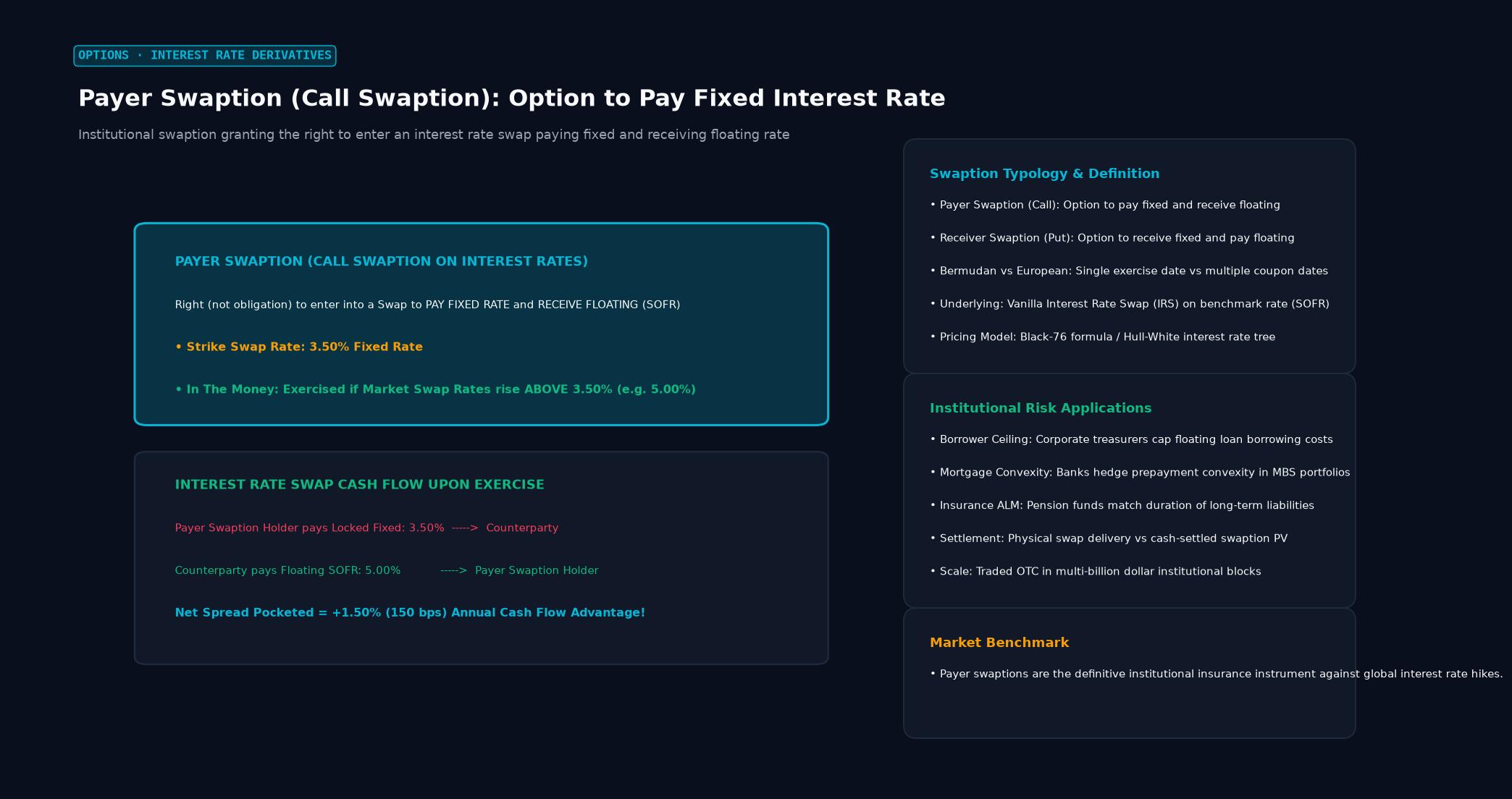 Figure: Institutional swaption granting the right to enter an interest rate swap paying fixed and receiving floating rate
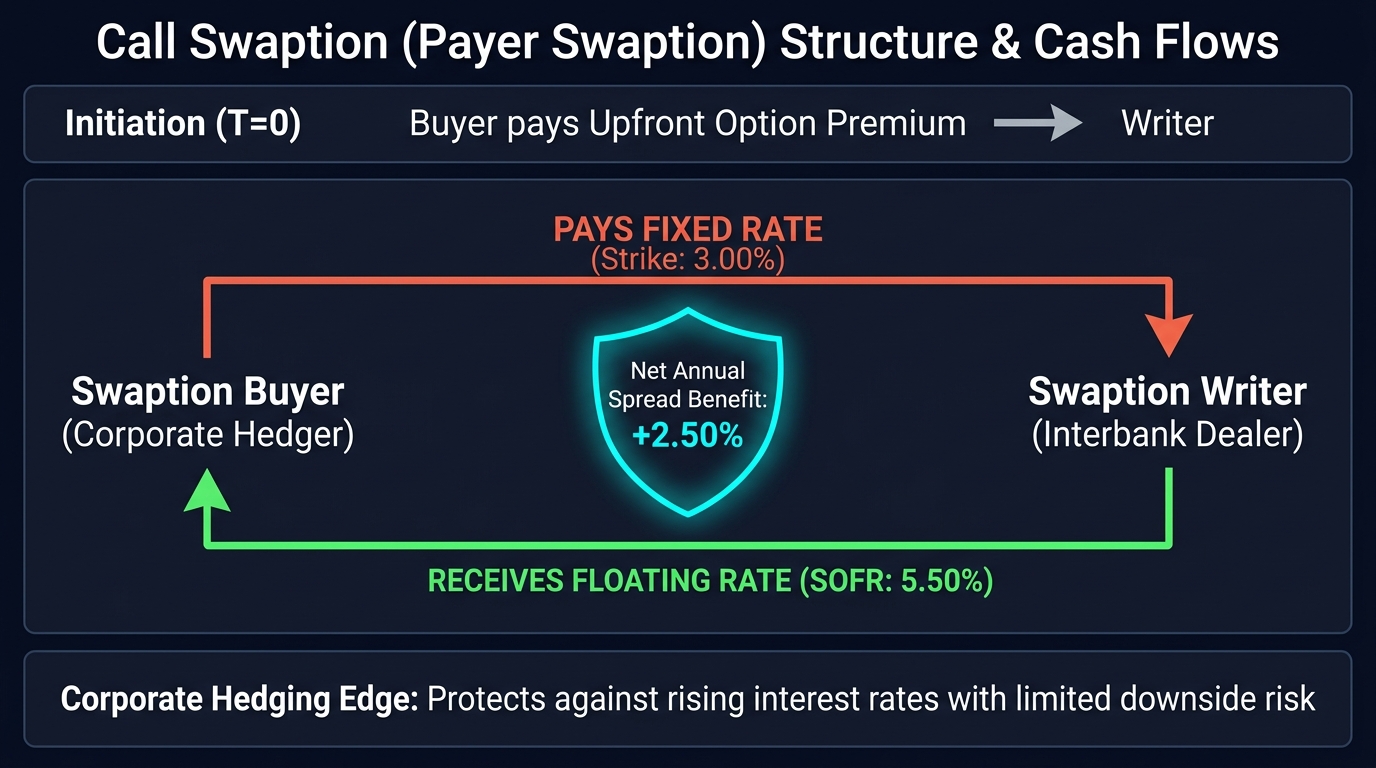
Technical Mechanics & Black’s Pricing Model
Swaptions are priced across the global interbank market using Black’s Model (Black-76) for forward swap rates, evaluated on a forward-starting swap annuity.
The Black Swaption Pricing Formula
The value of an European-style payer swaption ($V_{\text{payer}}$) is derived as:
$$V_{\text{payer}} = A(t) \cdot \left[ S_0 N(d_1) - K N(d_2) \right]$$
Where:
- $S_0$: Current forward swap rate for the underlying swap tenor.
- $K$: Contractual strike swap rate.
- $A(t)$: The Swap Annuity Factor (or PV01), representing the present value of a one basis point stream over the swap’s payment dates $T_i$: $$A(t) = \sum_{i=1}^{n} \tau_i P(0, T_i)$$ (Where $\tau_i$ is the year fraction for period $i$, and $P(0, T_i)$ is the zero-coupon discount factor).
- $N(\cdot)$: The cumulative standard normal distribution function.
- $d_1 = \frac{\ln(S_0 / K) + \frac{1}{2} \sigma^2 T}{\sigma \sqrt{T}}$
- $d_2 = d_1 - \sigma \sqrt{T}$
- $\sigma$: Annualized implied volatility of the forward swap rate (quoted from the interbank swaption volatility matrix).
The Embedded Swaption Equivalence
In institutional fixed-income analytics, a callable corporate bond is mathematically decomposed into an unencumbered bullet bond and an embedded swaption:
$$\text{Callable Bond} \equiv \text{Bullet Bond} - \text{Receiver Swaption}$$
$$\text{Borrower’s Synthetic Cap} \equiv \text{Floating Debt} + \text{Payer Swaption}$$
Comparative Matrix: Interest Rate Derivative Instruments
| Derivative Contract | Right / Obligation | Primary Benefit | Market Exposure |
|---|---|---|---|
| Payer Swaption (Call) | Right to Pay Fixed / Receive Floating | Hedges against rising rates | Net Long Interest Rates ($\Delta > 0$) |
| Receiver Swaption (Put) | Right to Receive Fixed / Pay Floating | Hedges against falling rates | Net Short Interest Rates ($\Delta < 0$) |
| Interest Rate Swap (IRS) | Obligation to exchange fixed/floating | Locks in precise borrowing cost | Linear interest rate exposure |
| Interest Rate Cap | Series of call options on floating rate | Caps max rate on floating debt | Non-linear upside rate protection |
Real-World Case Study: Corporate Debt Refinancing Hedges (2021–2022)
In late 2021, multinational corporations faced an acute risk: benchmark interest rates were anchored at zero, but soaring inflation indicated that the Federal Reserve would soon embark on an aggressive rate-hiking cycle.
Corporate Treasury Swaption Strategy:
1. The Exposure: A multinational industrial company planned to issue $2 billion in 10-year bonds in late 2022 to fund facility expansions.
2. The Risk: If 10-year benchmark rates surged before issuance, corporate borrowing costs would balloon by hundreds of millions of dollars.
3. The Trade: In November 2021, the corporate treasurer purchased a "1-Year into 10-Year" Payer Swaption (1Yx10Y) with a strike rate of 2.00% on the SOFR swap rate, paying an upfront premium of $18 million.
4. The Shock: By November 2022, the 10-year swap rate exploded to 4.25% (a 225-basis-point surge).
5. The Execution: The corporation exercised the payer swaption, locking in an effective 2.00% fixed rate on the swap and monetizing an intraday present value gain of over $320 million, completely neutralizing the surge in bond issuance yields.
Frequently Asked Questions (FAQ)
Why is a payer swaption termed a “call swaption”?
In derivatives conventions, an option is classified as a “call” if it gives the holder the right to buy the underlying instrument or benefits when the underlying price/rate rises. In interest rate markets, a payer swaption gives the holder the right to pay a fixed rate and receive a floating rate. As benchmark interest rates rise above the strike rate, the swaption gains value, making it functionally equivalent to a call option on interest rates.
What does “2Yx5Y” mean in interbank swaption quotation?
In interbank derivatives markets, swaptions are quoted using a standard “Option Tenor $\times$ Underlying Swap Tenor” matrix. A 2Yx5Y swaption (read as “two-year into five-year”) denotes an option that expires in two years, which, upon exercise, enters into a five-year interest rate swap.
What is the difference between physical settlement and cash settlement for a swaption?
Under physical settlement, the exercising party actually enters into a live interest rate swap with the counterparty for the remaining tenor, exchanging fixed and floating cash flows across future quarters. Under cash settlement, no live swap is created; instead, the swaption writer calculates the lump-sum net present value (NPV) of the in-the-money swap payments discounted at prevailing benchmark rates and wires that single cash amount to the buyer upon exercise.
Ready to trade forex?
Open a free demo account with a regulated broker. Practice with virtual funds before risking real money.