Vega
Vega (symbolized as ν) is a first-order derivative Greek that measures the sensitivity of an option contract's premium to a one-percentage-point (1%) change in the implied volatility of the underlying asset.
What Is Vega?
In options pricing and quantitative derivatives trading, Vega (technically not a letter in the Greek alphabet, but universally designated in financial mathematics by the Greek letter nu, $\nu$) quantifies the absolute price change of an option for every $1.00%$ ($100$ basis point) shift in the implied volatility ($\sigma$) of the underlying asset.
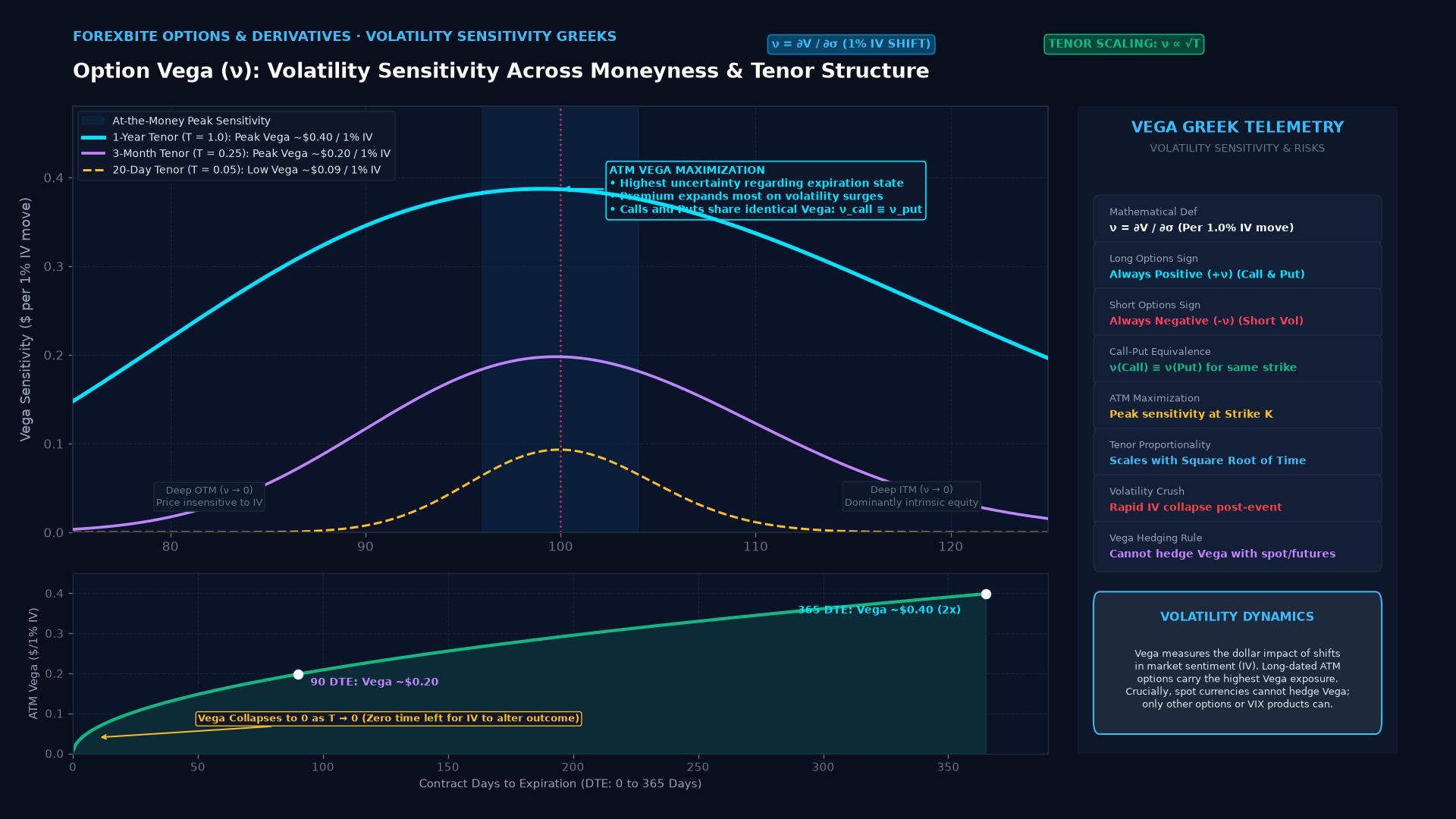
All long option positions—both calls and puts—possess positive Vega ($\nu > 0$). When market uncertainty expands and implied volatility rises, option premiums inflate because the probability of the underlying asset experiencing an extreme, profitable in-the-money excursion increases. Conversely, all short option positions possess negative Vega ($\nu < 0$), benefiting from volatility contractions (volatility crush) but suffering acute losses if volatility spikes unexpectedly.
Mathematical Formulation: The Black-Scholes Vega
Under the continuous Black-Scholes-Merton framework (and the Garman-Kohlhagen currency extension), Vega is the first partial derivative of option price ($V$) with respect to volatility ($\sigma$):
$$\nu = \frac{\partial V}{\partial \sigma} = S_0 e^{-q T} \sqrt{T} \phi(d_1)$$
Where:
- $S_0$: Current spot price of the underlying asset.
- $q$: Continuous dividend yield or foreign currency interest rate ($r_f$).
- $T$: Time to expiration in years.
- $\phi(d_1)$: The standard normal probability density function evaluated at $d_1$: $$\phi(d_1) = \frac{1}{\sqrt{2\pi}} e^{-\frac{d_1^2}{2}}$$
- $d_1 = \frac{\ln(S_0 / K) + \left( r - q + \frac{\sigma^2}{2} \right) T}{\sigma \sqrt{T}}$
Crucial Mathematical Properties:
- Call-Put Equivalence: Because $\phi(d_1)$ is identical for both calls and puts, a European call option and a European put option with identical strikes and expiries share the exact same Vega: $$\nu_{\text{call}} = \nu_{\text{put}}$$
- Tenor Proportionality: Vega scales proportionally with the square root of time to expiration ($\sqrt{T}$). A 1-year option possesses approximately twice the Vega of a 3-month option on the same asset.
Vega Exposure Across the Primary Greeks
| Greek | Mathematical Derivative | Measures Sensitivity To | Position Sign (Long Option) |
|---|---|---|---|
| Vega ($\nu$) | $\frac{\partial V}{\partial \sigma}$ | $1%$ change in Implied Volatility | Always Positive (+) |
| Delta ($\Delta$) | $\frac{\partial V}{\partial S}$ | $$1.00$ change in Underlying Spot Price | Positive for Calls, Negative for Puts |
| Gamma ($\Gamma$) | $\frac{\partial^2 V}{\partial S^2}$ | Change in Delta per $$1.00$ Spot Move | Always Positive (+) |
| Theta ($\Theta$) | $\frac{\partial V}{\partial t}$ | Passage of 1 calendar day (Time Decay) | Always Negative (-) |
Vega Hedging: Creating a Volatility-Neutral Book
Market makers and institutional options desks isolate directional price risk by maintaining a delta-neutral book ($\sum \Delta = 0$). However, a delta-neutral book remains heavily vulnerable to volatility shocks.
To neutralize volatility risk, traders execute Vega Hedging by trading secondary option contracts:
$$\nu_{\text{portfolio}} = \sum_{i=1}^{n} w_i \nu_i = 0$$
Because underlying spot or futures contracts have zero volatility sensitivity ($\nu_{\text{underlying}} = 0$), a trader cannot hedge Vega using spot or futures. Hedging Vega mandates buying or selling other options, variance swaps, or volatility futures (such as Cboe VIX futures).
Real-World Institutional Case Study: “Volmageddon” & The Short Vega Apocalypse (Feb 5, 2018)
Between 2016 and 2017, global financial markets entered an unprecedented period of artificial tranquility, with the Cboe VIX Index averaging historic lows near $9.0$–$11.0$.
Institutional hedge funds and retail retail traders heavily shorted volatility to harvest yield, crowding into exchange-traded products like the VelocityShares Daily Inverse VIX Short-Term ETN (XIV). These products held massive short Vega positions, effectively betting that volatility would remain permanently depressed.
[Monday, February 5, 2018: The Volmageddon Unwinding]
S&P 500 slipped 4.1% during regular market hours
                    |
                    v
At 16:00 EST Market Close: VIX spiked from 17.0 to 37.3 (A record +115% surge in hours)
                    |
                    v
CATASTROPHIC SHORT VEGA LIABILITIES:
Inverse ETN issuers (Credit Suisse) were contractually forced by their prospectuses
to buy hundreds of thousands of VIX futures in the after-hours market to re-hedge
                    |
                    v
FEEDBACK LOOP: Automated re-hedging drove VIX futures parabolically higher
XIV Net Asset Value collapsed from $1.9 Billion to under $63 Million in 60 minutes (-96%)
                    |
                    v
Result: XIV triggered an automatic termination acceleration event, completely wiping out investors
Volmageddon served as an indelible lesson in the destructive power of unhedged short Vega. While shorting options and collecting premium yields steady profits during stable regimes, an unexpected explosion in implied volatility creates non-linear, existential capital losses.
Frequently Asked Questions
If implied volatility rises, do both calls and puts increase in value?
Yes. Both call options and put options possess positive Vega when held long. An increase in implied volatility increases the likelihood that the underlying asset will swing widely enough to land deep in-the-money for both upside calls and downside puts, increasing the extrinsic time value of both contracts simultaneously.
What is “volatility crush”?
Volatility crush refers to the rapid collapse in an option’s implied volatility (and consequently its premium) immediately following the resolution of a major anticipated event—such as a corporate earnings announcement, an FOMC interest rate decision, or an election. Even if the underlying stock moves in the trader’s anticipated direction, the severe drop in Vega can cause the option premium to drop.
How does Vega change as an option approaches expiration?
As time to expiration ($T$) approaches zero, Vega collapses toward zero across all strike prices ($\lim_{T \to 0} \sqrt{T} = 0$). An option expiring in a few hours has almost no Vega sensitivity because there is insufficient time remaining for future volatility swings to alter the terminal outcome.
Ready to trade forex?
Open a free demo account with a regulated broker. Practice with virtual funds before risking real money.