Wholesale Money
Wholesale money refers to large-denomination funds borrowed, lent, and settled directly between commercial banks, corporations, central banks, and institutional money managers in the wholesale money market.
What Is Wholesale Money?
Wholesale money refers to large-denomination financial capital borrowed, lent, and cleared among institutional market participants—including commercial banks, sovereign central banks, asset managers, pension funds, and multinational corporations—rather than retail depositors.
While retail banking relies on millions of small, insured checking and savings accounts gathered through brick-and-mortar branches and consumer apps, wholesale money markets operate through direct interbank dealing, automated electronic brokerage networks, and primary dealer repo desks. Transactions in wholesale money routinely clear in minimum tranche sizes of $10 million, $50 million, or $100 million.
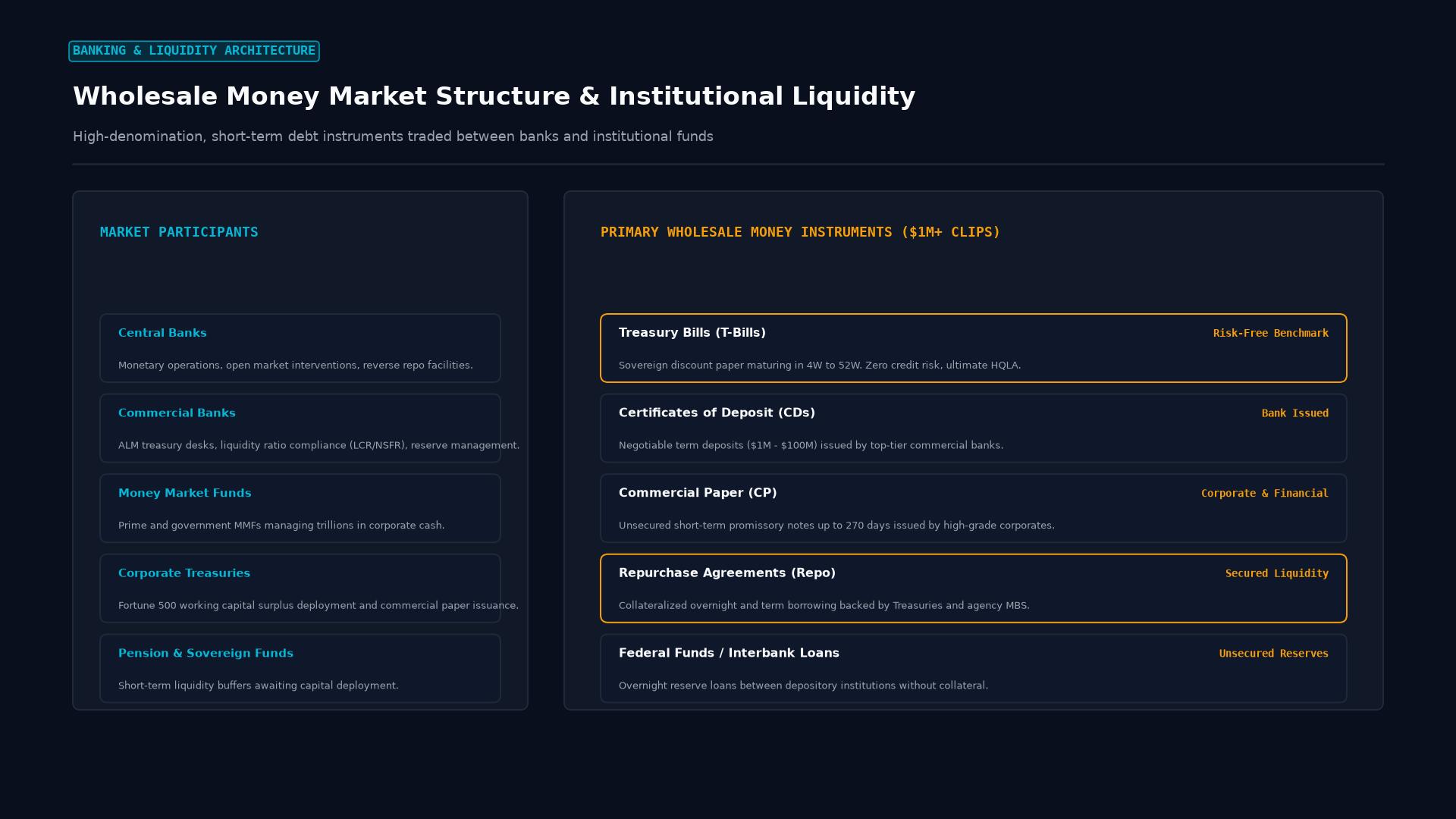 Figure: Wholesale liquidity market structure: institutional participants trading multi-million dollar T-Bills, CDs, Commercial Paper, and Repurchase Agreements.
Technical Instruments & Regulatory Mechanics
The wholesale money market comprises several core instruments, each varying by credit collateralization, duration, and counterparty exposure:
- Repurchase Agreements (Repo): Collateralized short-term borrowing where one institution sells securities (typically US Treasuries or agency MBS) to a lender with an agreement to repurchase them at an agreed date and higher price.
- Commercial Paper (CP): Unsecured promissory notes issued by highly rated corporations and bank holding companies with fixed maturities rarely exceeding 270 days.
- Negotiable Certificates of Deposit (CDs): Transferable, large-denomination time deposits issued by commercial banks that can be traded in secondary markets prior to maturity.
- Fed Funds / Interbank Deposits: Unsecured loans between depository institutions to maintain required overnight reserve balances held at the central bank.
Regulatory Metrics: Basel III Liquidity Standards
Because wholesale funding is highly sensitive to counterparty credit ratings, post-2008 Basel III regulations imposed strict constraints on institutional wholesale dependency:
$$\text{Liquidity Coverage Ratio (LCR)} = \frac{\text{Total Stock of High-Quality Liquid Assets (HQLA)}}{\text{Total Net Cash Outflows over 30-Day Stress Period}} \ge 100%$$
$$\text{Net Stable Funding Ratio (NSFR)} = \frac{\text{Available Stable Funding (ASF)}}{\text{Required Stable Funding (RSF)}} \ge 100%$$
Under Basel III, unsecured wholesale funding provided by financial institutions is assigned a 100% run-off factor over a 30-day stress horizon, forcing banks to hold dollar-for-dollar liquid sovereign bonds against short-term wholesale liabilities.
Comparative Matrix: Wholesale vs. Retail Banking Funding
| Dimension | Wholesale Funding | Retail Deposit Funding |
|---|---|---|
| Typical Ticket Size | $10,000,000 to $500,000,000 | $500 to $250,000 |
| Deposit Insurance | Uninsured (Exceeds sovereign guarantee caps) | Insured (Covered by FDIC, FSCS, or equivalent) |
| Rate Sensitivity | Hyper-sensitive; reprices daily on SOFR/Euribor basis | Sticky; slow to react to central bank rate changes |
| Operational Overhead | Extremely low (electronic dealing desks) | High (branch real estate, compliance, customer support) |
| Flight Risk (Run Risk) | Extreme; institutional capital exits within seconds | Low; retail consumers exhibit high inertia |
Real-World Case Study: The Wholesale Funding Shock (Northern Rock 2007)
The collapse of the British mortgage lender Northern Rock in September 2007 remains the classic historical textbook case of wholesale funding vulnerability.
The Anatomy of a Wholesale Funding Collapse:
- The Business Model: Northern Rock aggressively expanded mortgage lending, funding over 75% of its balance sheet through short-term wholesale money markets (securitization and commercial paper) rather than retail branch deposits.
- The Shock: In August 2007, subprime mortgage defaults froze global asset-backed commercial paper (ABCP) and interbank repo markets. Counterparty banks refused to roll over short-term wholesale debt.
- The Crisis: Northern Rock faced a massive liquidity shortfall within days, unable to refinance its maturing wholesale borrowings.
- The Result: The bank was forced to seek emergency liquidity support from the Bank of England, triggering the first major retail bank run in the UK in 140 years and eventual sovereign nationalization.
The Northern Rock disaster demonstrated that reliance on short-term wholesale markets to fund long-term illiquid assets (mortgages) creates fatal maturity transformation mismatches when interbank liquidity evaporates.
Frequently Asked Questions (FAQ)
Why is wholesale money considered more risky for a bank’s stability than retail money?
Wholesale money consists of uninsured funds managed by professional corporate treasurers and institutional asset managers who have a fiduciary duty to preserve principal. If the slightest rumor emerges regarding a bank’s solvency or credit rating downgrade, wholesale depositors will immediately withdraw their funds or refuse to roll over maturing commercial paper. Retail depositors, by contrast, are protected by government deposit insurance schemes (like the FDIC) and exhibit behavioral inertia, making retail deposits far stickier during financial panics.
How did the Secured Overnight Financing Rate (SOFR) reshape wholesale money markets?
Following international investigations into the manipulation of the unsecured London Interbank Offered Rate (LIBOR), global regulators phased out LIBOR in favor of transaction-backed risk-free rates. In the United States, the Alternative Reference Rates Committee (ARRC) selected the Secured Overnight Financing Rate (SOFR), which is calculated based on hundreds of billions of dollars of actual overnight Treasury repurchase transactions, providing a transparent, manipulation-resistant benchmark for wholesale borrowing.
What is the Federal Reserve’s Overnight Reverse Repo Facility (ON RRP)?
The Overnight Reverse Repo Facility (ON RRP) is a critical monetary policy tool operated by the Federal Reserve. It allows eligible non-bank financial institutions—such as money market mutual funds and government-sponsored enterprises—to lend cash to the Fed overnight against Treasury collateral at a fixed interest rate. By offering this facility, the Fed establishes a firm floor under short-term wholesale interest rates, preventing excess liquidity in the financial system from driving overnight repo yields below the Fed’s target range.
Ready to trade forex?
Open a free demo account with a regulated broker. Practice with virtual funds before risking real money.