Central African CFA Franc (XAF)
The Central African CFA Franc (ISO: XAF) is the shared official currency of Cameroon and five other CEMAC member states, pegged at a fixed parity to the Euro and guaranteed by the French Treasury.
What Is the Central African CFA Franc (XAF)?
The Central African CFA Franc (ISO code: XAF) is the official common currency of the six member states of the Central African Economic and Monetary Community (CEMAC): Cameroon, the Central African Republic, Chad, the Republic of the Congo, Equatorial Guinea, and Gabon.
Issued by the regional central bank—the Bank of Central African States (BEAC), headquartered in Yaoundé, Cameroon—the currency’s acronym originally stood for Colonies Françaises d’Afrique upon its creation in 1945, before being reformed post-independence as Coopération Financière en Afrique Centrale.
Cameroon is the demographic and economic powerhouse of the CEMAC zone, generating over 40% of the monetary union’s total Gross Domestic Product (GDP). Because the XAF is locked in a hard currency peg to the Euro (EUR), guaranteed by the French National Treasury, member nations enjoy exceptionally low inflation relative to the rest of Sub-Saharan Africa, balanced against the surrender of independent monetary policy and sovereign exchange rate flexibility.
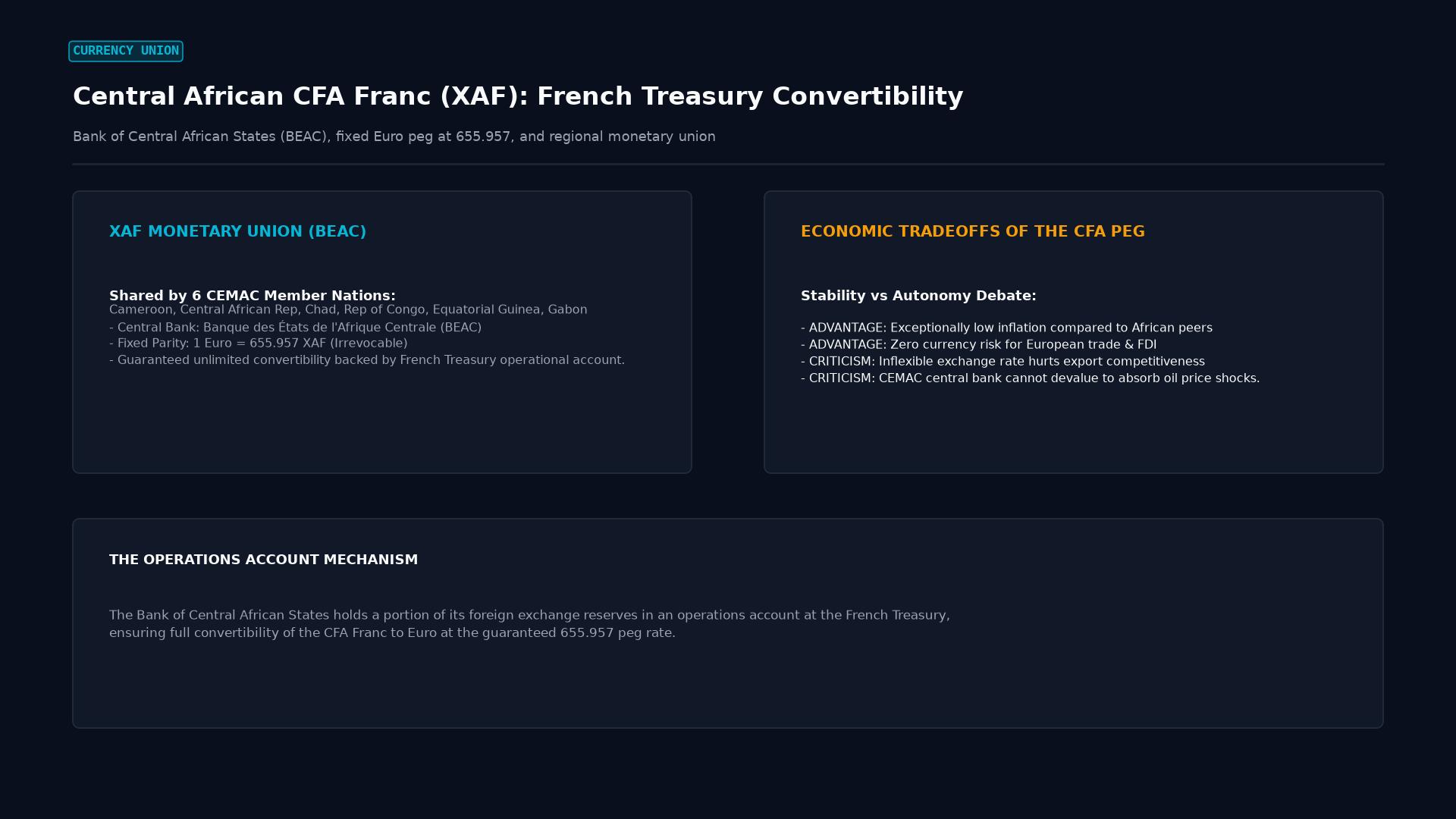 Figure: CEMAC monetary union: BEAC central bank issuing the CFA Franc pegged to the Euro at 655.957 with French Treasury operational account convertibility guarantees.
Technical Mechanics & The French Treasury Operations Account
The foundational stability of the Central African CFA Franc relies on institutional treaties between the BEAC and the French Treasury.
The Fixed Parity Ratio
Following the introduction of the Euro on January 1, 1999, the historical French Franc peg (100 XAF = 1 FRF) was mathematically converted into the Euro at the fixed conversion rate:
$$1 \text{ EUR} = 655.957 \text{ XAF} \quad (\text{Strictly Invariable})$$
The Operations Account Protocol (Compte d’Opérations)
Under the monetary cooperation agreement:
- Reserve Pooling: The BEAC historically deposited 50% of its total net foreign exchange reserves into a specialized operations account maintained directly at the French Treasury in Paris.
- Unlimited Convertibility: In exchange, the French Treasury grants an unlimited overdraft facility, guaranteeing that any XAF denominated balance can be converted into Euros at the official parity.
- Monetary Discipline: If the BEAC’s foreign reserve coverage ratio (foreign reserves divided by short-term liabilities) drops below the statutory 20% emergency threshold:
$$\text{Reserve Coverage Ratio} = \frac{\text{Net Foreign Assets}}{\text{Sight Liabilities}} < 20%$$
The BEAC is legally mandated to hike interest rates, restrict commercial bank refinancing, and implement emergency foreign exchange repatriation rationing.
Comparative Matrix: The CFA Franc Monetary Unions
| Dimension | Central African CFA (XAF) | West African CFA (XOF) | Eurozone Euro (EUR) |
|---|---|---|---|
| Regional Bloc | CEMAC (6 Central African States) | WAEMU / UEMOA (8 West African States) | European Union (20 member states) |
| Central Bank | BEAC (Yaoundé, Cameroon) | BCEAO (Dakar, Senegal) | European Central Bank (Frankfurt) |
| Dominant Economy | Cameroon (~40% of GDP) | Ivory Coast (~40% of GDP) | Germany (~28% of GDP) |
| Exchange Rate | Fixed to Euro: 655.957 XAF | Fixed to Euro: 655.957 XOF | Free Floating Benchmark |
| Cross-Circulation | Not legal tender in WAEMU | Not legal tender in CEMAC | Legal tender across Eurozone |
Critical Operational Distinction: While both CFA Francs share the exact same parity to the Euro (655.957), they are distinct currencies issued by different central banks; an XAF banknote cannot be spent in West African countries (like Senegal or Ivory Coast) without undergoing formal foreign exchange conversion.
Real-World Case Study: The 1994 CFA Devaluation & 2016 Oil Shock
The 50% Devaluation of January 12, 1994
Throughout the late 1980s, collapsing global cocoa, coffee, and crude oil prices combined with a strong French Franc rendered the CFA zone economies uncompetitive.
- On January 12, 1994, in Dakar, African leaders and French authorities executed a 50% overnight devaluation, changing the parity from 1 FRF = 50 CFA to 1 FRF = 100 CFA.
- The sudden devaluation halved the purchasing power of imported goods in Cameroon, but triggered an immediate export boom in timber, cocoa, and aluminum, restoring balance-of-payments equilibrium across the zone.
The 2014–2016 Commodity Crisis
Between 2014 and 2016, crude oil prices collapsed from $110 to $30. Because five of the six CEMAC member states are hydrocarbon exporters, regional foreign exchange reserves plummeted dangerously close to the 20% statutory threshold, triggering intense market rumors of a second 50% devaluation. In December 2016, Cameroonian President Paul Biya hosted an emergency summit in Yaoundé with IMF Managing Director Christine Lagarde, successfully averting devaluation by agreeing to strict IMF stabilization programs and stringent foreign exchange repatriation mandates.
Frequently Asked Questions (FAQ)
Can an investor spend Central African CFA Francs (XAF) in West Africa?
No. Despite sharing the same name (“CFA Franc”), identical fixed parities to the Euro (655.957), and identical French Treasury guarantees, the Central African CFA Franc (XAF) and the West African CFA Franc (XOF) are separate legal currencies issued by separate central banks (BEAC vs. BCEAO). Commercial banks and money changers in West Africa treat XAF as a foreign currency, charging standard foreign exchange conversion fees.
What are the main economic criticisms of the CFA Franc system?
Critics argue that the fixed peg to the Euro artificially overvalues the currency, making non-oil exports from nations like Cameroon uncompetitive relative to regional peers with flexible currencies (such as Nigeria or Ghana). Furthermore, by outsourcing monetary policy to the European Central Bank and holding foreign reserves in Paris, member nations forfeit independent monetary tools to combat localized unemployment. Proponents, however, note that CEMAC countries have maintained average annual inflation rates below 3% for decades, completely avoiding the destructive hyperinflation that devastated neighboring economies.
How does Cameroon dominate the CEMAC monetary zone?
Cameroon possesses the most diversified economy in Central Africa. Unlike its CEMAC peers (such as Equatorial Guinea, Gabon, and the Republic of the Congo), which are almost entirely dependent on oil extraction, Cameroon has an extensive agricultural export base (cocoa, coffee, bananas, cotton), substantial timber production, and the region’s primary deep-sea logistics hub—the Port of Douala. Consequently, Cameroon generates the steady trade flows and tax receipts that anchor regional banking liquidity.
Ready to trade forex?
Open a free demo account with a regulated broker. Practice with virtual funds before risking real money.