Two-Tier Market
A two-tier market is a dual exchange rate regime wherein a sovereign monetary authority operates two separate foreign exchange tiers: an official, subsidized peg for priority trade transactions and a floating or parallel market rate for financial capital flows.
What Is a Two-Tier Market?
A two-tier market (also known as a dual exchange rate system) is a macroeconomic foreign exchange framework in which a central bank or monetary authority establishes two separate conversion rates for the same domestic currency. Rather than permitting the entire economy to adjust through a single market-clearing floating exchange rate, the state bifurcates transactions into commercial and financial categories:
- Commercial Tier (Official Tier): A fixed, managed, or subsidized exchange rate strictly reserved for current account transactions deemed vital to national interests—such as staple food imports, petroleum, medical equipment, and approved debt service.
- Financial Tier (Market / Parallel Tier): A free-floating or heavily penalized exchange rate that absorbs private capital flows, speculative portfolio investments, offshore remittances, and outbound tourism.
Two-tier markets are traditionally implemented during balance-of-payments crises when a central bank’s foreign currency reserves are insufficient to defend a single exchange rate peg against intense speculative capital flight.
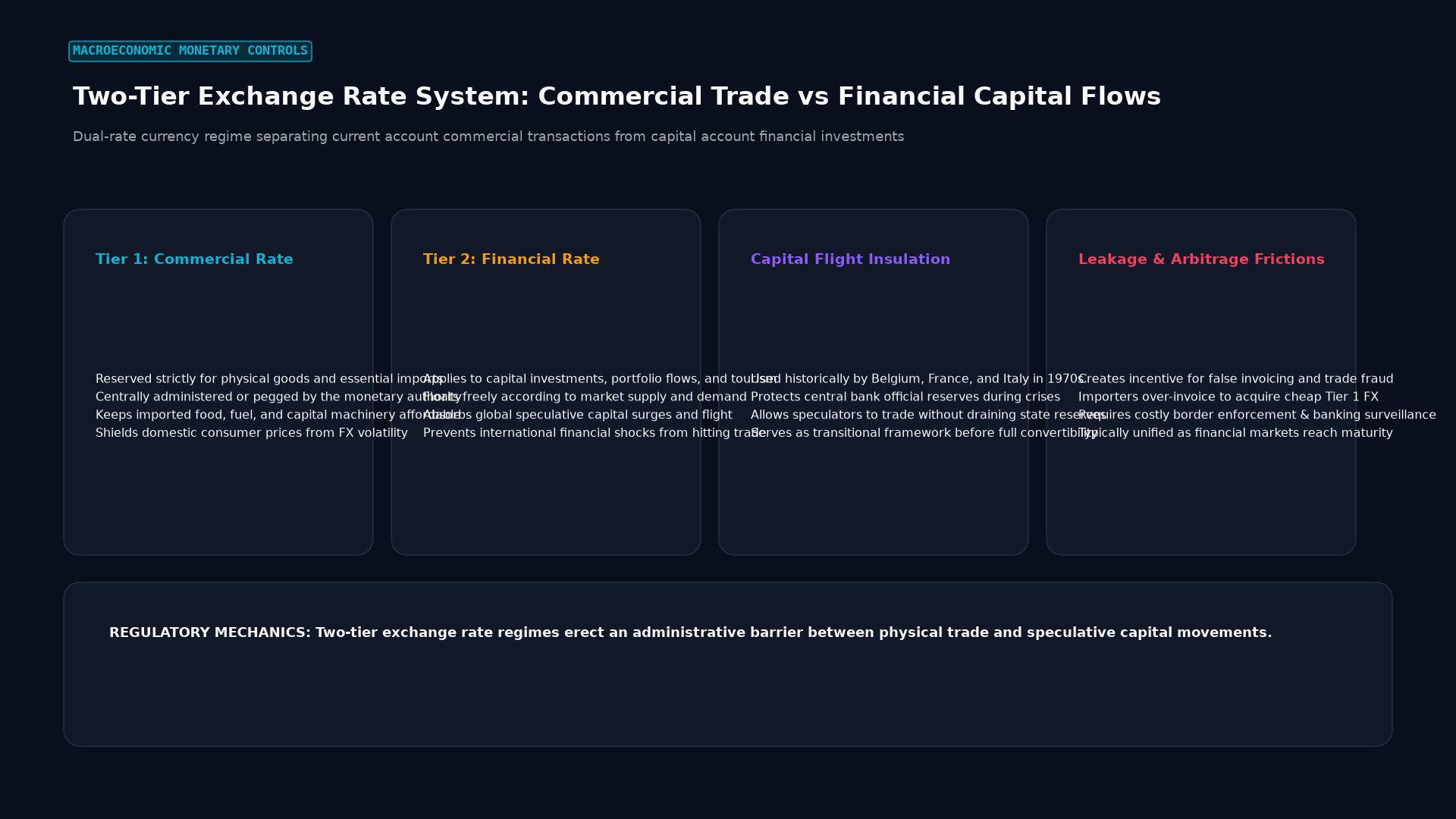 Figure: Dual-rate currency regime separating current account commercial transactions from capital account financial investments
Economic Formulation & The Parallel Spread
The primary metric evaluating stability in a two-tier exchange regime is the parallel spread (or dual exchange rate premium):
$$\text{Premium}{\text{parallel}} = \left( \frac{S{\text{financial}} - S_{\text{official}}}{S_{\text{official}}} \right) \times 100$$
Where $S_{\text{financial}}$ represents the units of domestic currency required to purchase one unit of foreign exchange in the free or parallel market, and $S_{\text{official}}$ is the subsidized government rate.
The Effective Real Exchange Rate (ERER)
Under a two-tier regime, the economy’s aggregate price competitiveness reflects a weighted average of both tiers:
$$\text{RER}{\text{eff}} = \left[ \omega \cdot S{\text{official}} + (1 - \omega) \cdot S_{\text{financial}} \right] \times \frac{P^*}{P}$$
Where $\omega$ represents the share of imports settled through the official window, $P^*$ is the foreign price level, and $P$ is the domestic price level. As the financial tier depreciates, import price inflation spills over into domestic consumer prices regardless of government subsidies.
Exchange Rate Regimes Compared
Monetary authorities evaluate two-tier systems against alternative currency arrangements based on capital control enforcement and market efficiency:
| Regime Type | Price Discovery | Capital Mobility | Central Bank Intervention | Long-Term Sustainability |
|---|---|---|---|---|
| Free-Floating | Continuous market clearing via interbank order flow | Unrestricted ($100%$ capital account convertibility) | Minimal / Ad-hoc smoothing | High (automatic external adjustment) |
| Conventional Peg | Fixed by decree; defended via FX reserves | Dependent on capital controls or interest rate parity | Continuous open-market intervention | Vulnerable to speculative attacks when reserves deplete |
| Two-Tier (Dual Market) | Divided: administered for trade, market-driven for capital | Segmented; strict legal documentation required | High in commercial tier; minimal in financial tier | Low; creates pervasive illicit arbitrage and corruption |
| Multiple Currency (MCP) | Fragmented into 3+ sector-specific exchange rates | Heavily restricted; bureaucratic rationing | Total central bank monopoly over foreign currency | Extremely poor; causes severe economic distortion |
Structural Leakages: The Breakdown of Dual Regimes
While theoretically attractive to policymakers seeking to shield working-class consumers from imported inflation, two-tier markets inherently foster systemic economic distortions:
[Incentive to Exploit the Spread]
Official Rate: 1 USD = 30 Local Currency | Financial Rate: 1 USD = 60 Local Currency
                                  |
                                  v
1. TRADE OVER-INVOICING:
   Importers falsify shipping manifests, requesting $10M at the official 30 rate.
   They import $2M of actual goods and divert $8M to the financial market at 60.
   Risk-free illicit profit = 240 Million Local Currency.

2. EXPORT UNDER-INVOICING:
   Exporters report only 50% of real export value to evade surrendering FX at 30,
   smuggling the remaining 50% abroad to sell on the parallel tier at 60.
These structural leakages inevitably drain the central bank’s foreign exchange reserves, forcing the official rate to undergo a massive, disorderly devaluation to re-unify the market.
Real-World Institutional Case Studies
1. The Belgian-Luxembourg Dual Exchange Market (1957–1990)
The most successful historic application of a two-tier market operated in the Belgium-Luxembourg Economic Union (BLEU). Following the post-WWII reconstruction, authorities established the Franc Commercial (pegged within Bretton Woods and European Snake bands for merchandise trade) and the Franc Financier (freely floating for capital movements). Supported by rigorous customs inspections and institutional compliance, the dual spread remained below $5%$ for decades, buffering the Belgian economy from speculative US Dollar capital outflows until full European Single Market integration forced unification in March 1990.
2. Egypt’s Dual Rate Crisis & The March 2024 Devaluation
In 2022–2024, Egypt operated a de facto two-tier market following foreign capital flight sparked by rising global interest rates. The Central Bank of Egypt maintained an official peg of approximately $30.9$ Egyptian Pounds (EGP) per US Dollar for state food and energy imports, while the parallel black market surged beyond $65$ EGP per USD—a parallel premium exceeding $110%$.
Commercial business ground to a halt as foreign shipping lines, international airlines, and automotive manufacturers refused to operate at the official rate. On March 6, 2024, as part of an expanded $$8$ billion International Monetary Fund (IMF) agreement, Egypt dismantled the two-tier structure, aggressively raising interest rates by $600$ basis points and allowing the EGP to collapse $38%$ to unified market-clearing levels near $49.5$ EGP per USD.
Frequently Asked Questions
Why do central banks institute two-tier exchange rate systems?
Central banks adopt two-tier systems during severe foreign exchange shortages to insulate domestic prices of essential survival goods (food, fuel, pharmaceuticals) from the volatility of financial capital outflows. By walling off speculative capital into a floating secondary tier, authorities attempt to conserve scarce foreign currency reserves.
Why does the International Monetary Fund (IMF) oppose two-tier markets?
Under Article VIII of the IMF Articles of Agreement, member nations pledge to avoid engaging in Multiple Currency Practices (MCPs). The IMF opposes dual rates because they distort international trade pricing, subsidize favored domestic industries at the expense of exporters, foster bureaucratic corruption, and impede efficient capital allocation.
How do traders exploit a two-tier market?
Traders and corporations exploit two-tier markets through trade misinvoicing: obtaining access to cheap foreign currency under the pretext of importing essential goods, and then redirecting those funds into the parallel or offshore market to capture the spread premium. Institutional traders monitor parallel premiums as leading indicators of imminent sovereign currency devaluations.
Ready to trade forex?
Open a free demo account with a regulated broker. Practice with virtual funds before risking real money.