Unconvertible Currency
An unconvertible currency, or non-convertible currency, is a sovereign legal tender that cannot be freely exchanged for foreign currencies or gold on international markets due to strict governmental capital controls, legal prohibitions, or economic isolation.
What Is an Unconvertible Currency?
An unconvertible currency (frequently referred to as a non-convertible currency or blocked currency) is a national monetary unit that cannot be freely converted into foreign currencies on open foreign exchange markets. Sovereign governments enforce unconvertibility through draconian foreign exchange controls, criminalizing unauthorized currency exchanges, mandating the compulsory surrender of foreign export revenues to the central bank, and forbidding domestic residents and foreign investors from repatriating capital.
Unconvertibility is typically deployed by regimes experiencing severe balance-of-payments deficits, hyperinflation, acute shortages of foreign reserves, or geopolitical embargoes. Because international commercial banks cannot clear these currencies across cross-border payment networks, unconvertible currencies have virtually zero external purchasing power outside their domestic borders and are excluded from international interbank continuous settlement systems (such as CLS Bank).
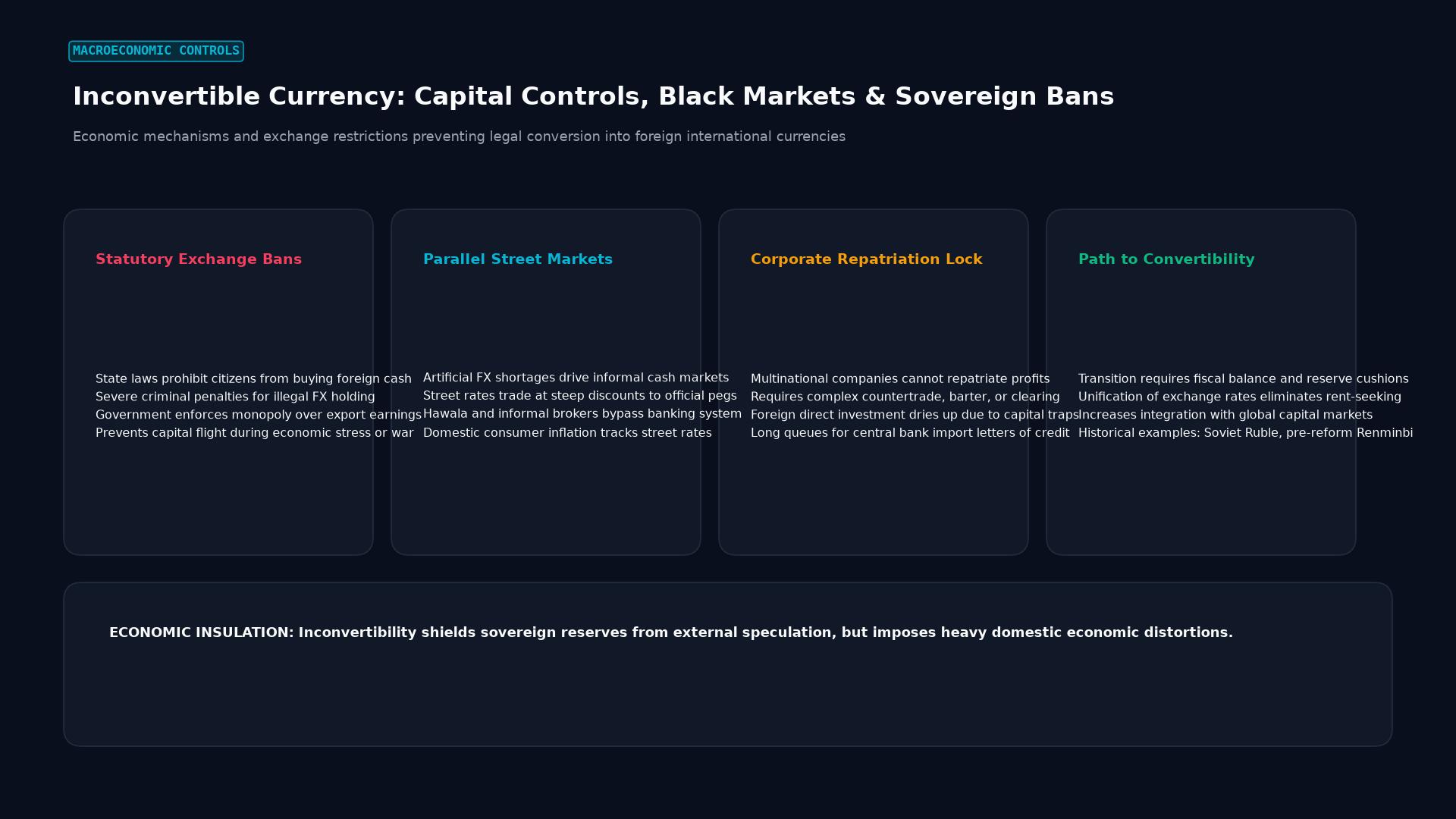 Figure: Economic mechanisms and exchange restrictions preventing legal conversion into foreign international currencies
The Economics of Currency Convertibility
The International Monetary Fund (IMF) evaluates currency convertibility under its Articles of Agreement through two distinct operational dimensions:
1. Current Account Convertibility (Article VIII)
A currency satisfies current account convertibility when the government imposes no restrictions, discriminatory currency arrangements, or multiple exchange rates on payments and transfers for international transactions—such as importing goods, paying for foreign services, or servicing foreign debt.
2. Capital Account Convertibility
Capital account convertibility permits domestic and foreign entities to convert domestic currency to acquire foreign financial assets (equities, bonds, real estate, direct investments) and vice versa without administrative restrictions.
Countries with unconvertible currencies violate both dimensions, asserting total state monopolization over external financial transactions:
[Domestic Exporter] ---> Sells goods abroad for $1,000,000 USD
                                   |
                                   v  (State Mandate)
Must surrender 100% of USD to Central Bank at artificial official rate
                                   |
                                   v
Receives illiquid, unconvertible domestic currency; barred from converting back
Trading Unconvertible Currencies: Non-Deliverable Forwards (NDFs)
Because unconvertible and partially convertible currencies cannot be physically delivered offshore, institutional global macro desks and multinational corporations trade them synthetically using Non-Deliverable Forwards (NDFs).
An NDF is an over-the-counter forward contract settled entirely in a freely convertible reserve currency (predominantly US Dollars) based on the net difference between the agreed contract forward rate and the official fixing rate on the valuation date.
NDF Cash Settlement Formula
For a corporate treasurer hedging exposure by agreeing to buy base currency at forward rate $F$ with notional USD amount $N$:
$$\text{Cash Settlement (USD)} = N \times \left( \frac{S_{\text{fixing}} - F}{S_{\text{fixing}}} \right)$$
Where:
- $N$: Notional principal amount in US Dollars.
- $F$: Contracted NDF forward exchange rate.
- $S_{\text{fixing}}$: Spot exchange rate determined by a recognized benchmark authority (e.g., central bank daily fix or industry association) on the fixing date.
Because only net US Dollar cash flows are exchanged between counterparties, zero domestic unconvertible currency ever crosses international borders, cleanly bypassing host-country capital controls.
Comparison Across Convertibility Regimes
| Feature | Fully Convertible (e.g., USD, EUR) | Partially Convertible (e.g., INR, CNY) | Unconvertible (e.g., KPW, CUC) |
|---|---|---|---|
| Offshore Physical Trading | Unrestricted on all global ECNs | Restricted; dual onshore/offshore rates (e.g., CNY vs CNH) | Prohibited; zero offshore liquidity |
| Capital Repatriation | Instantaneous via SWIFT / RTGS | Subject to central bank regulatory permits and tax clearance | Strictly blocked or confiscated |
| Derivatives Market | Deliverable forwards, futures, and options | Non-Deliverable Forwards (NDFs) and NDOs | None; illicit black-market cash exchange only |
| Exchange Rate Determination | Free market order book price discovery | Central bank daily reference rate with fluctuation bands | Fixed by decree; severe parallel black-market discount |
Real-World Institutional Case Study: The Soviet Ruble & Foreign Currency Certificates
During the Soviet era, the Soviet Ruble (SUR) was strictly unconvertible. Under Article 88 of the RSFSR Criminal Code, unauthorized foreign currency transactions were classified as state treason, punishable by long prison terms or capital punishment. The official exchange rate was arbitrarily pegged by the state planning agency (Gosbank) at approximately $$1.30$ to $$1.60$ per Ruble.
Because Western businesses, foreign diplomats, and Soviet citizens working abroad (sailors, engineers, translators) generated hard convertible foreign currency, the state created a segmented multi-tier internal system. Gosbank issued specialized Vneshposyltorg Certificates (later “Checks”) denominated in Rubles but backed by hard currency:
[Hard Foreign Currency Inflow]
Soviet sailor earns US Dollars abroad
                 |
                 v (Forced Conversion at Vneshtorgbank)
Receives "Vneshposyltorg Checks" (Yellow-stripe or Blue-stripe certificates)
                 |
                 v
Could ONLY be spent in exclusive state-run "Beryozka" retail shops
(Offering Western electronics, premium clothing, and scarce foodstuffs)
                 |
                 v
Parallel Black Market Rate: Checks traded at 5x to 10x the value of normal Rubles
This artificial unconvertibility created pervasive economic distortions, giving birth to a massive underground black market where Western tourists exchanged cash US Dollars for cash Rubles at rates ten times higher than the official rate. The system finally disintegrated between 1991 and 1992 when the newly formed Russian Federation abolished foreign exchange restrictions and liberalized the Ruble, causing nominal prices to adjust overnight.
Frequently Asked Questions
Can an individual take unconvertible currency across international borders?
National customs authorities typically impose strict physical limits or outright bans on carrying unconvertible banknotes out of the country. Even if a traveler successfully transports unconvertible physical banknotes abroad, foreign commercial banks, airport exchange kiosks, and retail dealers will refuse to accept or convert them because they cannot be cleared back into the issuing country’s banking system.
How do multinational companies get profits out of countries with unconvertible currencies?
Multinational corporations utilize several institutional mechanisms:
- Reinvestment in Local Capital: Purchasing domestic commercial real estate or funding local operational expansion.
- Transfer Pricing & Royalties: Licensing intellectual property or providing management consulting services from offshore entities invoiced at permissible service rates.
- Barter / Counter-Trade: Using local currency profits to purchase domestically produced agricultural commodities or raw materials that are physically exported and sold overseas for hard currency.
What is the difference between a blocked account and an unconvertible currency?
An unconvertible currency refers to the systemic legal and macroeconomic status of an entire sovereign monetary unit. A blocked account is a specific bank account whose funds are legally frozen—often due to international economic sanctions (e.g., OFAC designations), judicial asset freezes, or specific foreign exchange control decrees targeting specific entities.
Ready to trade forex?
Open a free demo account with a regulated broker. Practice with virtual funds before risking real money.