Canadian Dollar (CAD - 'Loonie')
The Canadian Dollar (ISO: CAD) is the sovereign currency of Canada and a primary G10 commodity currency, renowned in global foreign exchange for its deep liquidity, benchmark status, and strong econometric correlation with crude oil prices.
What Is the Canadian Dollar (CAD)?
The Canadian Dollar (ISO code: CAD) is the official currency of Canada, regulated and issued by the Bank of Canada (BoC). In global foreign exchange trading, the Canadian Dollar ranks among the top six most actively traded currencies, accounting for approximately 5% to 6% of daily global interbank foreign exchange turnover.
Traders universally refer to the Canadian Dollar as the “Loonie,” an affectionate market nickname derived from the solitary image of the aquatic common loon bird embossed on the reverse of the Canadian one-dollar coin introduced in 1987.
Within the G10 currency complex, the Canadian Dollar functions as the quintessential North American commodity currency. Canada possesses the world’s fourth-largest proven crude oil reserves (dominated by Alberta’s oil sands) and is an essential global exporter of natural gas, timber, uranium, potash, and wheat. Consequently, the currency’s valuation reflects a dynamic interplay between domestic resource exports, global commodity demand, and the intense economic integration shared with the United States.
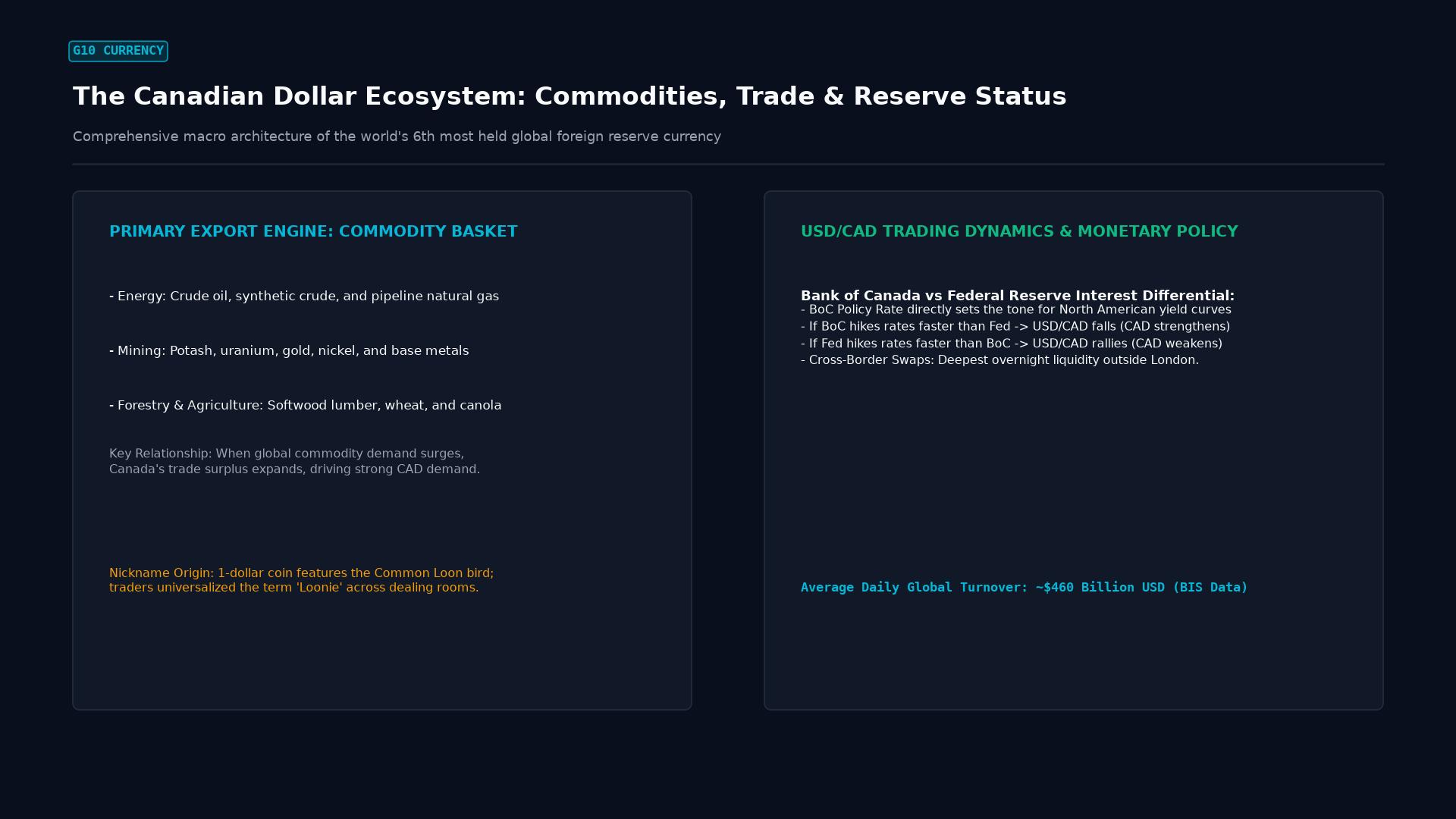 Figure: Comprehensive Canadian dollar macro structure: G10 reserve status, energy terms-of-trade, Bank of Canada policy rate spreads, and USMCA commerce.
Technical Mechanics & Econometric Energy Modeling
In quantitative foreign exchange modeling, the exchange rate of USD/CAD (the US Dollar quoted against the Canadian Dollar) is modeled as a function of the energy terms of trade and the 2-year sovereign yield differential:
The USD/CAD Econometric Specification
$$\Delta \ln(\text{USD/CAD})t = \alpha - \beta_1 \Delta \ln(\text{WTI Crude}t) - \beta_2 (r{\text{BoC}} - r{\text{Fed}})_t - \beta_3 \Delta \text{VIX}_t + \epsilon_t$$
Where:
- $\beta_1 > 0$: A rise in West Texas Intermediate (WTI) or Western Canadian Select (WCS) crude oil prices expands Canada’s terms of trade, appreciating the CAD and driving the USD/CAD exchange rate lower.
- $\beta_2 > 0$: A widening interest rate spread where the Bank of Canada overnight rate exceeds the US Federal Reserve Fed Funds rate attracts cross-border carry capital, strengthening CAD.
- $\beta_3 > 0$: Spikes in global risk aversion (VIX) prompt international investors to flee into the US Dollar safe-haven, pushing USD/CAD higher.
The Unique T+1 Settlement Convention
Unlike most other major G10 currency pairs (such as EUR/USD, GBP/USD, and USD/JPY) which clear on a standard T+2 working day settlement horizon, USD/CAD settles on a T+1 working day basis. Because financial networks in Toronto (Lynx) and New York (Fedwire) operate across identical time zones and geographic borders, interbank clearing is completed in 24 hours.
Comparative Matrix: Major G10 Commodity Currencies
| Currency | ISO Code | Nickname | Primary Commodity Drivers | Correlation to S&P 500 |
|---|---|---|---|---|
| Canadian Dollar | CAD | “Loonie” | Crude Oil, Natural Gas, Timber, Wheat | High (US Business Cycle) |
| Australian Dollar | AUD | “Aussie” | Iron Ore, Coal, Gold, LNG (China proxy) | Very High (Global Growth) |
| New Zealand Dollar | NZD | “Kiwi” | Dairy Products (Whole Milk Powder), Meat | High (Asian Consumer) |
| Norwegian Krone | NOK | “Krone” | Brent Crude Oil, Natural Gas, Salmon | Moderate (European Energy) |
Real-World Case Study: The 2014–2015 Crude Oil Shock & The “Loonie” Drop
The structural vulnerability of the Canadian Dollar to international energy price shocks was demonstrated during the historic crude oil collapse of 2014–2015.
Anatomy of an Oil-Driven Currency Plunge:
1. The Starting Baseline (June 2014): WTI crude oil traded at $107 per barrel; USD/CAD traded near parity at 1.0650.
2. The Supply Glut: A surge in US shale production combined with OPEC's decision to maintain production quotas caused global oil prices to freefall, dropping from $107 to below $30 per barrel by January 2016.
3. The Macro Impact: Canadian energy investment collapsed by over 40%, corporate profits plummeted, and economic growth turned negative.
4. Central Bank Reaction: To shield the real economy, Bank of Canada Governor Stephen Poloz enacted two emergency interest rate cuts in 2015, dropping the policy rate to 0.50%.
5. The FX Outcome: USD/CAD skyrocketed from 1.0650 to an eleven-year peak of 1.4600 (a massive 27% devaluation of the Canadian Dollar).
The episode illustrated why institutional global macro desks treat USD/CAD as a liquid, high-leverage trade on global energy commodity supply and demand dynamics.
Frequently Asked Questions (FAQ)
Why is the Canadian Dollar nicknamed the “Loonie”?
The nickname derives from the distinctive design of the Canadian one-dollar coin introduced by the Royal Canadian Mint in 1987 to replace paper dollar bills. The reverse side of the 11-sided bronze-plated nickel coin features an engraving of a solitary common loon bird floating on a northern lake. The nickname was immediately adopted by Canadian citizens and subsequently standardized across global financial media and institutional trading floors.
How closely is the Canadian economy tied to the United States?
The Canadian economy exhibits an extraordinary degree of integration with the United States. Over 75% of total Canadian merchandise exports are shipped directly to the US market under the United States-Mexico-Canada Agreement (USMCA). Due to deeply intertwined manufacturing supply chains (particularly the automotive corridor between Ontario and Michigan), Canada’s macroeconomic growth cycle mirrors that of the United States with an empirical correlation exceeding 0.85.
How does the Western Canadian Select (WCS) discount affect the Loonie?
Canada produces heavy, sour crude oil known as Western Canadian Select (WCS), extracted primarily from Alberta’s bitumen oil sands. Because WCS requires complex refining and must travel through constrained pipeline corridors to US Gulf Coast refineries, it trades at a persistent discount (the “WCS-WTI differential”) below light sweet benchmark crude. When pipeline bottlenecks widen this discount to $20 or $30 per barrel, Canadian export tax revenues decline sharply, exerting downward pressure on the Canadian Dollar even if global oil prices appear stable.
Ready to trade forex?
Open a free demo account with a regulated broker. Practice with virtual funds before risking real money.