Working Day (Business Day)
A working day (or business day) is any calendar day on which commercial banks in relevant financial centers are open for business to clear payments and settle foreign exchange and money market transactions.
What Is a Working Day?
In financial markets and foreign exchange operations, a working day (frequently designated as a business day) is any calendar day on which commercial banks and national central bank clearing settlement systems are open for regular operations in the relevant financial centers.
In foreign exchange, determining a valid working day is inherently more complex than in domestic equity markets. Because an FX transaction involves swapping two sovereign currencies, a valid working day for settlement requires that commercial banks in both financial centers be open simultaneously. If an American trader executes a EUR/USD spot contract on a Monday, and Wednesday is a public bank holiday in Germany or France (TARGET2 closed), settlement cannot take place on Wednesday and must roll forward to the next joint working day.
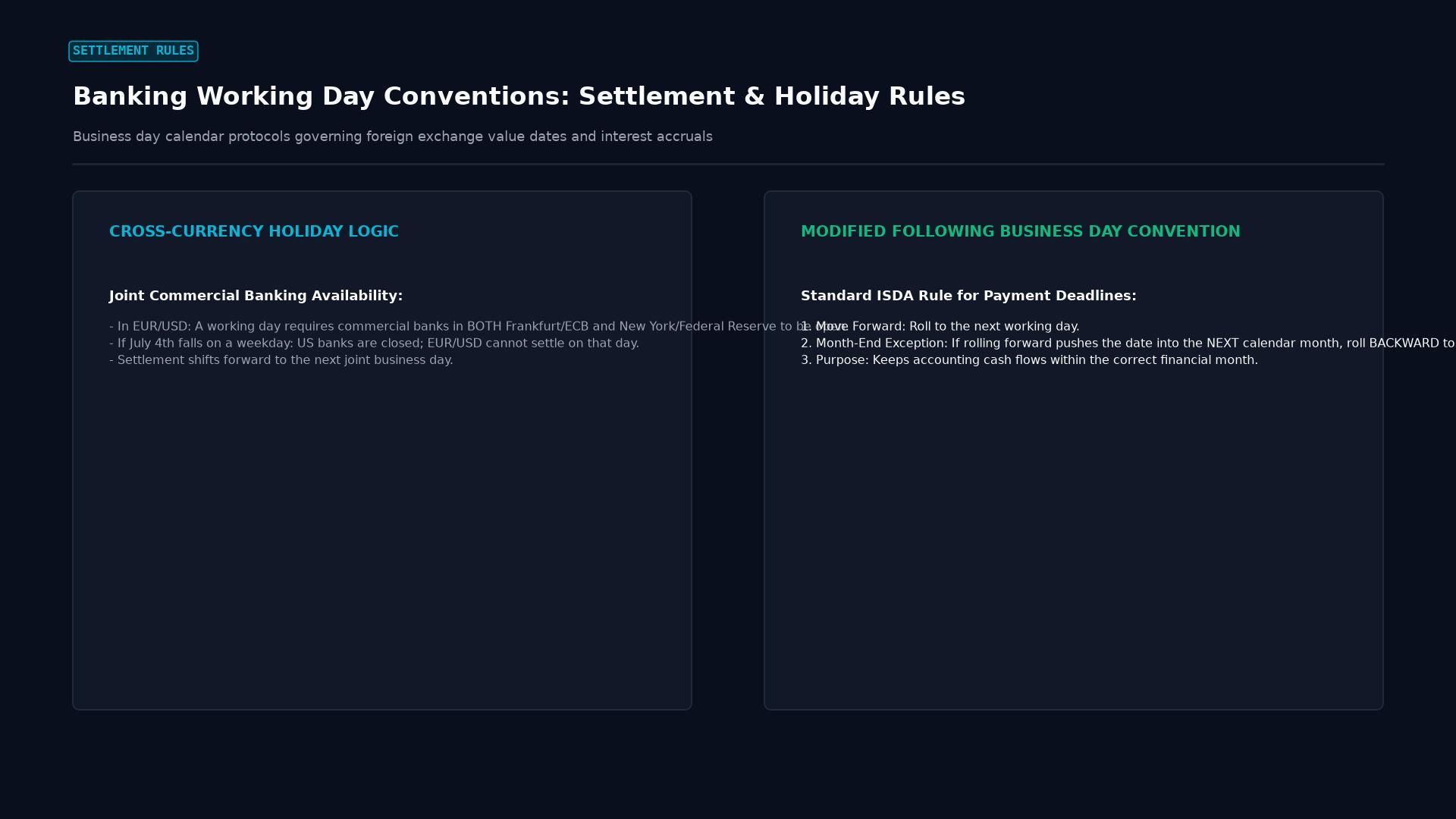 Figure: Financial calendar conventions: cross-currency joint bank holiday verification and the Modified Following Business Day rule.
Technical Mechanics & ISDA Business Day Conventions
In institutional derivative contracts, interest rate swaps, and forward currency agreements, market participants rely on standardized International Swaps and Derivatives Association (ISDA) business day conventions to handle payment dates that coincide with weekends or national public holidays:
1. Following Business Day Convention
If an interest or principal payment falls on a non-working day, the payment date automatically moves to the immediately following working day:
$$t_{\text{settle}} = \min { t \in \text{WorkingDays} \mid t > t_{\text{nominal}} }$$
2. Modified Following Business Day Convention (ISDA Standard)
The payment moves to the immediately following working day, unless that day falls into the next calendar month. If moving forward crosses into a new month, the payment date rolls backward to the immediately preceding working day:
$$t_{\text{settle}} = \begin{cases} \text{Following Day}, & \text{if } \text{Month}(t_{\text{following}}) = \text{Month}(t_{\text{nominal}}) \ \text{Preceding Day}, & \text{if } \text{Month}(t_{\text{following}}) \ne \text{Month}(t_{\text{nominal}}) \end{cases}$$
This prevents interest accruals and corporate accounting revenues from spilling across financial reporting periods.
Comparative Structure: Spot Settlement Rules by Currency Pair
| Currency Pair | Standard Settlement Tenor | Joint Center Requirements | Primary Exceptions |
|---|---|---|---|
| EUR/USD | T+2 Working Days | New York (Fedwire) & Frankfurt/EU (TARGET2) | Extended if either NY or TARGET2 is closed |
| GBP/USD | T+2 Working Days | New York & London (CHAPS) | UK Bank Holidays roll settlement |
| USD/JPY | T+2 Working Days | New York & Tokyo (BOJ-NET) | Japanese national holidays roll settlement |
| USD/CAD | T+1 Working Day | New York & Toronto (Lynx) | Settle in 1 business day due to geographic proximity |
| USD/MXN | T+1 Working Day | New York & Mexico City (SPEI) | Same-day or 1-day clearing alignment |
Real-World Case Study: The Japanese “Golden Week” Liquidity Shock (May 2019)
The operational risks associated with working day closures were demonstrated during Japan’s historic 10-day Golden Week bank holiday in May 2019, commemorating the accession of Emperor Naruhito.
Anatomy of a Working Day Liquidity Void:
- Tokyo Market Closure: Japanese commercial banks, pension funds, and retail FX margin brokers were closed for 10 consecutive calendar days (April 27 - May 6, 2019).
- Settlement Gridlock: No JPY transactions could settle on domestic central bank rails (BOJ-NET).
- Offshore Liquidity Drop: With the domestic Japanese institutional market maker desks dark, global liquidity in JPY crosses dropped by more than 75% during Asian trading hours.
- Flash Crash Vulnerability: On May 3, algorithmic selling during thin early Asian hours triggered cascading stop-loss orders, driving AUD/JPY down 150 pips in under five minutes.
The event highlighted why global banks adjust algorithmic trading parameters and widen bid-ask spreads whenever a major international financial center is closed for a local working day.
Frequently Asked Questions (FAQ)
What happens when an FX trade is executed on a Friday?
Because Saturday and Sunday are non-working days for international commercial banking, an FX spot trade executed on Friday settles on the following Tuesday ($T+2$), assuming neither Monday nor Tuesday is a national bank holiday in either currency’s financial center. In terms of financing, holding an open position across Wednesday evening typically incurs triple rollover (swap) charges to account for weekend interest financing.
Why do North American currency pairs like USD/CAD settle in T+1 instead of T+2?
USD/CAD, USD/MXN, and USD/PHP settle on a T+1 working day basis rather than the traditional $T+2$ global standard. Because Canada, Mexico, and the United States share closely aligned time zones, electronic clearing networks (such as Fedwire, Lynx, and SPEI) can reconcile and settle interbank transactions within 24 hours without the overnight time-zone lag that affects Asian and European currency clearing.
What is the difference between a Preceding and Modified Preceding business day convention?
Under the Preceding convention, a scheduled date falling on a weekend or bank holiday rolls backward to the nearest preceding working day, regardless of the month. Under the Modified Preceding convention, the date rolls backward to the preceding working day, but if doing so crosses into the prior calendar month, the date rolls forward to the nearest following working day, keeping accounting entries within the active monthly reporting cycle.
Ready to trade forex?
Open a free demo account with a regulated broker. Practice with virtual funds before risking real money.