US Dollar Index (USDX)
The US Dollar Index (USDX, commonly known as DXY) is a geometrically weighted geometric mean benchmark measuring the external value of the United States Dollar relative to a basket of six major foreign currencies.
What Is the US Dollar Index (USDX / DXY)?
The US Dollar Index (ticker symbols USDX or DXY) is the world’s most widely recognized benchmark for evaluating the international value of the United States Dollar (USD). Created by the US Federal Reserve in 1973 following the dissolution of the Bretton Woods system of fixed exchange rates, the index measures whether the greenback is broadly appreciating or depreciating against a trade-weighted basket of America’s primary historical trading partners.
Traded exclusively as a futures and options contract on the Intercontinental Exchange (ICE), the index established its baseline of $100.00$ in March 1973. A reading of $105.00$ signifies that the US Dollar has appreciated $5%$ against the currency basket since inception, whereas a reading of $90.00$ indicates a $10%$ net depreciation. Because it serves as the ultimate global liquidity barometer, moves in the DXY dictate cross-asset flows across emerging market currencies, global sovereign debt, and dollar-denominated commodities (crude oil, gold, and copper).
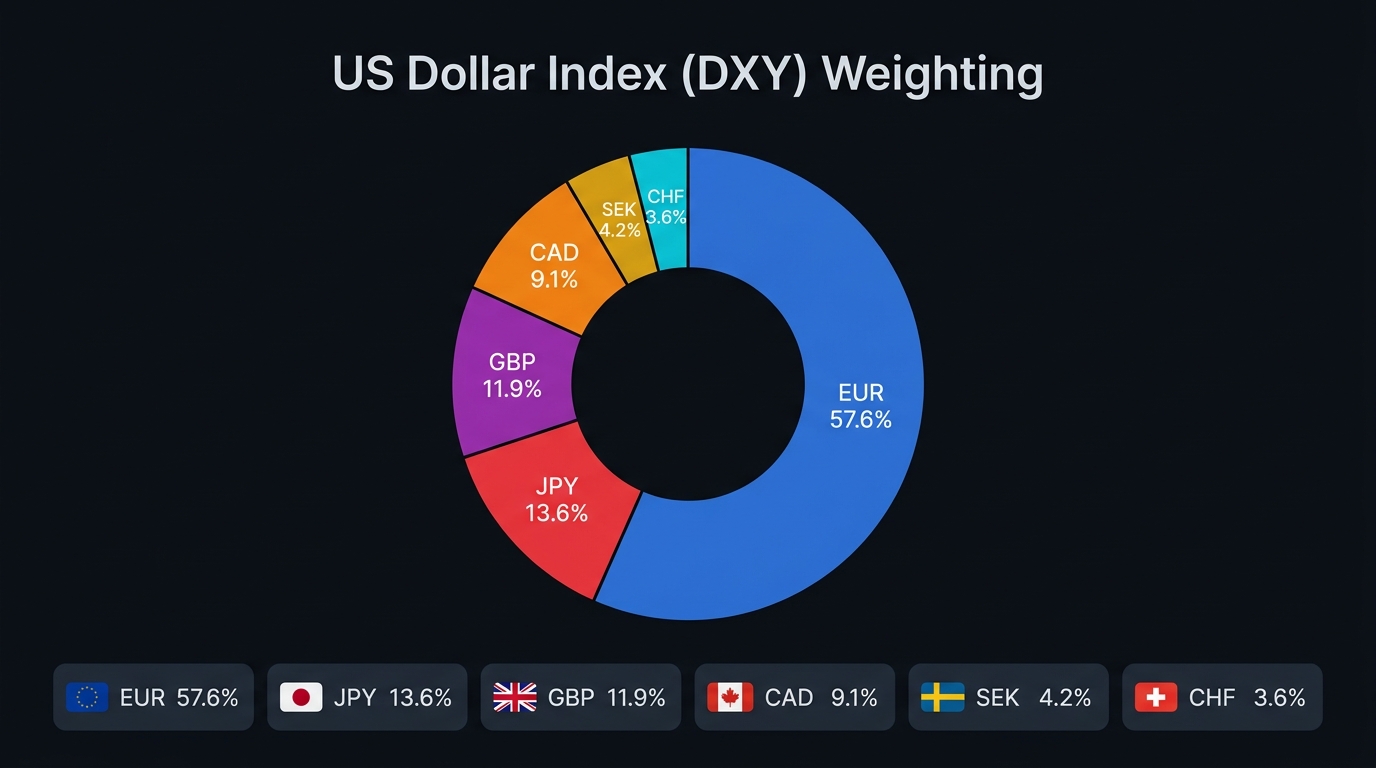
| Currency | ISO Code | Basket Weight | Key Economic Driver |
|---|---|---|---|
| Euro | EUR | 57.6% | ECB monetary policy, Eurozone sovereign yields |
| Japanese Yen | JPY | 13.6% | BOJ yield curve control, global risk sentiment |
| British Pound | GBP | 11.9% | Bank of England bank rate, UK services exports |
| Canadian Dollar | CAD | 9.1% | Crude oil commodity prices, Bank of Canada rates |
| Swedish Krona | SEK | 4.2% | Riksbank policy, European manufacturing demand |
| Swiss Franc | CHF | 3.6% | Safe-haven capital inflows, SNB FX reserves |
Mathematical Formulation: The Geometric Mean
The US Dollar Index is calculated mathematically as a geometrically weighted average of the six constituent currencies. Because pairs are quoted using different market conventions (direct vs. indirect quotes), European terms are expressed with positive exponents, while American terms take negative exponents:
$$\text{DXY} = 50.14348112 \times (\text{EUR/USD})^{-0.576} \times (\text{USD/JPY})^{0.136} \times (\text{GBP/USD})^{-0.119} \times (\text{USD/CAD})^{0.091} \times (\text{USD/SEK})^{0.042} \times (\text{USD/CHF})^{0.036}$$
Where:
- $50.14348112$: An arbitrary scaling constant calibrated to anchor the index at exactly $100.00$ at its March 1973 inception.
- Negative exponents ($-0.576, -0.119$): Apply to pairs quoted in “American terms” (units of USD per foreign currency). When EUR/USD or GBP/USD rises, the negative exponent causes the DXY to fall.
- Positive exponents ($0.136, 0.091, 0.042, 0.036$): Apply to pairs quoted in “European terms” (units of foreign currency per USD). When USD/JPY or USD/CAD rises, the DXY rises.
DXY vs. Alternative Dollar Benchmarks
Institutional investors recognize that the traditional DXY is heavily Euro-centric and omits modern top trading partners (such as China and Mexico). Consequently, asset managers cross-reference DXY against alternative dollar indices:
| Metric | Governing Body / Provider | Methodology | Basket Composition | Structural Advantage / Flaw |
|---|---|---|---|---|
| ICE US Dollar Index (DXY) | Intercontinental Exchange (ICE) | Geometric Mean; Fixed Weights | 6 Currencies (EUR, JPY, GBP, CAD, SEK, CHF) | High derivatives liquidity; heavily Euro-dominated (57.6%); excludes CNY & MXN. |
| Fed Broad Trade-Weighted Index | Federal Reserve Board | Geometrically weighted; annual trade update | 26 Currencies (includes CNY, MXN, CAD, EUR, etc.) | Reflects genuine US merchandise import/export trade; not directly tradable via standardized futures. |
| Bloomberg Dollar Spot (BBDXY) | Bloomberg L.P. | Arithmetic Mean; annual trade/liquidity rebalance | 10 Currencies (Dynamic weights; includes emerging markets) | Capped at 30% per currency; includes CNY, MXN, AUD; more representative of global macro flows. |
Inverse Correlation with Dollar-Denominated Assets
Because global commodities and international trade invoices are settled predominantly in US Dollars, the DXY exhibits strong mathematical inverse correlations with other asset classes:
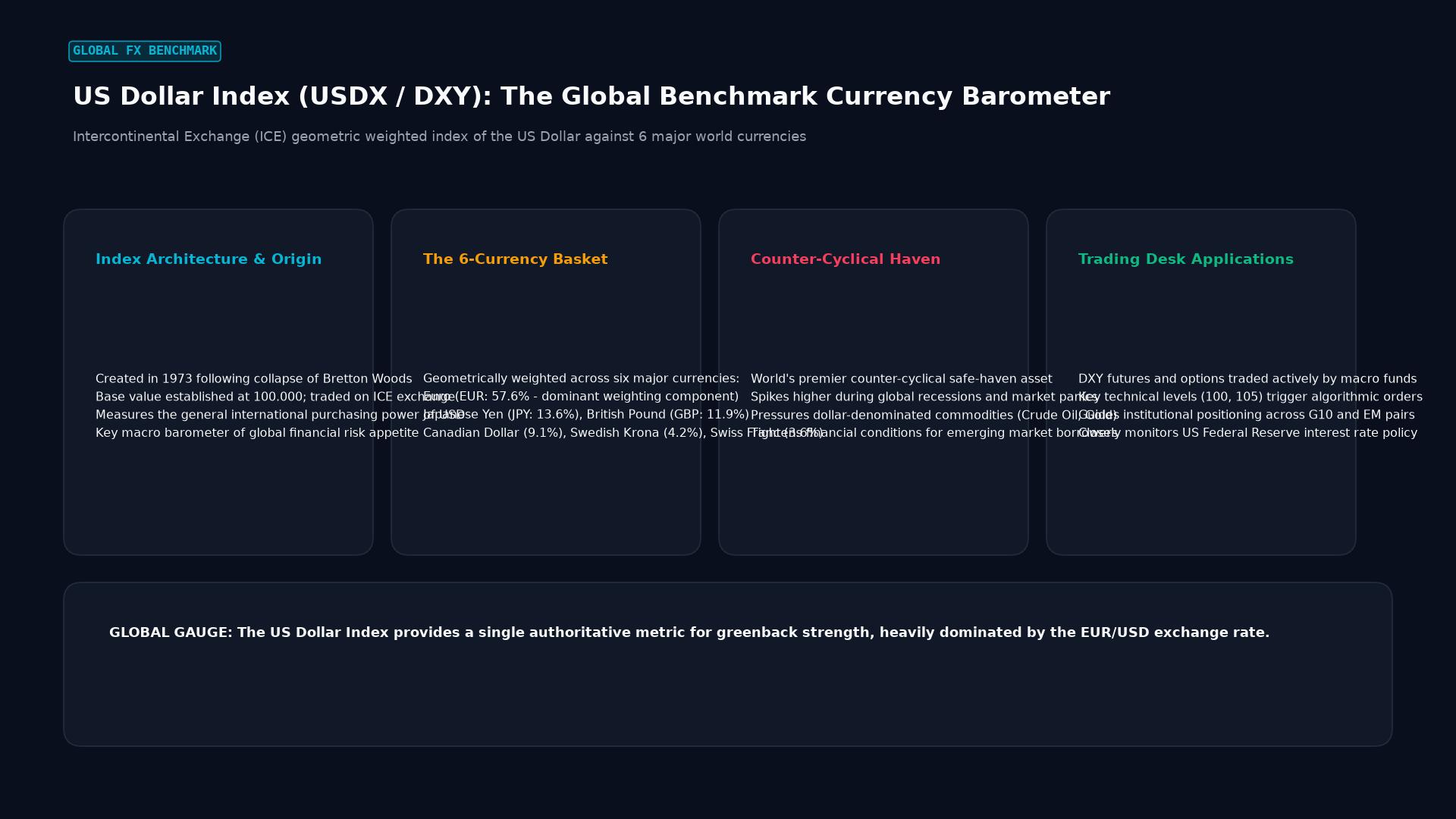 Figure: Intercontinental Exchange (ICE) geometric weighted index of the US Dollar against 6 major world currencies
Real-World Institutional Case Study: The 2022 Macro Dollar Super-Spike
Between May 2021 and September 2022, the US Dollar Index mounted its most explosive bull run in four decades, surging from $89.50$ to a 20-year high of $114.78$—an appreciation of over $28%$.
The move was propelled by three converging macroeconomic catalysts:
- Aggressive Monetary Divergence: The Federal Reserve initiated its most aggressive tightening campaign since 1981, raising the Fed Funds rate by 300 basis points in six months, while the European Central Bank lagged and the Bank of Japan maintained negative yields.
- European Energy Crisis: Following geopolitical sanctions and the shutoff of the Nord Stream pipeline, European natural gas prices surged 1,000%, driving EUR/USD below parity ($0.9535$) and dragging down the European currency, which represents $57.6%$ of the DXY.
- Global Safe-Haven Flight: S&P 500 equities entered a bear market, prompting international asset managers to liquidate risk assets and hoard cash US Dollars.
[September 2022: The DXY Apex at 114.78]
EUR/USD: Breaks below parity to 0.9535
GBP/USD: Collapses to all-time low of 1.0350 (Truss mini-budget crisis)
USD/JPY: Breaches 145.90, forcing first BOJ currency intervention since 1998
                    |
                    v
GLOBAL IMPACT: World Bank warned of widespread emerging-market debt defaults;
US multinational corporate earnings suffered an estimated $40 Billion in foreign revenue FX drag
The peak at $114.78$ marked an extreme macroeconomic overshoot. As European winter temperatures proved milder than feared and US inflation peaked, institutional profit-taking triggered an immediate $10%$ mean-reversion decline in the DXY over the subsequent quarter.
Frequently Asked Questions
Why is the Euro weighted so heavily in the DXY?
When the Euro was introduced in 1999, it replaced several historic European currencies that were originally in the 1973 basket: the Deutsche Mark (20.8%), French Franc (13.1%), Italian Lira (9.0%), Dutch Guilder (8.3%), and Belgian Franc (6.4%). Consolidating these legacy currencies created a single monolithic $57.6%$ Euro weighting that has remained unchanged since 1999.
Why doesn’t the DXY include the Chinese Yuan (CNY) or Mexican Peso (MXN)?
Despite China and Mexico being two of America’s largest merchandise trade partners, the ICE DXY basket has never been formally updated to include them. The Chinese Yuan operates under capital account restrictions and managed pegs, while ICE prioritizes high liquidity in freely convertible G10 currencies to underpin its standardized futures contracts.
What does “trading with the DXY” mean for forex traders?
Retail and institutional forex traders monitor the DXY as a directional trend filter. When the DXY is in a confirmed uptrend (above its 50-day and 200-day moving averages), traders prioritize short positions across major pairs (EUR/USD, GBP/USD, AUD/USD) and long positions in USD-base pairs (USD/JPY, USD/CAD), avoiding fighting broad institutional Dollar liquidity.
Ready to trade forex?
Open a free demo account with a regulated broker. Practice with virtual funds before risking real money.