Cancel
An instruction transmitted to a broker, exchange, or matching engine to delete an unexecuted pending order from the order book, terminating the trader's trading obligation before execution occurs.
What is an Order Cancellation?
In electronic trading and exchange operations, a cancel (or order cancellation) is an explicit directive sent by a market participant to a broker, electronic communications network (ECN), or exchange matching engine instructing it to immediately delete an open, unexecuted pending order from the order book.
Until an order is filled, it remains a resting conditional commitment. Submitting a cancellation revokes that offer, releases any purchasing power or margin held in escrow by the broker, and ensures that the matching engine will not execute the trade if market prices subsequently reach that level.
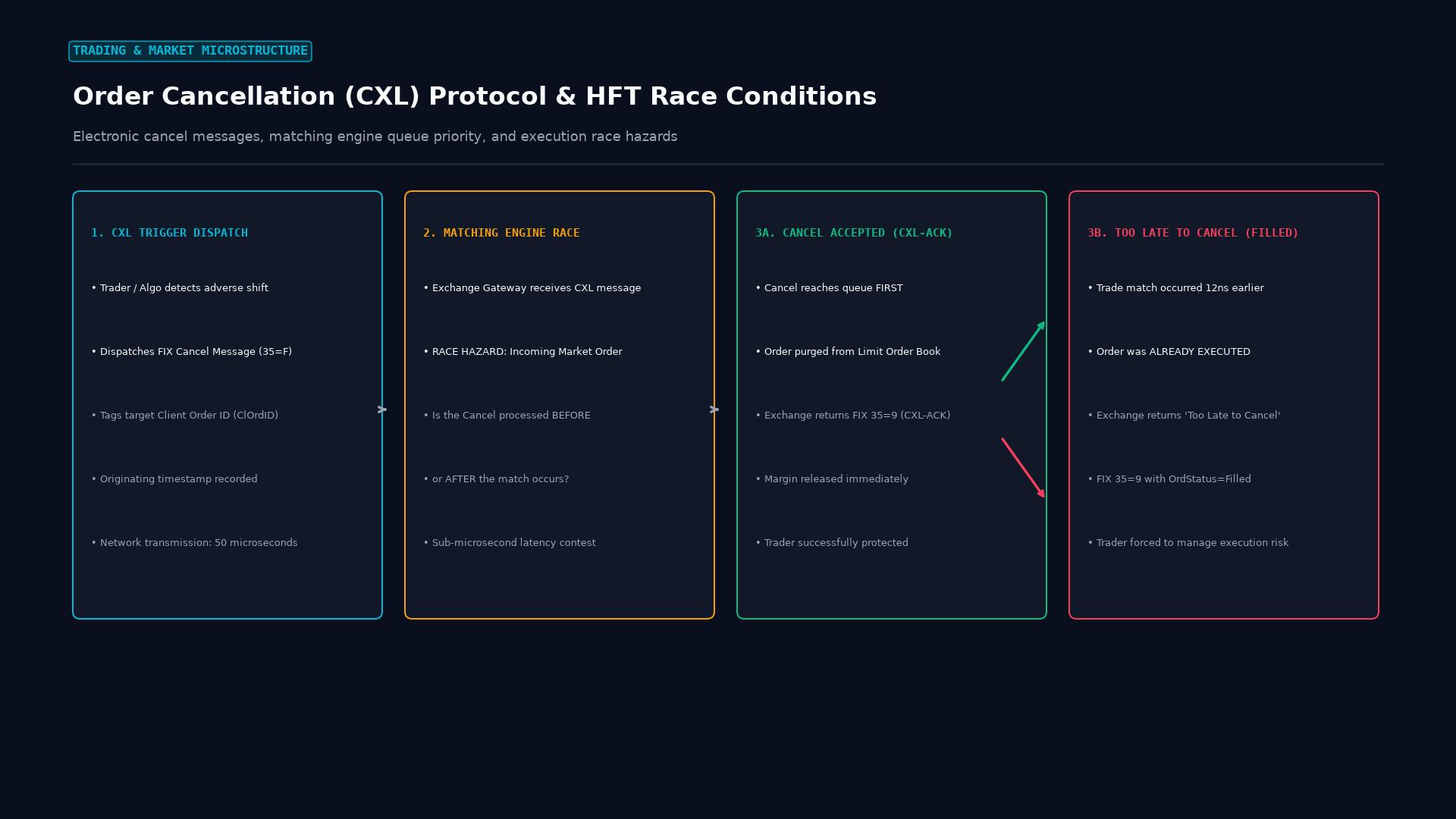 Figure: Electronic order cancellation lifecycle: FIX 35=F message routing, matching engine queue processing, and microsecond race conditions against incoming aggressive fills.
Order Cancellation Types: Microstructure Mechanics
Institutional trading infrastructure utilizes specialized message types (standardized under the Financial Information eXchange - FIX protocol) to handle order cancellations:
1. Straight Cancellation (Order Cancel Request - Tag 35=F)
Deletes the specific pending limit or stop order entirely. Once confirmed by the exchange (Tag 35=8), the order is expunged from the Depth of Market (DOM).
2. Cancel-Replace / Order Modification (Tag 35=G)
Used when a trader wishes to adjust the price or quantity of an existing order. Rather than sending two separate messages (which increases latency), a single Cancel-Replace message modifies the ticket.
- The Queue Priority Penalty: In standard Price-Time Priority (FIFO) matching engines, changing an order’s price or increasing its volume automatically resets its timestamp. The order loses its place in line and is sent to the back of the queue at that price tier.
3. Cancel on Disconnect (COD)
A critical institutional risk mitigation feature. If the trader’s FIX session, trading terminal, or internet connection drops unexpectedly, the exchange’s matching engine automatically cancels all active resting limit orders after a pre-configured heartbeat timeout (e.g., 500 milliseconds), protecting the firm from unmonitored market exposure.
The Race Condition: Execution vs. Cancellation in Flight
One of the most frequent technical frustrations in electronic markets is the “too late to cancel” exception (Reject MsgType 35=9):
- Suppose spot EUR/USD is tumbling rapidly. A trader sees their resting buy limit order at 1.0820 and hits “Cancel” at 14:02:15.100.
- The cancel message takes 25 milliseconds to reach the exchange server in New York (arriving at 14:02:15.125).
- However, an aggressive institutional market sell order struck the resting buy order at 14:02:15.110 (15 milliseconds earlier).
- The Result: The exchange server executes the fill, rejects the cancel message, and reports: “Order already filled.” The trader now owns the asset despite having clicked cancel.
High-Frequency Trading (HFT) and Order-to-Trade Ratios (OTR)
In modern algorithmic market microstructure, the overwhelming majority of market activity consists of cancellations rather than completed trades:
- Algorithmic Probing & Market Making: High-frequency algorithms constantly post and cancel limit orders within milliseconds to test market depth, rebalance inventory, and chase tick momentum.
- Quote Stuffing Concerns: Unethical predatory algorithms historically flooded matching engines with millions of rapid cancel requests to create latency bottlenecks for competitors.
- Regulatory Penalties (MiFID II and SEC Rules): To combat market degradation, regulatory frameworks enforce strict Order-to-Trade Ratios (OTR). If a proprietary firm or broker submits more than a designated threshold of cancellations per executed trade (e.g., exceeding an OTR of 100:1 or 1,000:1), exchanges assess punitive financial surcharges.
Comparative Matrix: Order Termination Mechanisms
| Cancellation Directive | Trigger Mechanism | Latency Risk | Margin Impact | Primary Use Case |
|---|---|---|---|---|
| Manual Cancel | Direct human trader input | High (Human reaction time) | Instantly releases free margin | Exiting invalidated setups |
| Cancel-Replace | Algorithmic parameter update | Moderate (Queue priority reset) | Recalculates margin on new size | Trailing stops, moving limits |
| One-Cancels-Other (OCO) | Automated execution of twin order | Zero (Handled by server engine) | Releases margin of unhit leg | Breakout trading (Strangle) |
| Cancel on Disconnect | Automated heartbeat loss | Zero (Server-side trigger) | Releases all resting margin | Protection against outages |
| Immediate-or-Cancel (IOC) | Exchange execution constraint | Microseconds | Unfilled balance expunged | Sweeping top-tier liquidity |
Strategic Significance for Currency Traders
- Freeing Capital for High-Conviction Setups: Stale pending orders lock up margin equity. Routinely canceling resting orders that have lost technical validity ensures capital is available for higher-probability opportunities.
- Preventing “Ghost Fills”: Leaving unmonitored pending orders on a broker’s server overnight or over the weekend leaves traders vulnerable to Sunday market open price gaps, where prices spike momentarily, fill the dormant order at a terrible price, and immediately reverse.
Key Takeaways
- An order cancellation instructs the exchange to delete an unexecuted pending order, terminating all trading obligations.
- Once an order has executed, it cannot be canceled; attempting to cancel an order already executed in-flight will result in an immediate rejection.
- Modifying an order’s price or increasing its volume resets its queue priority in FIFO matching engines.
- Cancel on Disconnect (COD) safeguards institutional traders against catastrophic market swings during hardware or network outages.
- Global regulators monitor Order-to-Trade Ratios (OTR) to penalize excessive order flooding and quote stuffing by high-frequency algorithms.
Frequently Asked Questions
Can an executed trade be canceled or reversed?
Under normal market operations, no. Once an order is filled, the contract is legally binding. In extremely rare instances involving severe exchange technical malfunctions or erroneous “fat-finger” trades that breach exchange price bands, exchanges may declare a “trade bust” and nullify the transactions.
What is the difference between “Cancel” and “Close”?
“Cancel” applies exclusively to unfilled pending orders (such as resting limit or stop orders), deleting them before they execute. “Close” applies to active, open positions, executing an offsetting trade to liquidate current market exposure.
Why do brokers charge cancellation fees in certain futures markets?
In high-volume futures markets (such as CME or Eurex), exchanges charge clearing members fees if their automated trading algorithms generate an excessive ratio of order cancellations relative to filled volume, compensating the exchange for server bandwidth.
What happens to pending orders when the market closes on Friday?
Depending on the order duration tag selected:
- Good ’Til Cancelled (GTC): The order remains dormant on the broker’s server over the weekend and reactivates when trading resumes on Sunday afternoon.
- Day Order (DAY): The broker automatically cancels the order at the daily market close (5:00 PM EST).
Ready to trade forex?
Open a free demo account with a regulated broker. Practice with virtual funds before risking real money.