Cap / Blanket
An over-the-counter derivative contract or institutional lending provision that establishes a definitive ceiling on floating interest rates. A blanket cap extends this protective interest rate threshold across an entire aggregate credit facility or multi-subsidiary debt portfolio under a unified hedging umbrella.
What is a Cap / Blanket in Banking?
In corporate banking, syndicated lending, and structured finance, the term cap / blanket encompasses two interconnected interest rate risk management mechanisms:
- Interest Rate Cap: An over-the-counter (OTC) derivative agreement that guarantees an institutional borrower will never pay an interest rate higher than a specified strike ceiling on floating-rate debt (such as loans benchmarked to SOFR or Euribor).
- Blanket Cap (Blanket Facility): An overarching, unified hedging structure that covers an entire multi-facility loan portfolio, revolving credit line, or multi-subsidiary conglomerate debt program under a single Master Agreement, eliminating the administrative friction of structuring piecemeal hedges for individual loans.
By purchasing an interest rate cap, a corporate borrower effectively buys financial insurance against aggressive central bank rate hikes while preserving 100% of the benefit if benchmark interest rates fall.
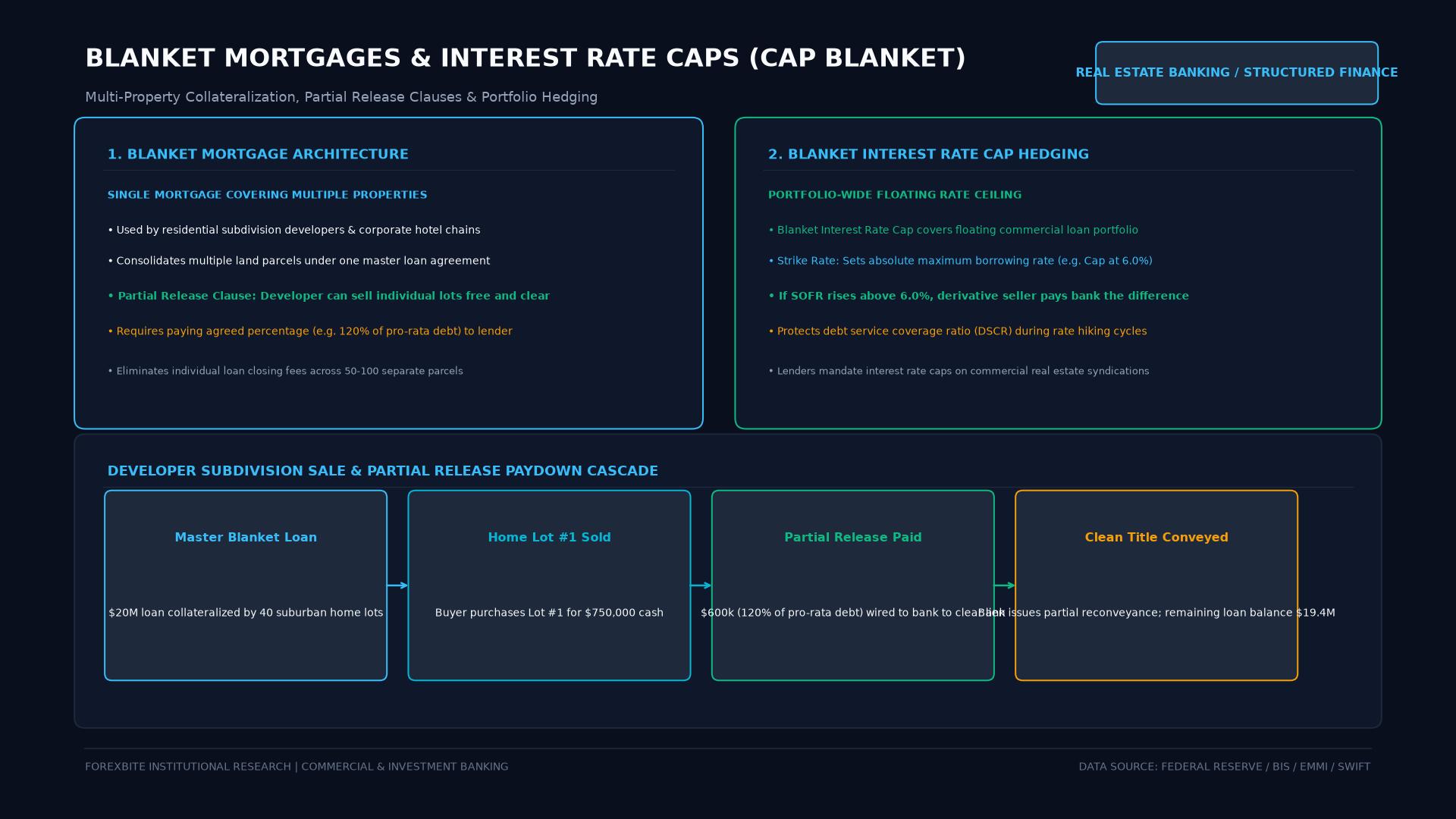 Figure: Portfolio-level floating rate risk mitigation: strike rate ceiling, option premium cost, and interest reimbursement payoff when SOFR/EURIBOR spikes.
The Structural Mechanics: A Portfolio of Caplets
From a quantitative financial engineering perspective, an interest rate cap is not a single option; it is a strip of European call options on an interest rate benchmark, with each individual option termed a caplet:
- For a 5-year cap with quarterly reset dates, the contract comprises 20 discrete caplets.
- On each quarterly observation date $t$, the benchmark rate (e.g., 3-month SOFR) is recorded.
- If the benchmark rate exceeds the cap strike rate ($R_t > K$), the seller of the cap (typically an investment bank) reimburses the borrower for the difference at the end of the calculation period:
$$\text{Caplet Payout} = \max(0, R_t - K) \times \text{Notional Principal} \times \left( \frac{\text{Days}}{360} \right)$$
Where:
- $R_t$ = Fixing benchmark interest rate.
- $K$ = Agreed cap strike rate.
- $\text{Days} / 360$ = Money market day count convention.
If the benchmark rate fixes below the strike rate ($R_t \le K$), the caplet expires worthless for that quarter, and the borrower simply pays the prevailing low market rate on their loan.
The Blanket Facility Architecture
Large multinational enterprises and private equity real estate funds rarely manage a single isolated loan. They manage dozens of revolving credit lines, equipment leases, and construction loans across diverse subsidiaries.
A blanket cap provides comprehensive enterprise-level protection:
- Unified Umbrella: Rather than executing 30 individual derivative tickets, the parent treasury purchases a single blanket cap based on the aggregate projected debt balance.
- Dynamic Drawdown Allocation: As subsidiaries draw down or repay funds on their revolving bank lines, the blanket cap automatically absorbs the fluctuating balance.
- Legal Simplicity: Executed under a single ISDA Master Agreement, reducing legal negotiation expenses and simplifying collateral margin requirements.
Step-by-Step Corporate Hedging Case Study
Consider a commercial real estate developer holding $50,000,000 in floating-rate construction debt benchmarked to 3-Month SOFR + 2.00%.
To satisfy lending covenants demanded by the syndicated banking group, the developer purchases a 3-Year 5.00% SOFR Interest Rate Cap:
- Notional Principal: $50,000,000
- Cap Strike ($K$): 5.00% SOFR (Maximum total borrowing cost = $5.00% + 2.00% = 7.00%$).
- Upfront Premium Paid: 1.80% of notional ($900,000 one-time fee).
Quarterly Performance Scenarios
| Scenario | Market 3M SOFR | Developer Loan Rate (SOFR + 2%) | Cap Derivative Payout | Net Effective Rate Paid | Total Quarterly Interest Paid |
|---|---|---|---|---|---|
| A: Low Rates | 3.25% | 5.25% | $0 (Expired Worthless) | 5.25% | $656,250 |
| B: At the Strike | 5.00% | 7.00% | $0 | 7.00% | $875,000 |
| C: Inflation Shock | 6.50% | 8.50% | +$187,500 (Reimbursement) | 7.00% (Protected!) | $875,000 |
| D: Severe Crisis | 8.00% | 10.00% | +$375,000 (Reimbursement) | 7.00% (Protected!) | $875,000 |
In Scenario D, central bank emergency tightening pushed borrowing costs to 10.00%. The cap paid out $375,000 for the quarter, perfectly insulating the developer from insolvency and capping their effective borrowing rate at exactly 7.00%.
Comparative Matrix: Interest Rate Hedging Instruments
| Derivative Structure | Directional Protection | Downside Benefit If Rates Fall | Upfront Premium Cost | Cash Flow Predictability |
|---|---|---|---|---|
| Interest Rate Cap | Caps maximum rate ceiling | Full Benefit (Rates float down) | Yes (Paid upfront) | Capped maximum ceiling |
| Interest Rate Floor | Sets minimum rate floor | Protects lenders against rate drops | Yes (Paid by lender) | Guaranteed minimum floor |
| Interest Rate Collar | Caps maximum & floors minimum | Limited (Floored at minimum) | Zero (Zero-cost collar) | Confined within a corridor |
| Vanilla Interest Rate Swap | Swaps floating to 100% fixed | Zero Benefit (Locked into fixed rate) | None (Zero upfront outlay) | 100% Deterministic |
Strategic Significance for Corporate Treasurers
- Asymmetry without Opportunity Cost: Unlike a fixed-rate swap (which locks the borrower in and prevents them from benefiting if rates drop), a cap provides pure upside flexibility.
- Mandatory Syndicated Debt Compliance: Commercial mortgage-backed securities (CMBS) and syndicated project loans almost universally require developers to purchase an approved interest rate cap to ensure debt service coverage ratios (DSCR) remain solvent during macroeconomic shocks.
Key Takeaways
- An interest rate cap establishes an inviolable ceiling on floating-rate debt interest payments.
- It is engineered as a strip of European call options on an interest rate index, known as caplets.
- A blanket cap aggregates multiple loan lines or subsidiary credit facilities under a unified institutional hedging umbrella.
- The borrower pays an upfront cash premium, preserving the full benefit of lower interest rates if market yields decline.
- If benchmark rates exceed the strike price, the derivative seller reimburses the borrower for the excess interest expense.
Frequently Asked Questions
What happens to the upfront premium if interest rates never exceed the cap strike?
The upfront premium is non-refundable; it is the cost of insurance. If benchmark rates remain low throughout the contract duration, the borrower benefits by paying low borrowing costs on their underlying loan, while the caplets simply expire unexercised.
What is the difference between an interest rate cap and an interest rate collar?
An interest rate cap involves only buying an upper ceiling and requires paying an upfront premium. An interest rate collar combines the purchase of a cap with the simultaneous sale of a floor. The premium collected from the floor offsets the cost of the cap (creating a “zero-cost collar”), but sacrifices the benefit of interest rate declines below the floor level.
Who sells interest rate caps?
Interest rate caps are underwritten and sold by major global investment banks and market-making dealers (such as JPMorgan Chase, Bank of America, BNP Paribas, and Barclays). Dealers dynamically hedge their cap exposure in the interbank swaption and Eurodollar/SOFR futures markets.
Can an interest rate cap be terminated or sold before maturity?
Yes. An interest rate cap is an asset owned by the borrower. If the company refinances its debt or repays the loan early, it can sell the remaining tenor of the cap back to the underwriting dealer or secondary market makers at prevailing market value.
Ready to trade forex?
Open a free demo account with a regulated broker. Practice with virtual funds before risking real money.