Capital
Financial assets, economic resources, and accumulated wealth mobilized by individuals, corporations, or sovereign governments to generate income, expand commercial production, or fund investment and speculative trading activities.
What is Capital?
In economics, finance, and trading, capital represents any accumulated economic resource or financial asset utilized not for immediate personal consumption, but to generate revenue, produce goods, or accumulate future wealth.
Unlike ordinary consumer spending, capital is productive. In corporate commerce, capital builds factories, funds research and development, and finances inventory. In global financial markets, capital is the liquid lifeblood deployed by investment funds, proprietary trading desks, and retail traders to capture market inefficiencies, harvest yield differentials, and assume managed market risk.
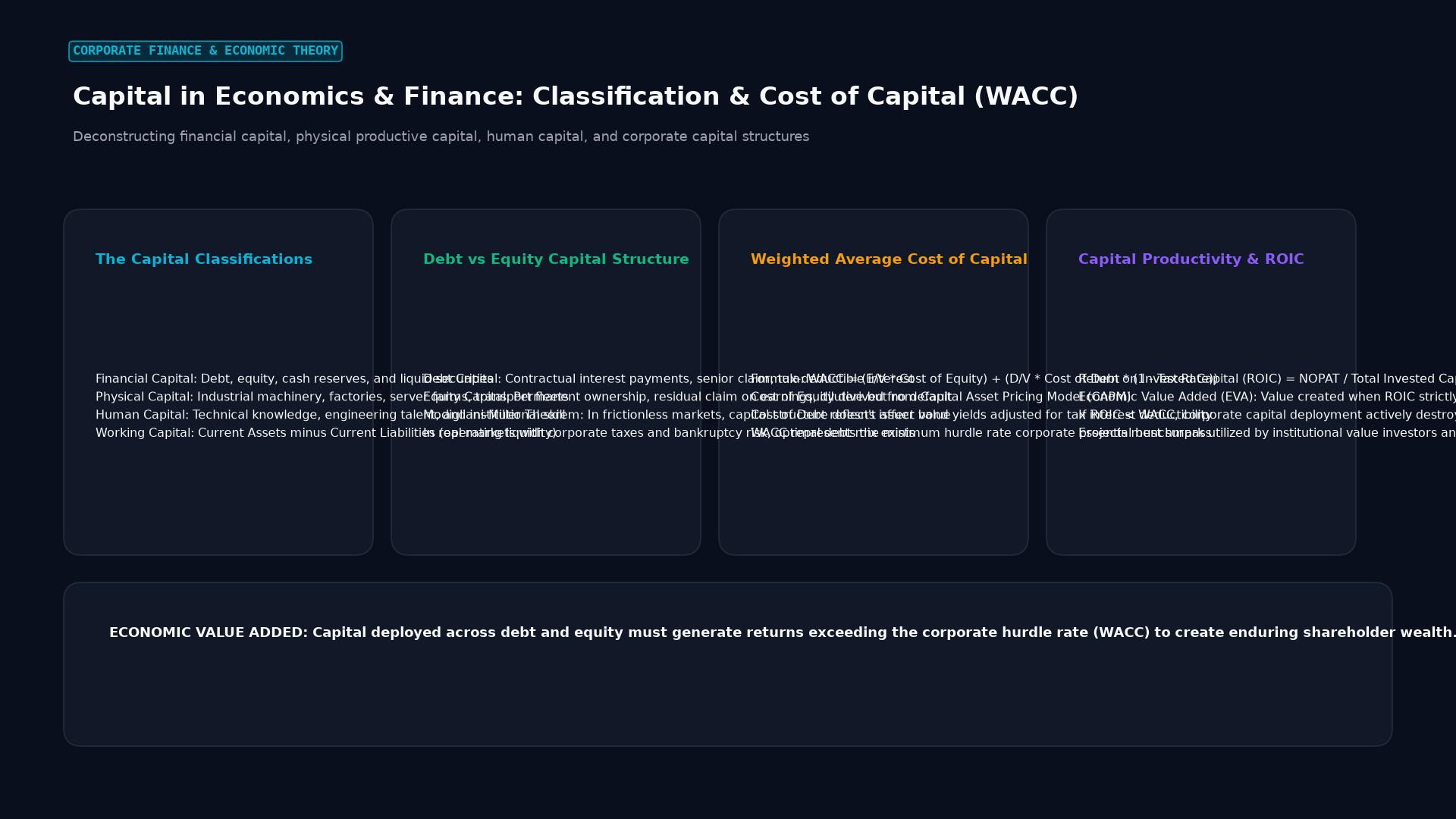 Figure: Deconstructing financial capital, physical productive capital, human capital, and corporate capital structures
The Primary Classifications of Capital
Economists and accountants categorize capital into three distinct operating structures:
1. Fixed Capital
Tangible, long-term physical assets owned by a business—such as commercial real estate, manufacturing plants, specialized machinery, and data centers. Fixed capital cannot be quickly liquidated into cash and is depreciated across its useful economic lifespan on corporate balance sheets.
2. Working Capital (Circulating Capital)
The operational liquidity required to sustain day-to-day business activities: $$\text{Working Capital} = \text{Current Assets} - \text{Current Liabilities}$$ It encompasses cash on deposit, trade receivables from customers, and raw inventory. Positive working capital ensures that an enterprise can service short-term debt obligations without halting operations.
3. Financial & Trading Capital
Liquid monetary funds dedicated strictly to financial asset allocation, investment, and speculative trading. In foreign exchange, risk capital represents the specific pool of money an investor can afford to lose without endangering their personal financial security or solvency.
Corporate Capital Structure: Equity, Debt, and WACC
When corporations fund operations, corporate treasurers balance two primary forms of capital:
- Equity Capital: Capital raised by issuing common or preferred shares to investors. It requires no fixed interest repayments, but dilutes ownership and claims on future earnings.
- Debt Capital: Capital borrowed through bank lines, syndicated loans, or corporate bond issuances. It requires contractual interest servicing and principal repayment, but interest expenses are tax-deductible.
The blended cost of this capital is measured by the Weighted Average Cost of Capital (WACC):
$$\text{WACC} = \left( \frac{E}{V} \times R_e \right) + \left( \frac{D}{V} \times R_d \times (1 - T_c) \right)$$
Where:
- $E, D$ = Market value of equity and debt, respectively.
- $V = E + D$ = Total enterprise capital value.
- $R_e, R_d$ = Cost of equity and cost of debt.
- $T_c$ = Corporate income tax rate.
A company creates economic value only when its return on invested capital (ROIC) exceeds its WACC.
Risk Capital in Currency Trading: The Mathematics of Survival
In leveraged currency trading, capital management supersedes technical chart analysis. Because retail forex accounts utilize leverage ranging from 30:1 to 500:1, improper capital allocation leads directly to account liquidation.
The Asymmetric Math of Capital Drawdowns
When trading capital is lost, recovering to breakeven requires an exponentially higher percentage return:
| Capital Loss Percentage | Equity Remaining ($10,000 Initial) | Required Gain to Return to Breakeven | Difficulty Assessment |
|---|---|---|---|
| 10% Loss | $9,000 | +11.1% Gain | Standard trading performance |
| 20% Loss | $8,000 | +25.0% Gain | Manageable recovery |
| 30% Loss | $7,000 | +42.8% Gain | Requires disciplined regime |
| 50% Loss | $5,000 | +100.0% Gain | Extremely difficult; high risk |
| 75% Loss | $2,500 | +300.0% Gain | Near-impossible without gambling |
| 90% Loss | $1,000 | +900.0% Gain | Statistically insurmountable |
The Institutional 1% to 2% Rule
Professional proprietary trading desks enforce strict risk limits: no single trade setup may risk more than 1% to 2% of total trading capital. This risk control guarantees that even an extraordinary losing streak of 10 consecutive trades consumes less than 18% of account equity, preserving the capital needed to capitalize on subsequent market trends.
Comparative Matrix: Capital Across Industry Frameworks
| Capital Dimension | Managing Authority | Core Function | Liquidity Profile |
|---|---|---|---|
| Trading Risk Capital | Individual Trader / Hedge Fund | Absorption of market volatility for alpha | Instantaneous (T+0 / T+2 settlement) |
| Regulatory Capital (Tier 1) | Central Banks / Basel Committee | Bank solvency buffer against credit losses | High-quality liquid assets (Common equity) |
| Venture Capital (VC) | VC Funds / Angel Investors | High-risk funding of early-stage startups | Extremely illiquid (5 to 10 year lockup) |
| Working Capital | Corporate Treasurer | Meeting operational supplier & payroll debt | Short-term cash & liquid receivables |
Key Takeaways
- Capital represents productive financial assets and wealth deployed to generate income, fund production, or capture market returns.
- It is categorized into physical fixed capital, circulating working capital, and liquid financial trading capital.
- Corporate finance optimizes capital through the Weighted Average Cost of Capital (WACC), balancing debt and equity.
- In currency and derivatives trading, capital preservation is paramount due to the non-linear math of drawdown recovery.
- Professional traders restrict single-trade risk to 1%–2% of total capital to eliminate the mathematical probability of ruin.
Frequently Asked Questions
What is the difference between money and capital?
Money is a medium of exchange used for immediate consumption, transaction settlement, and storing value. Money becomes capital only when it is actively invested or deployed into productive assets (businesses, machinery, bonds, currencies) with the explicit expectation of generating an economic return.
What is “Tier 1 Capital” in banking?
Under the international Basel III regulatory framework, Tier 1 capital is the core measure of a bank’s financial health. It consists primarily of common equity, retained earnings, and disclosed reserves—funds that can absorb losses immediately while the bank continues normal commercial operations.
What is “capital flight”?
Capital flight is the rapid, large-scale exit of domestic and foreign financial assets from a nation. It is typically triggered by political instability, severe currency hyperinflation, punitive capital controls, or sovereign debt defaults, resulting in aggressive depreciation of the national currency.
How much risk capital should a beginner start with in forex?
Traders should only allocate disposable discretionary funds as risk capital—money that, if lost entirely, would not compromise their living expenses, savings goals, or debt obligations. Beginners frequently start with micro or mini accounts ($500 to $2,000) to practice position sizing and discipline under live market psychology.
Ready to trade forex?
Open a free demo account with a regulated broker. Practice with virtual funds before risking real money.