Carry Grid
A specialized quantitative trading strategy that synthesizes positive carry trading with automated grid order execution, placing a structured matrix of limit orders across predetermined price intervals exclusively in the direction of positive interest rate rollover swaps.
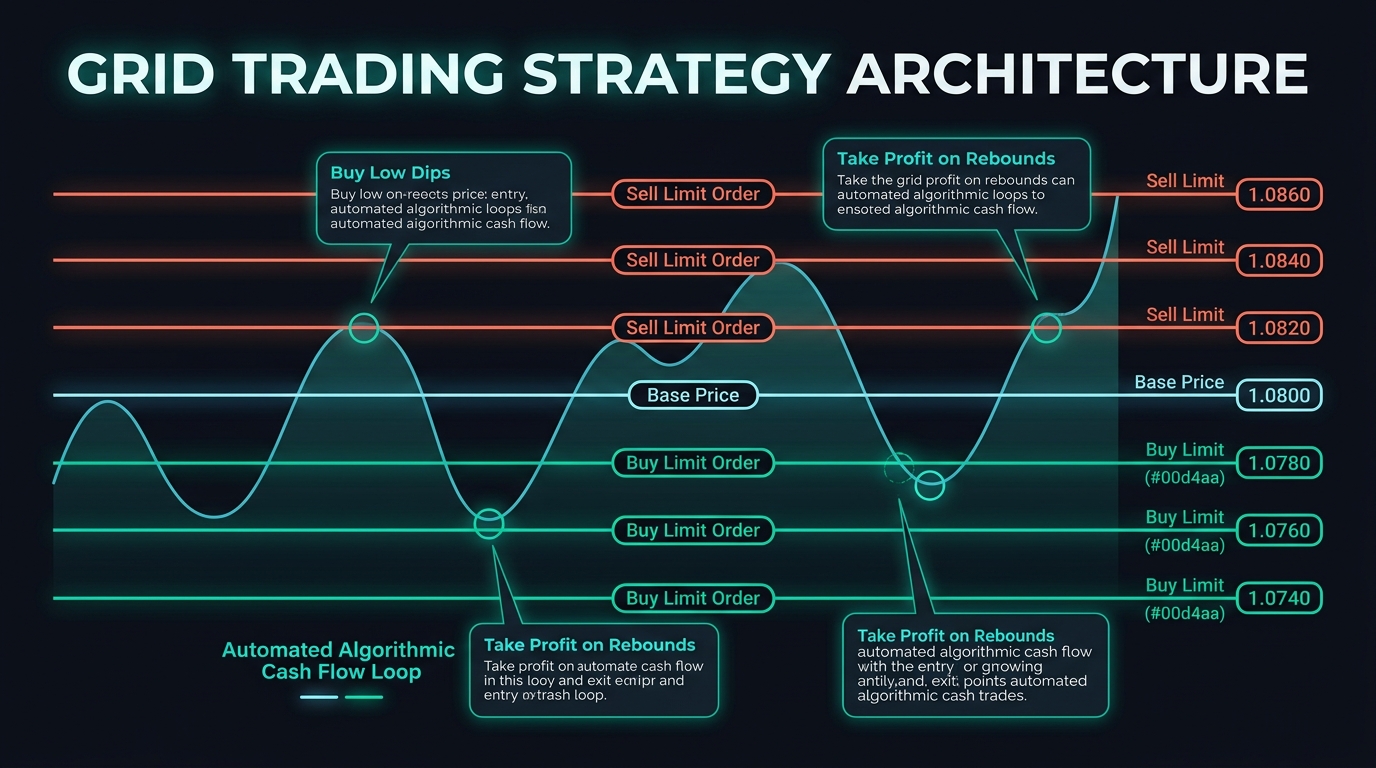
What is a Carry Grid?
A carry grid is an advanced algorithmic trading strategy that integrates two classic foreign exchange concepts: the carry trade and grid trading.
In a traditional carry trade, an investor buys a high-yielding currency against a low-yielding currency to capture the continuous daily interest rate differential (positive rollover swap). In a traditional grid system, an algorithm places automated buy and sell limit orders at fixed intervals above and below a reference price to profit from market oscillations.
A carry grid merges these models by enforcing a strict directional filter: orders are placed exclusively in the direction that earns positive overnight swap credits. As the currency pair fluctuates or pulls back against the long-term macroeconomic trend, the algorithm accumulates successive tranches at discounted prices, continuously harvesting daily rollover interest while waiting for price to rebound and liquidate individual grid levels for capital gains.
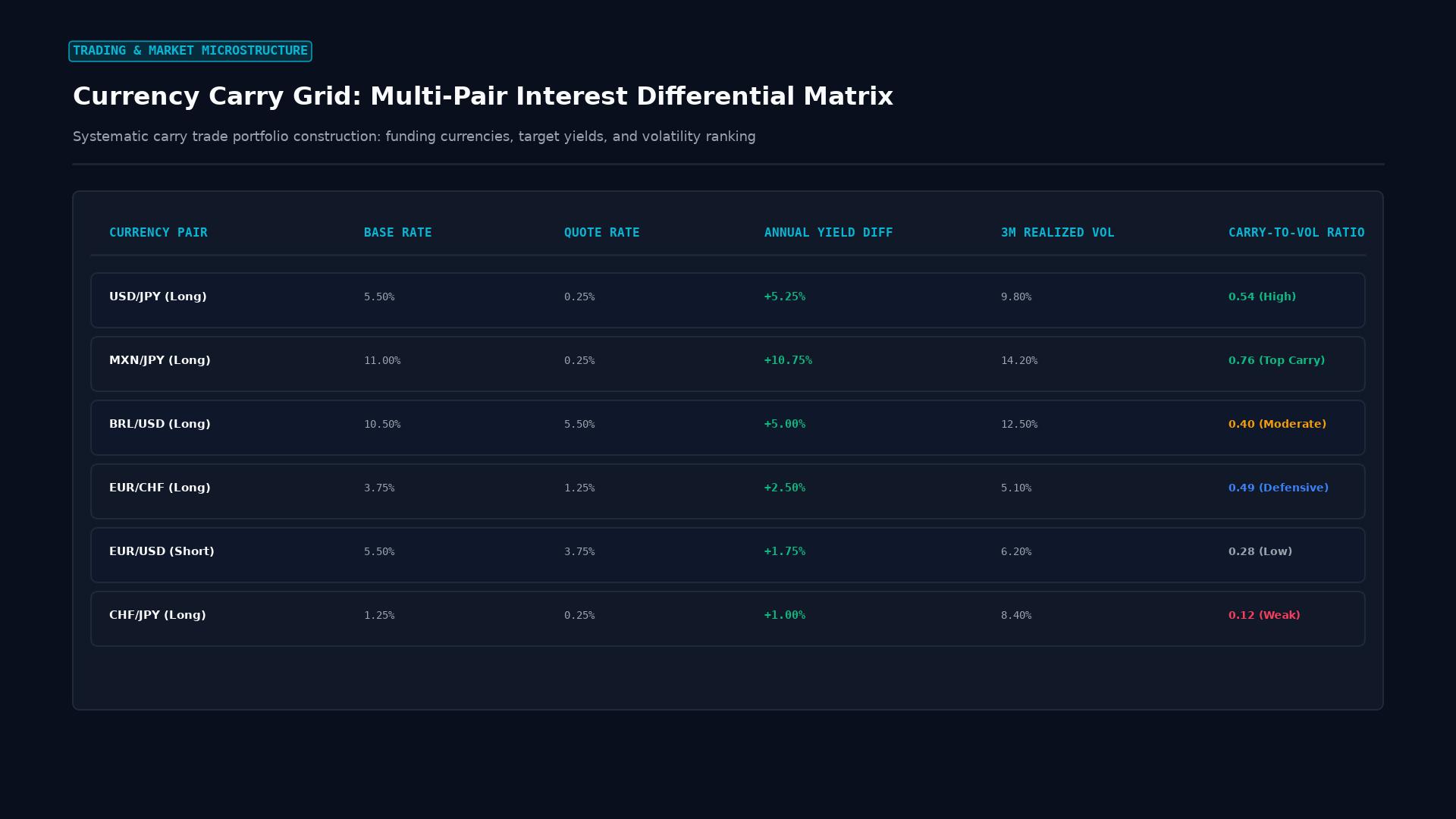 Figure: Systematic carry trade portfolio construction: ranking currency pairs by interest rate differentials, 3-month realized volatility, and carry-to-risk Sharpe ratios.
The Dual-Engine Profit Model
A carry grid generates revenue through two independent, complementary mechanisms:
- Daily Financing Yield (Rollover Swaps): Every day at 5:00 PM EST, the broker credits the trader’s account with positive swap interest on all open positions. Because the carry grid holds multiple open contracts across various price rungs, the aggregate daily interest accrual expands as more grid tiers are filled.
- Volatile Range Monetization (Capital Gains): Currencies spend roughly 70% to 80% of their time oscillating within structural ranges. Whenever the currency pair dips and rebounds, individual grid buy orders trigger and subsequently close at their designated profit targets, locking in realized cash gains while the remaining rungs continue generating overnight carry.
Step-by-Step Strategic Example: USD/JPY Carry Grid
Consider a quantitative trader operating an automated carry grid on USD/JPY during an era where the U.S. Federal Reserve maintains a 5.25% policy rate while the Bank of Japan holds rates near 0.10%.
Strategy Configuration
- Direction: Strictly Long USD/JPY (Positive carry: earning ~$40 per standard lot daily).
- Base Price: 155.00
- Grid Spacing: 50 pips between rungs.
- Position Sizing: Fixed 0.20 lots ($20,000 notional) per rung (avoiding martingale multipliers).
- Take-Profit Target: 50 pips per rung above entry.
- Grid Depth: 5 Rungs (Covering a 250-pip retracement down to 152.50).
Execution Sequence Over a 30-Day Consolidation Period
| Grid Rung | Trigger Price | Volume | Status After 30 Days | Cumulative Swap Earned | Realized Capital Gain |
|---|---|---|---|---|---|
| Rung 1 | 154.50 | 0.20 Lots | Triggered, closed at 155.00 | +$48.00 (6 Days open) | +$100.00 (50 pips) |
| Rung 2 | 154.00 | 0.20 Lots | Triggered, closed at 154.50 | +$72.00 (9 Days open) | +$100.00 (50 pips) |
| Rung 3 | 153.50 | 0.20 Lots | Triggered, held for 18 days | +$144.00 (18 Days open) | Open floating |
| Rung 4 | 153.00 | 0.20 Lots | Triggered, held for 12 days | +$96.00 (12 Days open) | Open floating |
| Rung 5 | 152.50 | 0.20 Lots | Unfilled | $0.00 | $0.00 |
Outcome
Even though USD/JPY experienced a multi-week pullback from 155.00 to 153.00, the carry grid generated $360.00 in passive rollover swaps and $200.00 in closed scalping profits, substantially offsetting the temporary paper drawdown on open tranches.
The Existential Threat: The Carry Unwind Flash Crash
While a carry grid is highly profitable during calm, range-bound markets, it carries a severe vulnerability commonly known on institutional trading desks as “picking up pennies in front of a steamroller”:
- The Carry Unwind Cascade: When global risk sentiment suddenly collapses (a “risk-off” shock) or the funding currency’s central bank unexpectedly intervenes to strengthen its currency, thousands of leveraged hedge funds liquidate their carry positions simultaneously.
- The Runaway Drawdown Trap: If USD/JPY plunges 1,000 pips without bouncing (as occurred during the historic Bank of Japan carry unwind in July–August 2024), an unmanaged carry grid will fill every single buy rung on the way down. Cumulative floating losses will rapidly overwhelm all historical swap profits, leading to a catastrophic margin call.
Comparative Matrix: Grid Trading Variations
| Grid Strategy Model | Directional Filter | Sizing Progression | Carry Role | Risk Profile | Primary Market Environment |
|---|---|---|---|---|---|
| Carry Grid | Direction of positive swap only | Fixed or linear | Core Revenue Engine | High (Vulnerable to macro policy pivot) | Stable interest rate divergence |
| Classic Neutral Grid | Both Long and Short | Fixed lots | Irrelevant (Ignored) | Moderate (Range-bound) | Sideways non-trending consolidation |
| Martingale Grid | Directional | Doubles size on each dip | Secondary | Extreme (100% Risk of Ruin) | Short-term mean-reverting scalping |
| Trend-Following Grid | In direction of moving average | Scales up on winners | Incidental | Low (Hard stop on trend reversal) | Strong parabolic breakouts |
Mandatory Risk Management Safeguards for Carry Grids
- Absolute Portfolio Stop-Loss: Never run an open-ended carry grid. Program an automated “nuclear switch” that liquidates the entire grid if aggregate floating drawdown exceeds a strict ceiling (e.g., 10% or 15% of total account equity).
- Volatility-Adjusted Spacing (ATR Spacing): Instead of arbitrary 50-pip rungs, use the Average True Range (ATR) to widen grid spacing during turbulent market regimes.
- Macroeconomic Calendar Blackouts: Disable grid order placement ahead of Tier 1 central bank interest rate announcements or G7 emergency meetings.
Key Takeaways
- A carry grid combines positive interest rate carry trading with automated limit-order grid execution.
- It operates exclusively in the direction of positive rollover swaps, generating dual profit streams from daily interest and grid bounce capital gains.
- The strategy outperforms standard grids during prolonged, range-bound currency consolidation.
- The primary strategic hazard is a violent carry trade unwind, where rapid currency repatriation wipes out accumulated swap gains.
- Successful implementation requires fixed lot sizing, wide grid spacing, and strict portfolio-level stop-loss equity caps.
Frequently Asked Questions
Can a carry grid be used on any currency pair?
A carry grid should only be deployed on currency pairs with wide, stable interest rate differentials (such as USD/JPY, USD/CHF, or AUD/JPY during monetary divergence cycles). Using it on pairs with near-zero interest rate differentials (like EUR/CHF) eliminates the primary carry yield edge.
How does the Wednesday “Triple Swap” affect a carry grid?
Because spot forex settles on a $T+2$ basis, holding positions through Wednesday at 5:00 PM EST earns three days worth of rollover swap interest to account for the weekend settlement. For an active long carry grid, Wednesday rollover delivers a massive yield injection.
Why is fixed lot sizing critical in a carry grid?
Using a Martingale system (doubling lot size on each lower rung) in a carry grid is suicidal. A 500-pip adverse trend will cause position sizes to balloon exponentially, exhausting available free margin and triggering automated broker stop-outs within minutes.
Does a carry grid work in crypto or equity markets?
Yes. In crypto perpetual futures, traders construct carry grids by buying spot and shorting perpetual contracts to harvest positive funding rates, running an automated market-neutral basis grid.
Ready to trade forex?
Open a free demo account with a regulated broker. Practice with virtual funds before risking real money.