Funding Currency
A funding currency is a national currency characterized by low benchmark interest rates, deep international liquidity, and a dovish monetary policy environment, borrowed by investors to finance the purchase of higher-yielding foreign assets in a currency carry trade.
What Is a Funding Currency?
In international finance and foreign exchange, a funding currency is a currency that market participants borrow at exceptionally low interest rates to purchase higher-yielding foreign financial assets. It serves as the liability side of the renowned Currency Carry Trade.
To qualify as an effective funding currency, a currency must possess three essential characteristics:
- Low Interest Rates: An ultra-low or negative policy rate set by the sovereign central bank, minimizing the cost of borrowing capital.
- Deep Market Liquidity: Massive international turnover in interbank money and foreign exchange swap markets, allowing multi-billion-dollar positions to be opened and closed without market friction.
- Depreciation Bias or Price Stability: A tendency for the currency to remain stable or gradually weaken over time. If the borrowed currency appreciates violently, the capital loss will wipe out the accumulated interest rate yield advantage.
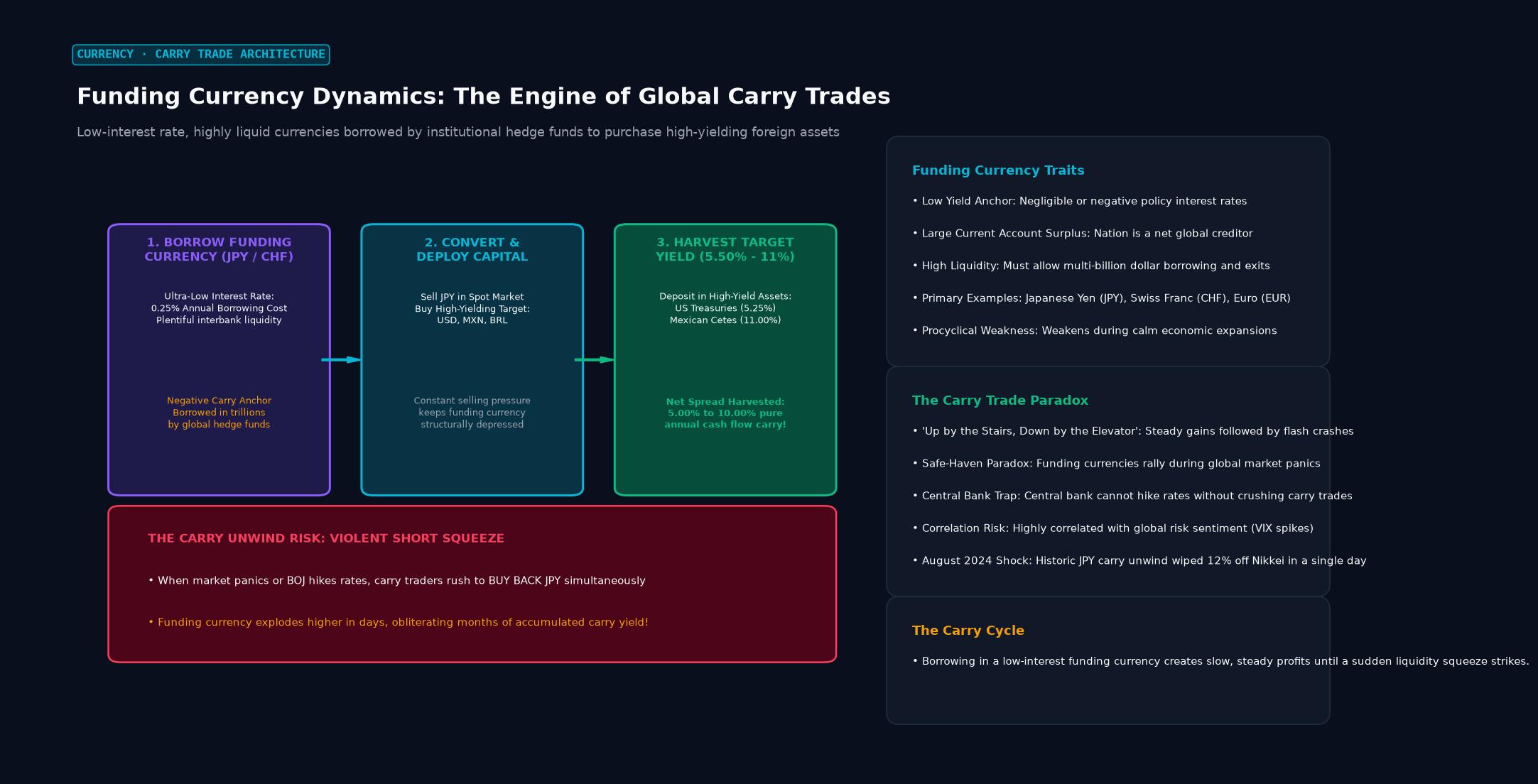 Figure: Low-interest rate, highly liquid currencies borrowed by institutional hedge funds to purchase high-yielding foreign assets
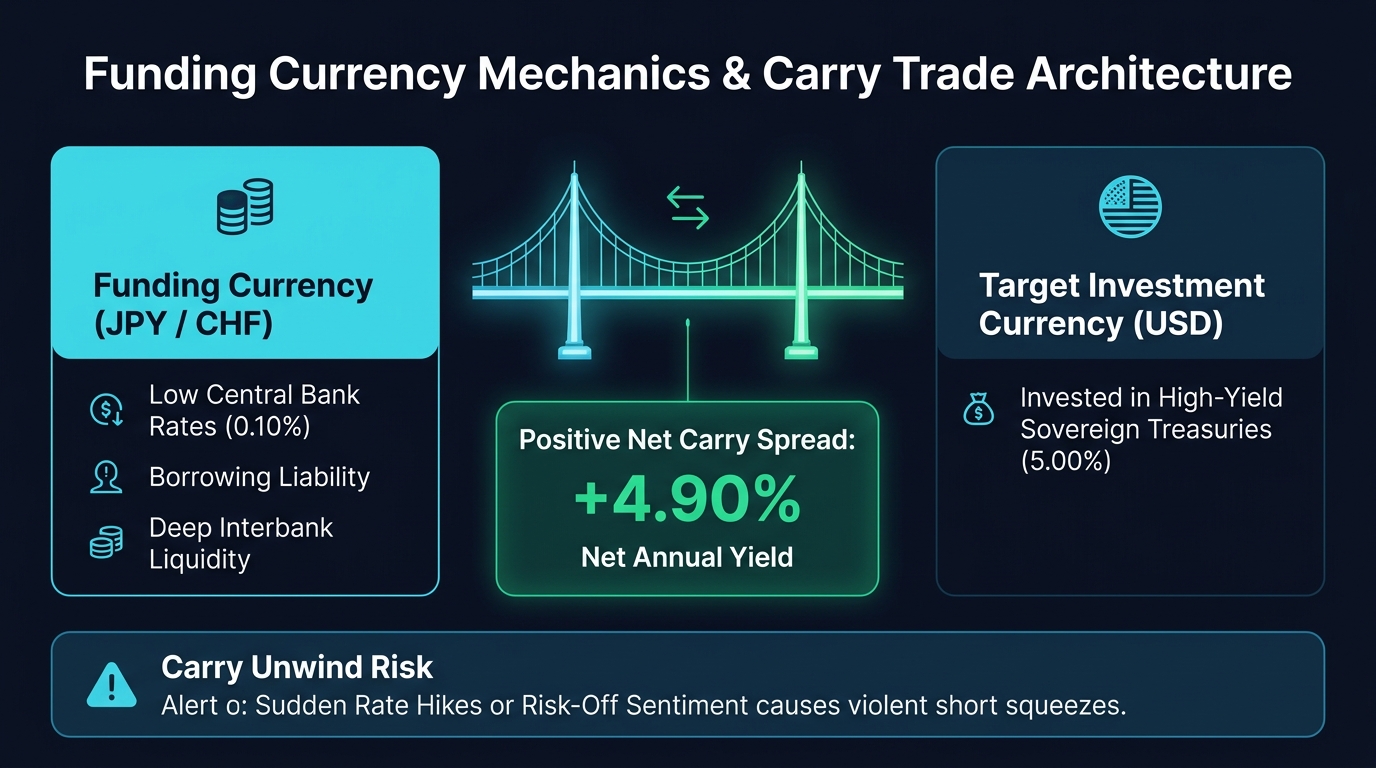
Key Takeaways
- The Liability Leg: In any carry trade pair (such as USD/JPY or AUD/JPY), the funding currency is sold short to finance the long investment in the target currency.
- The Japanese Yen Dominance: The Japanese Yen (JPY) has reigned as the world’s premier funding currency for decades due to the Bank of Japan’s persistent Zero Interest Rate Policy (ZIRP) and Yield Curve Control (YCC).
- The Swiss Franc Alternative: The Swiss Franc (CHF) historically served as a core European funding currency, particularly during its multi-year period of negative benchmark interest rates (-0.75%).
- Violent Asymmetric Risk (The Carry Crash): When global market panic strikes or the issuing central bank unexpectedly hikes interest rates, investors rapidly liquidate carry trades, buying back the funding currency and causing explosive, violent short squeezes.
Funding Currency vs. Target (Investment) Currency
| Feature | Funding Currency | Target / Investment Currency |
|---|---|---|
| Benchmark Interest Rate | Very low (0.00% – 1.00% or negative) | High (4.50% – 10.00%+) |
| Primary Examples | Japanese Yen (JPY), Swiss Franc (CHF) | U.S. Dollar (USD), Mexican Peso (MXN), Australian Dollar (AUD) |
| Position Direction | Short (Borrow and sell) | Long (Buy and hold for yield) |
| Central Bank Posture | Dovish, expansionary, focused on growth/deflation | Hawkish, fighting inflation with elevated rates |
| Behavior in Market Panics | Surges violently (Short squeeze repatriation) | Collapses as risk assets are liquidated |
The Great Historical Funding Currencies
1. The Japanese Yen (JPY)
Since the mid-1990s, Japan’s struggle against domestic deflation forced the Bank of Japan to pioneer unconventional monetary policies, including zero interest rates, negative deposit rates, and massive bond purchases. Global hedge funds, family offices, and Japanese retail domestic investors (nicknamed “Mrs. Watanabe”) borrowed trillions of Yen to buy foreign sovereign bonds, high-dividend stocks, and real estate worldwide.
2. The Euro (EUR) as an Unintended Funding Currency (2014–2021)
When the European Central Bank introduced negative deposit facility rates (-0.50%) and Quantitative Easing in the 2010s, borrowing costs in Euros plummeted. International macro funds borrowed Euros to fund carry positions in emerging market currencies (such as the Mexican Peso and South African Rand) and the U.S. Dollar.
The “Carry Crash”: The Peril of Funding Currency Short Squeezes
The primary vulnerability of borrowing a funding currency is captured by the market adage: “Carry trades pick up nickels in front of a steamroller.”
Mechanics of an Unwind / Carry Crash:
1. Bank of Japan unexpectedly raises interest rates or signals tightening.
2. The interest rate differential narrows; carry trade profitability shrinks.
3. Speculative funds rush to close positions, SELLING USD and BUYING JPY.
4. JPY rallies sharply, wiping out months of accumulated interest yields.
5. Algorithmic margin calls trigger forced liquidations: JPY surges 500–1,000 pips in days.
The August 2024 Case Study: When the Bank of Japan hiked rates to 0.25% in late July 2024 while U.S. employment data cooled, the global Yen carry trade experienced a historic unwinding. USD/JPY plunged from 161.90 to below 142.00 in days, causing global equity markets to crash and demonstrating the immense systemic risk embedded in funding currency leverage.
Frequently Asked Questions
Why do funding currencies act as “safe havens” during market crises?
Funding currencies appreciate during global panics not because investors suddenly love the underlying economy, but because massive short positions are being aggressively liquidated. Global funds sell foreign assets and convert the capital back into the funding currency to repay their original low-interest loans.
Can a funding currency switch to becoming an investment currency?
Yes. If the issuing central bank faces severe structural inflation and hikes benchmark interest rates aggressively, borrowing costs rise, destroying its viability as a funding vehicle. If rates rise high enough, capital begins flowing into the currency rather than using it to borrow.
What are the risks of using retail forex leverage to trade carry pairs?
Retail traders collecting daily positive swap payments by longing target currencies against funding currencies face severe tail risk. A sudden 5% or 10% counter-trend spike in the funding currency will instantly erase years of accumulated swap earnings and can trigger total account stop-out.
Ready to trade forex?
Open a free demo account with a regulated broker. Practice with virtual funds before risking real money.