Cash Market
A marketplace where financial instruments, commodities, or currencies are bought and sold for immediate cash settlement and delivery, operating in direct contrast to derivatives markets like futures and options where settlement occurs on a predetermined future date.
What is a Cash Market?
A cash market (universally referred to in foreign exchange and commodities as the spot market) is an exchange or over-the-counter (OTC) financial marketplace where transactions are executed for immediate payment and physical or electronic delivery of the underlying asset.
The defining operational principle of a cash market is the prompt transfer of ownership. When an investor buys an asset in the cash market, they exchange legal tender cash immediately and take title to the security or currency, rather than entering into an agreement to exchange assets at a future milestone (as in futures, forwards, or options).
In global foreign exchange, the cash market forms the core pricing engine for the entire currency ecosystem. The cash exchange rate quoted in interbank networks (such as EUR/USD at 1.0850) serves as the fundamental baseline upon which forward swap points, currency futures, and exotic options are priced.
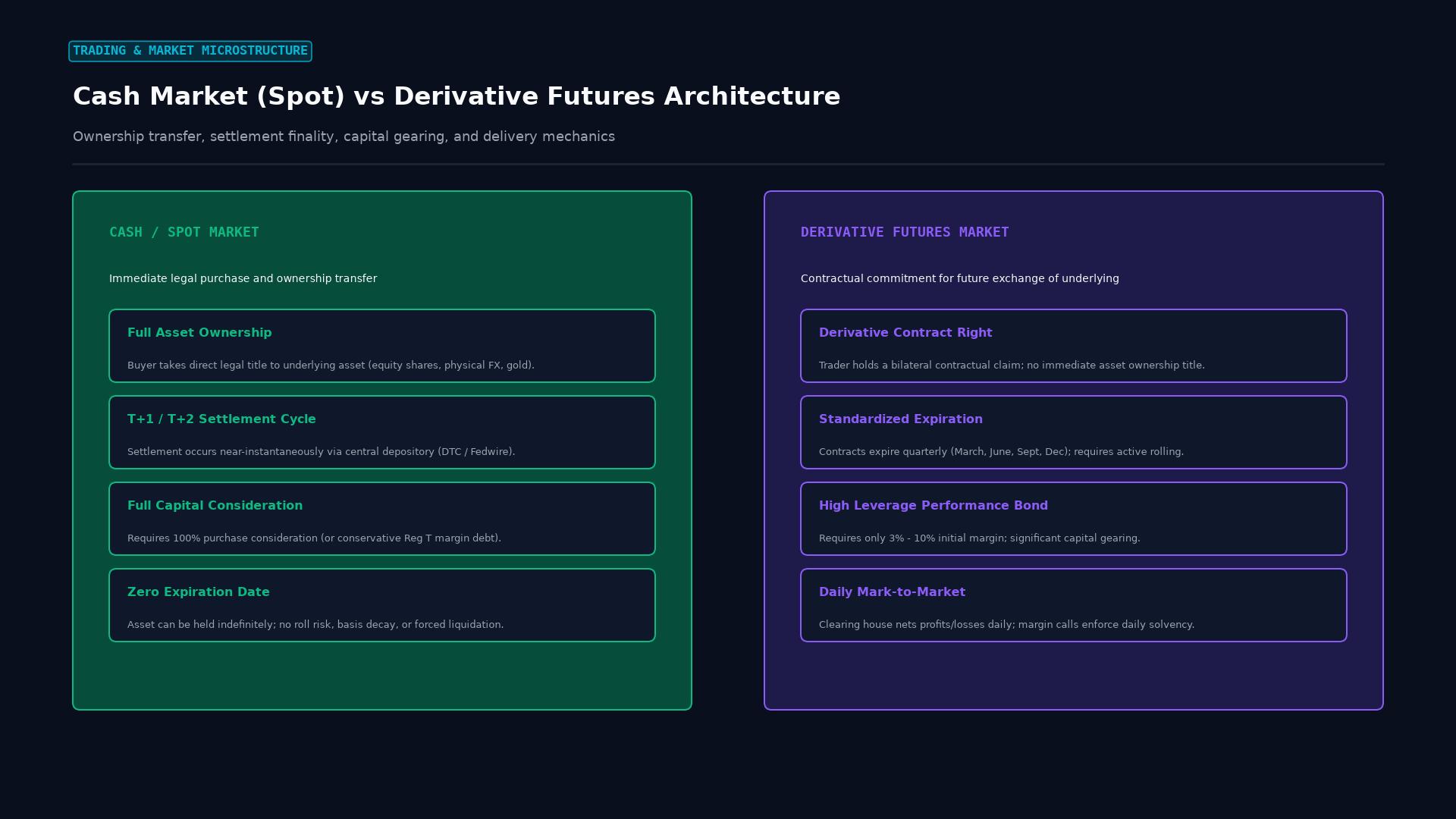 Figure: Market structure comparison: immediate asset ownership transfer and cash consideration in spot markets versus leveraged margin commitments in futures markets.
Settlement Conventions: What “Immediate” Means in Practice
While the term “cash market” implies instantaneous hand-to-hand exchange, wholesale financial settlement operates under standardized international conventions to accommodate global banking time zones, anti-money laundering verifications, and cross-border currency clearing:
- Value Today ($T+0$): Settlement occurs on the identical calendar day the trade is executed. Common in domestic money markets and bilateral emergency liquidity swaps.
- Value Tomorrow ($T+1$): Settlement occurs on the next business day. Standard for North American currency pairs (such as USD/CAD) to accommodate synchronized banking hours between New York and Toronto.
- Standard Spot ($T+2$): The global standard for the vast majority of foreign exchange pairs (including EUR/USD, GBP/USD, and USD/JPY). The two-day window accounts for international time differences between Asian, European, and American financial centers.
The Interlocking Relationship: Cash vs. Futures Markets
Cash markets and derivatives markets are tethered together by the economic law of arbitrage:
- Price Discovery Transmission: While retail volume often trades through cash spot brokers, institutional price discovery frequently originates in the deep, centralized order books of currency futures (such as the Chicago Mercantile Exchange - CME).
- The Basis Connection: The difference between the cash market price and the futures price is the basis ($\text{Basis} = \text{Cash Price} - \text{Futures Price}$).
- Arbitrage Bounds: If the cash price of a currency deviates significantly from the futures price adjusted for interest rates (Covered Interest Rate Parity), quantitative proprietary desks execute cash-and-carry arbitrage, buying the undervalued market and selling the overvalued market until equilibrium is restored.
Step-by-Step Institutional Trade Example: Cash FX Execution
Consider a global logistics corporation requiring €10,000,000 to pay European port authorities and freight handlers.
Execution Workflow
- The Order: The corporate treasury accesses an electronic multi-bank portal (such as FXall or Bloomberg FIT) and requests a streaming cash market quote for EUR/USD.
- The Execution: The best institutional bid-ask quote is displayed as 1.08500 / 1.08508. The corporation hits the ask to buy €10,000,000 at 1.08508.
- The Obligation: The transaction requires a cash settlement of: $$€10,000,000 \times 1.08508 = $10,850,800\text{ USD}$$
- Settlement ($T+2$): Two business days later, via the Continuous Linked Settlement (CLS) bank network, the corporation’s custodian bank debits $$10,850,800$ and receives legal delivery of $€10,000,000$ directly into its European operational bank account.
Comparative Matrix: Cash Market vs. Derivative Venues
| Trading Dimension | Cash (Spot) Market | Currency Futures Market | Over-the-Counter (OTC) Forwards |
|---|---|---|---|
| Settlement Horizon | Immediate ($T+0$ to $T+2$) | Fixed quarterly delivery (H, M, U, Z) | Bespoke negotiated maturity date |
| Market Structure | Decentralized OTC interbank network | Centralized regulated exchange (CME) | Decentralized bilateral contracts |
| Counterparty Risk | Bilateral bank risk (Mitigated by CLS) | Guaranteed by Clearinghouse (CCP) | Pure bilateral credit risk |
| Contract Standardization | Fully customizable lot sizes | Rigid standardized lot sizes | Fully customizable |
| Pricing Basis | Spot supply and demand order flow | Spot price $\pm$ Cost of carry (interest) | Spot price $\pm$ Forward swap points |
Strategic Significance for Currency Traders
- Clean Trend Visibility: Cash spot price charts provide the purest reflection of real-time macroeconomic demand, free from the expiration rollover distortions or contango premiums found in futures charts.
- Continuous 24-Hour Liquidity: The cash forex market operates continuously from Sunday afternoon (5:00 PM EST) through Friday afternoon (5:00 PM EST), allowing participants to react instantly to breaking geopolitical developments without waiting for exchange opening bells.
Key Takeaways
- A cash market is a financial marketplace where assets are purchased for immediate settlement and transfer of ownership.
- In foreign exchange, the cash market is synonymous with the spot market, typically settling on a $T+2$ basis.
- Cash market quotes serve as the foundational pricing anchor for all forward, futures, and options contracts.
- Cash markets contrast with derivatives markets, where payment and physical settlement are deferred to a future date.
- Arbitrageurs continuously enforce mathematical pricing alignment between cash markets and futures markets.
Frequently Asked Questions
Is the retail forex market a true cash market?
Most retail forex brokers offer rolling spot CFDs (Contracts for Difference) rather than physical cash settlement. While the pricing reflects the cash spot market, positions are automatically rolled over each day at 5:00 PM EST, meaning retail traders rarely take physical delivery of currency notes or commercial bank deposits.
Why do some cash currency pairs settle on T+1 instead of T+2?
Currency pairs like USD/CAD, USD/MXN, and USD/TRY settle on a $T+1$ (next business day) convention because the financial centers of North America operate within identical or neighboring time zones, allowing banking systems to complete clearing checks in 24 hours.
What is the difference between a cash market and a spot market?
In institutional practice, the terms are interchangeable. “Spot market” is the standard nomenclature in foreign exchange and commodities, while “cash market” is frequently used in fixed income and equities to distinguish the underlying physical security from its futures contract.
Can cash market transactions be reversed?
No. Once a cash market trade is executed and settled via interbank payment networks, the legal transfer of ownership is final and irreversible. Any reversal requires entering into an entirely new, separate transaction in the opposite direction.
Ready to trade forex?
Open a free demo account with a regulated broker. Practice with virtual funds before risking real money.