Clean Float
A foreign exchange rate regime in which a national currency's exchange value is determined strictly and exclusively by market supply and demand forces in global financial markets, operating with zero intervention, price manipulation, or capital controls by the sovereign central bank.
What is a Clean Float?
A clean float (commonly termed a pure float or free floating exchange rate) is a macroeconomic currency regime where the exchange rate of a national currency is determined exclusively by the uninhibited market forces of private supply and demand in the international foreign exchange market.
Under a clean float, the sovereign central bank and national treasury maintain a strict, non-interventionist posture. The monetary authority does not buy or sell foreign currency reserves to influence the exchange rate, does not enforce artificial exchange bands, and does not impose administrative capital controls. Instead, the currency acts as an unconstrained macroeconomic shock absorber, adjusting continuously in response to trade balances, foreign investment flows, inflation differentials, and economic growth rates.
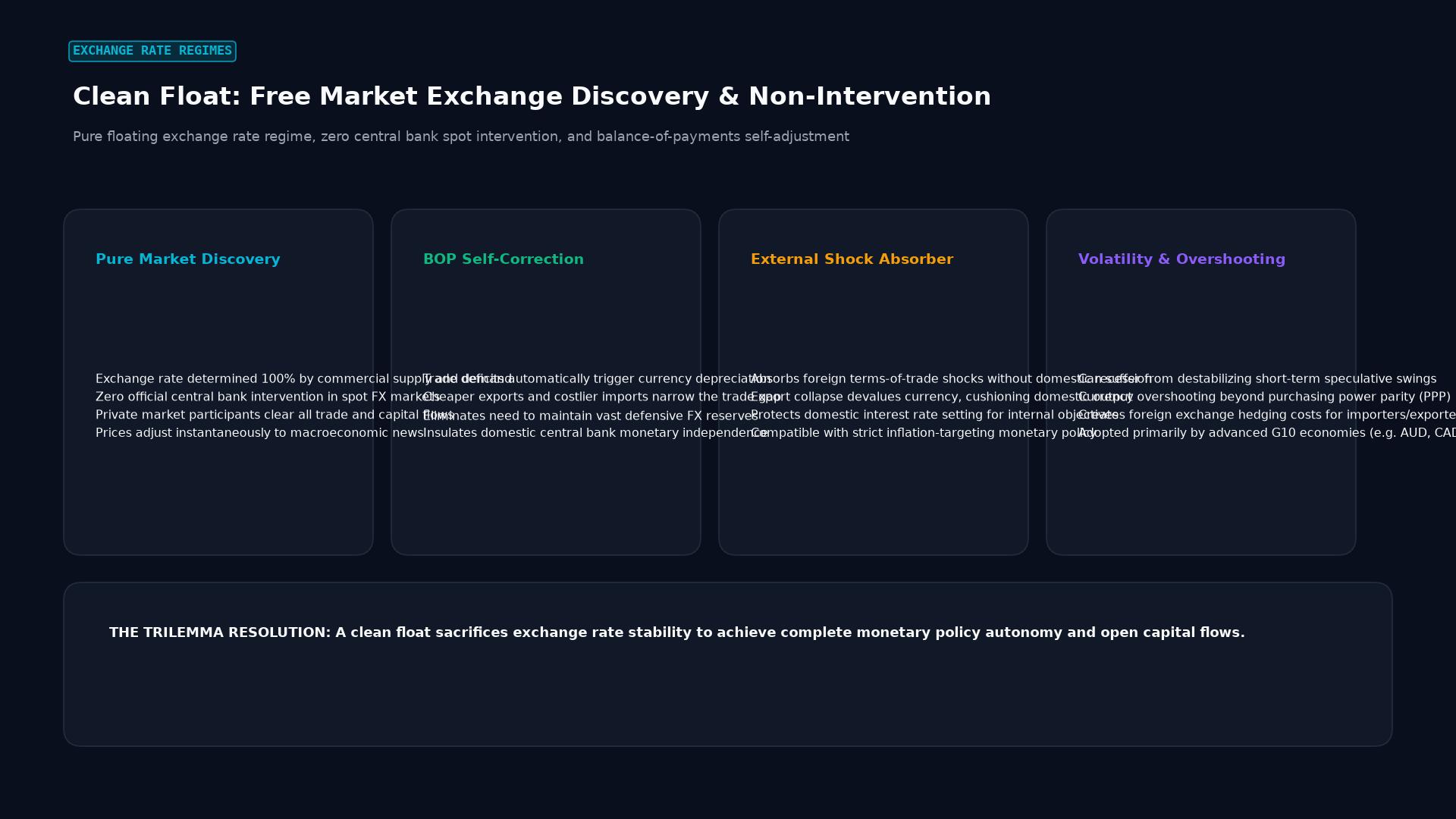 Figure: Pure floating exchange rate regime, zero central bank spot intervention, and balance-of-payments self-adjustment
Clean Float vs. Dirty (Managed) Float
In contemporary global economics, truly “pure” clean floats are rare, as even major central banks occasionally monitor currency swings:
1. Clean Float (Pure Free Float)
- Central Bank Stance: 100% laissez-faire toward the exchange rate. The central bank focuses exclusively on domestic macroeconomic mandates (price stability, inflation targets, maximum employment).
- Foreign Reserves: Reserves are maintained for national security and emergency liquidity, not for daily currency market intervention.
- Classic Examples: The United States Dollar (USD), the Euro (EUR), the Australian Dollar (AUD), and the Canadian Dollar (CAD) operate as clean floats under standard peacetime economic conditions.
2. Dirty Float (Managed Float)
- Central Bank Stance: The currency floats generally based on market forces, but the central bank actively intervenes when volatility becomes extreme or threatens national interests.
- Intervention Mechanics: The central bank sells foreign currency reserves to support a crashing currency, or buys foreign currency to suppress an appreciating currency that harms domestic exporters.
- Classic Examples: The Bank of Japan (BOJ) intervening in USD/JPY, the Swiss National Bank (SNB) actively managing EUR/CHF, and the Reserve Bank of India (RBI) smoothing Indian Rupee volatility.
Theoretical Foundation: The Mundell-Fleming Trilemma
The economic rationale for adopting a clean float is explained by the Impossible Trinity (Mundell-Fleming Trilemma), which dictates that a sovereign nation can achieve only two of the following three objectives simultaneously:
- Free Capital Mobility (Unrestricted international financial flows).
- Independent Monetary Policy (Setting domestic interest rates to manage local inflation and unemployment).
- Fixed Exchange Rate (A pegged or rigidly managed currency).
                  The Impossible Trinity (Trilemma)
                  Independent Monetary Policy
                             /\
                            /  \
                           /    \
     [ CLEAN FLOAT ] =====+======+===== [ CAPITAL CONTROLS ]
     Picks Independence   /      \      Picks Independence
     & Free Capital      /        \     & Fixed Exchange
                        /          \
  Free Capital Mobility +----------+ Fixed Exchange Rate
                        [ CURRENCY BOARD / PEG ]
                        Picks Free Capital & Fixed Exchange;
                        SURRENDERS MONETARY INDEPENDENCE!
By choosing a clean float, advanced economies secure Monetary Independence and Free Capital Mobility, willingly surrendering control over the exchange rate to let global markets discover fair value.
The Clean Float as an Automatic Macroeconomic Stabilizer
The primary macroeconomic advantage of a clean float is its ability to automatically insulate an economy from external economic shocks without requiring painful domestic recessions:
Case Study: Australia and the Commodity Terms of Trade
Australia is a major global exporter of iron ore, coal, and natural gas:
- The External Shock: Global commodity prices crash by 40% due to an industrial slowdown in major importing nations.
- The Automatic Currency Adjustment: International demand for Australian Dollars collapses. Under a clean float, the AUD depreciates immediately by 15% against the U.S. Dollar without the Reserve Bank of Australia spending a single dollar of foreign reserves.
- The Economic Cushion:
- Australian commodity exporters receive more AUD for every USD of raw materials sold, softening domestic revenue drops.
- Foreign goods become more expensive, encouraging Australians to buy locally produced goods.
- International tourism and education in Australia become cheaper and more attractive.
- The Outcome: The economy rebalances smoothly through currency depreciation, preventing widespread factory closures and mass unemployment.
Comparative Matrix: Global Exchange Rate Regimes
| Exchange Regime | Market Determination | Central Bank Intervention | Monetary Independence | Primary Vulnerability |
|---|---|---|---|---|
| Clean Float | 100% Free Market | Zero | Full (Independent interest rates) | High short-term exchange rate volatility |
| Dirty (Managed) Float | Partial Market | Periodic / Discretionary | High | Depletion of foreign reserves during crises |
| Crawling Peg | Government Band | Continuous | Limited | Speculative attacks; currency misalignment |
| Hard Currency Peg | Fixed by Law | Permanent / Mandatory | Zero (Must mirror anchor bank rates) | Massive capital flight when reserves fail |
| Dollarization | Uses Foreign Currency | Impossible (No central bank) | Zero | Total loss of sovereign monetary tools |
Strategic Significance for Currency Traders
- Absence of Central Bank Manipulation Risk: Traders can analyze macroeconomic trends and order flow patterns without fear that a central bank will abruptly dump $30 billion onto the market to defend an artificial price peg.
- Deepest Global Liquidity: Clean floating currencies attract the vast majority of institutional capital, providing the tightest bid-ask spreads, deepest order book depth, and lowest transaction slippage in global finance.
Key Takeaways
- A clean float is an exchange rate regime where currency valuations are determined purely by open market supply and demand.
- The central bank does not intervene in foreign exchange markets, allowing the currency to fluctuate freely.
- Under the Mundell-Fleming Trilemma, a clean float enables a nation to maintain independent monetary policy alongside free capital mobility.
- Clean floating currencies serve as automatic macroeconomic stabilizers, buffering economies against external trade and commodity shocks.
- Major international currencies—including USD, EUR, AUD, and CAD—operate as clean floats during standard peacetime conditions.
Frequently Asked Questions
Has any central bank ever maintained a 100% clean float indefinitely?
While the U.S. Federal Reserve, the European Central Bank, and the Reserve Bank of Australia come closest to pure clean floats, even these institutions reserve the legal right to intervene during extraordinary, once-in-a-generation systemic crises (such as the coordinated G7 intervention following the 2011 Japanese earthquake).
Why don’t developing economies adopt clean floats?
Developing and frontier economies often suffer from thin financial markets, high reliance on essential imported food and energy, and heavy foreign currency debt (such as dollar-denominated loans). A sudden 30% currency crash under a clean float would trigger domestic hyperinflation and widespread corporate bankruptcies, leading them to prefer managed floats or pegs.
What is the difference between a clean float and a floating exchange rate?
“Floating exchange rate” is the broad umbrella term encompassing both clean floats and dirty (managed) floats. A “clean float” specifically denotes the pure, unadulterated version with zero central bank intervention.
How does a clean float affect international trade?
A clean float introduces exchange rate uncertainty for international exporters and importers. Consequently, businesses in clean float nations actively utilize financial derivatives—such as forward outright contracts, currency options, and cross-currency swaps—to hedge their foreign exchange risk.
Ready to trade forex?
Open a free demo account with a regulated broker. Practice with virtual funds before risking real money.