Terms of Trade (TOT)
Terms of Trade (TOT) is a core macroeconomic ratio that measures the price of a country's exports relative to the price of its imports, indicating how many units of imports a nation can purchase for each unit of goods it exports.
Terms of Trade (TOT) is a vital macroeconomic barometer that evaluates a nation’s relative international purchasing power and trade health. Expressed as the ratio between a country’s export price index and its import price index, TOT tracks how effectively a country exchanges its domestic production for foreign commodities, capital equipment, and consumer goods.
In currency markets, Terms of Trade is one of the most powerful long-term fundamental drivers of foreign exchange valuation. An improvement in a country’s terms of trade increases national real income, strengthens its trade balance, and generates persistent institutional demand for its domestic currency.
The Mathematical Formula for Terms of Trade
Terms of Trade is calculated by dividing an index of export prices by an index of import prices, scaled by a baseline factor of 100:
$$\text{Terms of Trade (TOT)} = \left(\frac{\text{Export Price Index}}{\text{Import Price Index}}\right) \times 100$$
Interpreting the TOT Ratio
- Improving (Favorable) TOT: When the TOT index rises above 100 or expands over time, export prices are rising faster than import prices (or export prices are steady while import prices fall). The nation can purchase more foreign imports while exporting the same physical volume of goods.
- Deteriorating (Unfavorable) TOT: When the TOT index declines, import prices are rising faster than export prices. The country must produce and export a greater volume of goods simply to finance the same quantity of imports, draining national wealth.
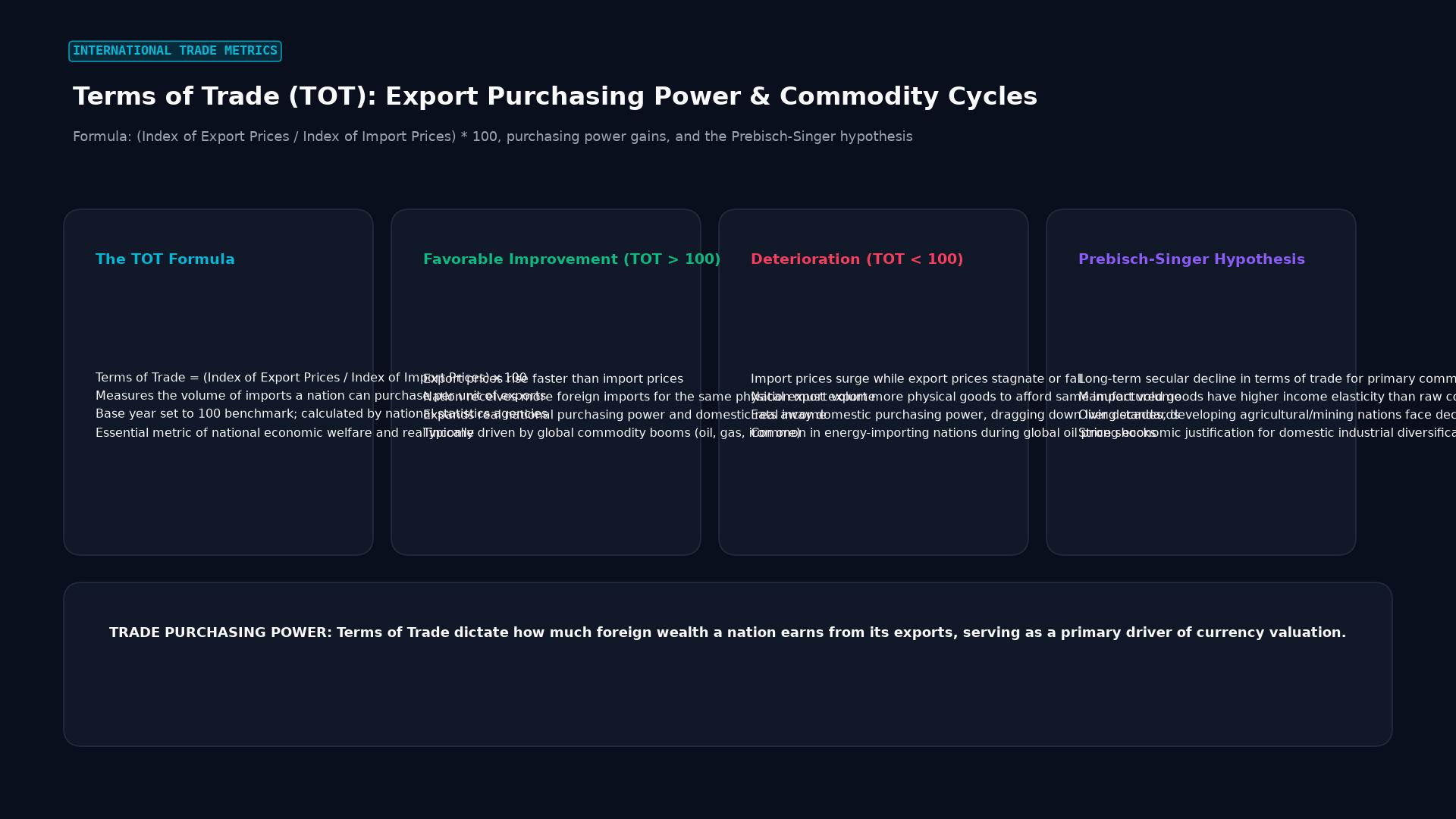 Figure: Formula: (Index of Export Prices / Index of Import Prices) * 100, purchasing power gains, and the Prebisch-Singer hypothesis
Key Drivers of Terms of Trade Fluctuations
A nation’s TOT shifts continuously based on global economic cycles and structural supply-demand imbalances:
- Global Commodity Cycles: Resource-exporting nations experience dramatic TOT swings driven by global demand for raw materials (such as crude oil, liquefied natural gas, copper, and iron ore). A spike in energy prices dramatically boosts terms of trade for net energy exporters while punishing net energy importers.
- Exchange Rate Movements: While exchange rates influence trade prices, currency depreciation does not automatically improve TOT. If a currency devalues, import prices rise immediately in domestic currency terms, often degrading the terms of trade in the short run (the classic J-Curve price effect).
- Productivity and Value-Add: Industrialized nations that export high-tech machinery, pharmaceuticals, and intellectual property maintain more stable, elevated terms of trade than developing economies that export unprocessed agricultural commodities.
Terms of Trade and the Forex Market
Global currency desks track TOT reports closely because of their direct connection to currency valuation:
| Nation Type | Primary Export Profile | TOT Reaction to Rising Commodity Prices | Currency Impact |
|---|---|---|---|
| Commodity Exporters (Australia, Canada, Norway) | Crude oil, natural gas, iron ore, metals, wheat | Sharp Improvement: Export prices soar relative to imported consumer manufactured goods | Bullish: Strong currency appreciation (AUD, CAD, NOK rally) |
| Manufacturing Exporters (Germany, Japan, South Korea) | Automobiles, semiconductors, precision industrial machinery | Deterioration: Imported raw energy and component costs explode relative to finished good prices | Bearish: Margin compression; downward pressure on EUR, JPY, KRW |
| Diversified Economies (United States) | High-tech, agricultural products, financial services, energy | Balanced / Resilient: High domestic energy production insulates against external price shocks | Neutral to Bullish: Resilient dollar stability across cycles |
Practical Example: Australia’s Commodity Boom (2021–2022)
The connection between Terms of Trade and currency valuation is clearly visible in the Australian Dollar (AUD):
- The Catalyst: Following global economic reopening, international demand for steel and green infrastructure triggered a historic rally in industrial metals. The benchmark price for iron ore—Australia’s single largest export—soared from $85 to over $215 per metric ton.
- The Surge in TOT: Australia’s Export Price Index leaped by more than 38% over four consecutive quarters, while its Import Price Index rose by only 10%. As a consequence, Australia’s Terms of Trade reached an all-time record high of 132.0.
- Current Account Transformation: This massive TOT expansion turned Australia’s historical trade deficits into record-shattering monthly trade surpluses exceeding 15 billion Australian dollars.
- Forex Performance: Foreign steel mills and commodity traders were legally obligated to purchase massive tranches of Australian dollars to settle physical shipment invoices. Despite domestic central bank hesitation, the Australian dollar surged over 1,000 pips against the Japanese Yen (AUD/JPY climbing from 75.00 to above 95.00), driven almost entirely by the relentless fundamental engine of expanding Terms of Trade.
Key Takeaways
- Trade Price Ratio: Terms of Trade measures the ratio of a nation’s export prices to its import prices.
- Purchasing Power Gauge: An improving TOT allows a country to buy more foreign imports with the same quantity of exports, expanding national wealth.
- Commodity Currency Lifeline: Currencies like the Australian Dollar, Canadian Dollar, and Norwegian Krone are fundamentally anchored to shifts in their national terms of trade.
- Manufacturing Headwinds: Severe commodity spikes degrade the TOT of energy-importing manufacturing hubs like Japan and the Eurozone, weakening their currencies.
- Institutional Demand: Expanding terms of trade generate persistent structural commercial demand for a country’s currency in global foreign exchange markets.
Frequently Asked Questions
What is the difference between Terms of Trade and Balance of Trade?
The Balance of Trade (trade balance) measures the absolute monetary difference between the total value of exports and imports ($\text{Exports} - \text{Imports}$). Terms of Trade measures the ratio of the prices of exports relative to imports. A nation can experience improving terms of trade even if its physical trade volume temporarily contracts.
How does inflation affect a country’s Terms of Trade?
If domestic inflation causes a country’s export prices to rise faster than the prices of the goods it imports, its technical Terms of Trade may improve in the short run. However, if this higher price reduces foreign demand for its exports, the total volume sold will decline, eventually harming the overall economy.
Why do central banks monitor Terms of Trade data?
Central banks track TOT because an improving terms of trade represents a positive real income shock to the domestic economy. This can stimulate domestic consumer demand, generate inflationary pressures, and prompt the central bank to adopt a more hawkish interest rate stance.
Ready to trade forex?
Open a free demo account with a regulated broker. Practice with virtual funds before risking real money.