Closing Market Rate
The final executable price quote recorded for a currency or financial instrument at the official conclusion of a trading session, serving as the definitive benchmark for daily candlestick generation, mark-to-market accounting, and rollover financing.
What is the Closing Market Rate?
The closing market rate (commonly termed the closing price or daily close) is the final prevailing exchange rate or asset valuation recorded at the formal end of an active trading day. In traditional centralized stock exchanges (such as the New York Stock Exchange or London Stock Exchange), the closing rate is determined by an electronic Closing Cross auction at a precise second (e.g., 4:00 PM local time).
In the decentralized, over-the-counter (OTC) foreign exchange market, trading operates continuously 24 hours a day, five days a week. Because the currency market never technically sleeps from Sunday afternoon through Friday afternoon, the global financial industry had to establish an agreed convention: 5:00 PM Eastern Standard Time (EST) in New York is universally recognized as the official closing market rate for foreign exchange.
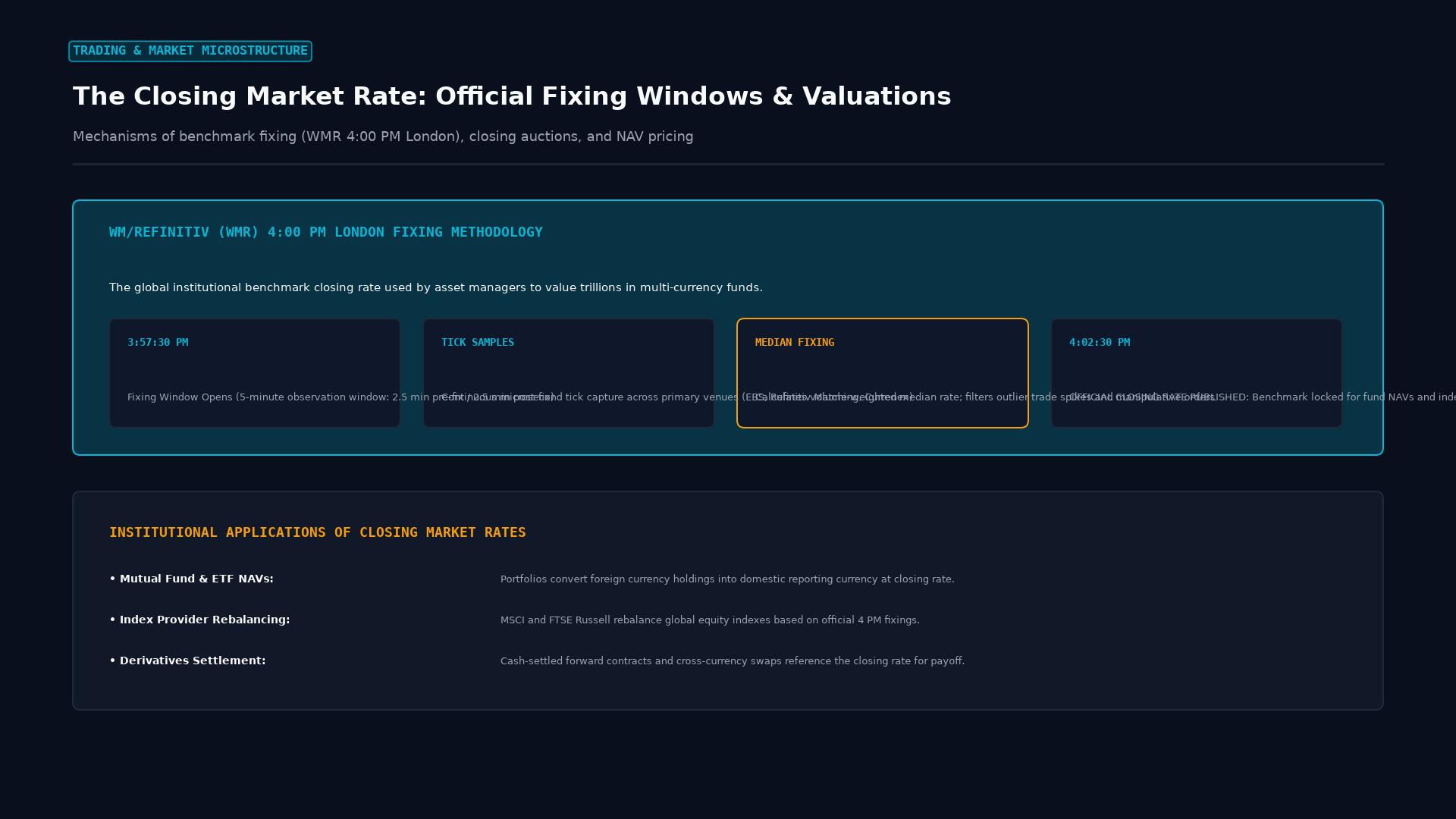 Figure: Global benchmark fixing architecture (WM/Refinitiv 4:00 PM London fix): capturing volume-weighted median tick rates for institutional fund NAV valuation and index rebalancing.
The 5:00 PM EST Standard: The Engine of Daily FX Rollover
The choice of 5:00 PM EST as the official daily close is not arbitrary; it represents a critical structural milestone in interbank market microstructure:
- The Global Liquidity Lull: At 5:00 PM EST, American dealing desks have finished their trading day, while Asian and Australian desks are only beginning to power on their systems. This brief 30-to-60 minute window represents the lowest global volume and widest bid-ask spreads of the 24-hour cycle.
- Value Date Advancement: At 5:00 PM EST, the spot settlement clock advances by one business day. A spot transaction entered at 4:59 PM EST settles two days later ($T+2$); an identical trade entered at 5:01 PM EST settles on the subsequent business day ($T+3$).
- Overnight Rollover Swap Fixing: All open positions held through 5:00 PM EST incur or earn daily financing swaps. The closing market rate serves as the base rate for computing daily interest rate differentials between the base and quote currencies.
Technical Charting Impact: “New York Close” vs. 6-Day Broken Charts
For technical analysts and price action traders, the broker’s definition of the closing rate fundamentally alters the accuracy of daily indicators:
1. True New York Close Charts (5 Daily Candles per Week)
Regulated institutional brokers configure their trading servers to GMT+2 (or GMT+3 during daylight saving time) so that each daily candlestick opens and closes exactly at 5:00 PM New York time:
- Each week produces exactly 5 daily candles (Monday through Friday), each encompassing a full 24 hours of trading.
- Daily indicators (such as the 200 EMA, RSI, and Daily Bollinger Bands) receive consistent mathematical inputs, producing reliable signals.
2. Broken 6-Day Charts (The Sunday Candle Error)
Brokers whose servers operate on GMT or local European time generate an artificial “Sunday Candle” covering the small 2-to-4 hour window between Sunday market open and midnight:
- This creates 6 daily candles per week, with the tiny Sunday candle skewing moving averages, creating false RSI divergences, and degrading technical pattern recognition.
Institutional Benchmarks: 5:00 PM Close vs. The 4:00 PM London Fix
In institutional asset management, two distinct closing benchmarks dominate daily operations:
| Benchmark Rate | Scheduled Time | Primary Operating Function | Industry Governance |
|---|---|---|---|
| New York Close | 5:00 PM EST | Retail daily candle close, overnight swap calculation, balance sheet rollover | Interbank standard convention |
| WM/Refinitiv London Fix | 4:00 PM London (GMT/BST) | Global benchmark for equity index rebalancing, pension fund portfolio valuation | Regulated by UK Financial Conduct Authority |
| Tokyo TTM Fixing | 9:55 AM Tokyo (JST) | Official corporate import/export accounting rate for Japanese financial institutions | Bank of Japan / Commercial banking group |
| ECB Reference Rate | 2:15 PM Frankfurt (CET) | European Central Bank statistical reference rate based on daily central bank polling | European Central Bank (ECB) |
The WM/Refinitiv 4:00 PM London Fix is determined by sampling market transactions during a 5-minute window (3:57:30 PM to 4:02:30 PM London time). Passive index funds (like MSCI and FTSE Russell) trade billions of dollars at this exact closing benchmark rate to align their fund portfolios with international benchmark indices.
Mark-to-Market (MTM) Accounting and NAV Audits
For hedge funds, mutual funds, and multinational corporations, the closing market rate is a legal auditing requirement:
$$\text{Net Asset Value (NAV)} = \frac{\sum (\text{Assets at Closing Market Rate}) - \text{Liabilities}}{\text{Total Shares Outstanding}}$$
- Every day at the close, custodian banks revalue all open currency holdings, bond inventories, and equity derivatives using the official closing market rate.
- This calculation establishes the daily Mark-to-Market (MTM) P&L, determining mutual fund share prices, triggering investor performance fees, and calibrating clearinghouse margin calls.
Key Takeaways
- The closing market rate is the final recorded price of a financial instrument at the end of an official trading day.
- In 24-hour foreign exchange markets, 5:00 PM Eastern Standard Time (EST) in New York is the universal closing benchmark.
- At the 5:00 PM close, spot value dates advance and daily overnight rollover financing swaps are applied.
- Technical traders must use brokers offering “New York Close” charting (5 candles per week) to prevent indicator distortion caused by artificial Sunday candles.
- Institutional index funds and global asset managers rely on the WM/Refinitiv 4:00 PM London Fix for official daily Net Asset Value (NAV) portfolio audits.
Frequently Asked Questions
Why do spreads widen dramatically at the 5:00 PM EST market close?
At 5:00 PM EST, liquidity providers temporarily pull back resting orders to execute balance sheet rollover computations, reconcile daily ledgers, and transition market books from New York to Asian dealing centers. This temporary vacuum causes bid-ask spreads to widen from fractions of a pip to 10–25 pips for roughly 15 to 30 minutes.
What is the difference between the “London Close” and the “New York Close”?
The “London Close” (4:00 PM London time) marks the end of European trading hours and the determination of the global WM/Refinitiv benchmark. The “New York Close” (5:00 PM EST) represents the true end of the entire global 24-hour trading day when spot value dates rollover.
Can an order execute at the closing market rate after trading has ended?
On centralized stock exchanges, market-on-close (MOC) orders execute precisely at the closing cross auction rate. In spot forex, because trading is continuous, orders submitted after 5:00 PM EST simply execute against the prevailing opening rates of the nascent Asian trading session.
How does the closing rate affect daily candlestick bodies?
A candlestick’s real body represents the difference between the session’s opening rate and its closing market rate. A close above the open produces a green (bullish) candle; a close below the open produces a red (bearish) candle. The high and low of the session form the upper and lower wicks (shadows).
Ready to trade forex?
Open a free demo account with a regulated broker. Practice with virtual funds before risking real money.